Showing posts with label folk legends. Show all posts

Sunday, October 17, 2010

''Elver's Hoh''


Click to enlarge

ELVER'S HOH

DANISH—M.G. Lewis

"The original is to be found in the Kiampe-Viiser, Copenhagen, 1739. My version of this ballad (as also of most of the Danish ballads in this collection) was made from a German translation to be found in Herder’s Volkslieder." [Lewis's note]

- - - -

The knight laid his head upon Elver’s Hoh,
    Soft slumbers his senses beguiling;
Fatigue press’d its seal on his eyelids, when lo!
    Two maidens drew near to him, smiling;
The one she kiss’d softly Sir Algamore’s eyes;
    The other she whisper’d him sweetly,
“Arise! thou gallant young warrior, arise,
    For the dance it goes gaily and featly!

“Arise, thou gallant young warrior, arise,
    And dance with us now and for ever!
My damsels with music thine ear shall surprise,
    And sweeter a mortal heard never—”
Then straight of young maidens appear’d a fair throng,
    Who their voices in harmony raising,
The winds they were still as the sounds flew along,
    By silence their melody praising.

The winds they were still as the sounds flew along,
    The wolf howl’d no more from the mountains;
The rivers were mute upon hearing the song,
    And calm’d the loud rush of their fountains:
The fish, as they swam in the waters so clear,
    To the soft sounds delighted attended,
And nightingales, charm’d the sweet accents to hear,
    Their notes with the melody blended.

“Now hear me, thou gallant young warrior, now hear!
    If thou wilt partake of our pleasure,
We’ll teach thee to draw the pale moon from her sphere,
    We’ll show thee the sorcerer’s treasure!
We’ll teach thee the Runic rhyme, teach thee to hold
    The wild bear in magical fetters,
To charm the red dragon, who broods over gold,
    And tame him by mystical letters.”

Now hither, now thither, then danced the gay band,
    By witchcraft the hero surprising,
Who ever sat silent, his sword in his hand,
    Their sports and their pleasures despising.
“Now hear me, thou gallant young warrior, now hear!
    If still thou disdain’st what we proffer,
With dagger and knife from thy breast will we tear
    Thine heart, which refuses our offer!”

Oh! glad was the knight when he heard the cock crow!
    His enemies trembled, and left him:
Else must he have stayed upon Elver’s Hoh,
    And the witches of life had bereft him.
Beware then, ye warriors, returning by night
    From court, dress’d in gold and in silver;
Beware how you slumber on Elver’s rough height,
    Beware of the witches of Elver!

1801


-from M.G. Lewis, Tales of Wonder (1801).
-originally published as Elvers Hoh in J.G. Herder, Volkslieder (1778).

(Illustration is Lawrence Koe, Venus and Tannhäuser, 1896)

Wednesday, October 6, 2010

''Lohengrin in Brabant''


LOHENGRIN IN BRABANT

Jakob & Wilhelm Grimm

The Duke of Brabant and Limburg died, without leaving other heirs than a young daughter, Els, or Elsa by name; her he recommended on his deathbed to one of his retainers, Friedrich von Telramund. Friedrich, the intrepid warrior, became emboldened to demand the youthful duchess’ hand and lands, under the false claim that she had promised to marry him. She steadfastly refused to do so. Friedrich complained to Emperor Henry I ("the Fowler"), and the verdict was that she must defend herself against him, through some hero, in a so-called divine judgment, in which God would accord the victory to the innocent, and defeat the guilty. As none were ready to take her part, the young duchess prayed ardently to God to save her; and far away in distant Montsalvatsch, in the Council of the Grail, the sound of the bell was heard, showing that there was someone in urgent need of help. The Grail therefore resolved to despatch as a rescuer, Lohengrin, the son of Parsifal. Just as he was about to place his foot in the stirrup a swan came floating down the water drawing a skiff behind him. As soon as Lohengrin set eyes upon the swan, he exclaimed: "Take the steed back to the manger; I shall follow this bird wherever he may lead me."

Meanwhile Elsa had summoned her chieftains and retainers to a meeting in Antwerp. Precisely on the day of the assembly, a swan was sighted swimming upstream (river Scheldt) and drawing behind him a skiff, in which Lohengrin lay asleep on his shield. The swan promptly came to land at the shore, and the prince was joyfully welcomed. Hardly had his helmet, shield, and sword been taken from the skiff, when the swan at once swam away again. Lohengrin heard of the wrong which had been done to the duchess and willingly consented to become her champion. Elsa then summoned all her relatives and subjects. A place was prepared in Mainz for Lohengrin and Friedrich to fight in the emperor's presence. The hero of the Grail defeated Friedrich, who confessed having lied to the duchess, and was executed with the axe. Elsa was awarded to Lohengrin, they having long been lovers; but he secretly insisted upon her avoiding all questions as to his ancestry, or whence he had come, saying that otherwise he would have to leave her instantaneously and she would never see him again.

For some time, the couple lived in peace and happiness. Lohengrin was a wise and mighty ruler over his land, and also served his emperor well in his expeditions against the Huns and the heathen. But it came to pass that one day in throwing the javelin he unhorsed the Duke of Cleve, so that the latter broke an arm. The Duchess of Cleve was angry, and spoke out amongst the women, saying, "Lohengrin may be brave enough, and he seems to be a good Christian; what a pity that his nobility is not of much account for no one knows whence he has come floating to this land." These words pierced the heart of the Duchess of Brabant, and she changed color with emotion. At night, when her spouse was holding her in his arms, she wept, and he said, "What is the matter, Elsa, my own?" She made answer, "The Duchess of Cleve has caused me sore pain." Lohengrin was silent and asked no more. The second night, the same came to pass. But in the third night, Elsa could no longer retain herself, and she spoke: "Lord, do not chide me! I wish to know, for our children's sake, whence you were born; for my heart tells me that you are of high rank." When the day broke, Lohengrin declared in public whence he had come, that Parsifal was his father, and God had sent him from the Grail. He then asked for his two children, which the duchess had borne him, kissed them, told them to take good care of his horn and sword, which he would leave behind, and said: "Now, I must be gone." To the duchess he left a little ring which his mother had given him. Then the swan, his friend, carne swimming swiftly, with the skiff behind him; the prince stepped in and crossed the water, back to the service of the Grail. Elsa sank down in a faint. The empress resolved to keep the younger boy Lohengrin, for his father's sake, and to bring him up as her own child. But the widow wept and mourned the rest of her life for her beloved spouse, who never came back to her.

1816


-from the Bros. Grimm collection Deutsche Sagen (German Legends).
-original title: Lohengrin zu Brabant.
-trans. from Otto Rank, The Myth of the Birth of the Hero (1914).

Illustration is Norman Price (1877-1951), Lohengrin.

Thursday, September 30, 2010

Lohengrin


The following video shows two exciting midpoints and the conclusion of Act I of Wagner's grand opera Lohengrin (1850). Elsa von Brabant has been falsely accused of a grave sin by Friedrich von Telramund. She denies the perfidious charge, and the call goes out for a knight to champion Elsa in combat. The first call goes unheeded. Elsa implores the king for a second call, which goes out, and this too appears to be ignored.


At the very moment when all hope appears to be lost for Elsa, she falls to her knees in prayer, and a commotion begins among the crowd. A knight in a boat drawn by a swan approaches along the river. He disembarks and vows to defend Elsa's honour. The duel begins, and while Friedrich von Telramund is aided by the black arts of the pagan sorceress Ortrund, the knight Lohengrin has God on his side.

These excerpts are from the best currently available video rendition of the opera, with Peter Hofmann as an uncommonly credible Lohengrin (a rare example of a singer who actually looks the part of a Teutonic knight) and Eve Marton as a somewhat too old but nevertheless convincing Elsa.

The definitive complete audio recording of this opera is the 1982 EMI 3CD set featuring the Berlin Philharmonic conducted by Herbert von Karajan.

Thursday, July 29, 2010

"Barbarossa"


BARBAROSSA

Friedrich Rückert

Old Friedrich Barbarossa,
The emperor renowned,
Inhabits now, enchanted,
A castle underground.

Not dead is he, but resting,
He still lives there today,
And in this hidden castle
He sits and sleeps away.

He took the empire’s glory
Down with him in its prime,
And will return in splendor
With it, in his own time.

The chair on which he slumbers
Of ivory is made,
The table is of marble
On which his head is laid.

His flowing beard, not flaxen,
But red with fiery glow,
Has grown right through the table
And to the stone below.

He nods and stirs in dreaming
And winks a sleepy eye,
And now and then he beckons
A servant, standing by.

He speaks to him in slumber:
"Find out, O dwarf, if still
You see the ravens flying
Above the castle hill.

And if the ancient ravens
Above the castle soar,
I still must sleep, enchanted,
A hundred years or more."

1817


(Illustration is Julius Schnorr von Carolsfeld (1794-1872), The Sleep of Emperor Friedrich Barbarossa.)

Tuesday, July 27, 2010

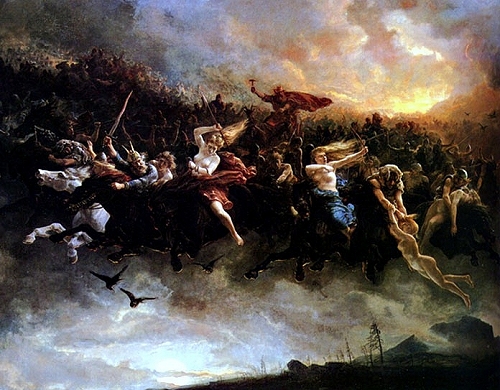
''The Wild Huntsman''


Click to enlarge

THE WILD HUNTSMAN (1778)

Gottfried August Bürger


Loud, loud the baron winds his horn;
      And, see, a lordly train
On horse, on foot, with defening din,
      Comes scouring o'er the plain.

O'er heath, o'er field, the yelping pack
      Dash swift, from couples freed;
O'er heath, o'er field, close on their track,
      Loud neighs the fiery steed.

And now the Sabbath's holy dawn
      Beam'd high with purple ray,
And bright each hallowed temple's dome
      Reflected back the day.

Now deep and clear the pealing bells
      Struck on the list'ning ear,
And heaven-ward rose from many a voice
      The hymn of praise and prayer.

Swift, swift along the crossway, still
      They speed with eager cry:
See! right and left, two horsemen strange
      Their rapid coursers ply.

Who were the horsemen right and left?
      That may I guess full well:
Who were the horsemen right and left?
      That may I never tell.

The right, of fair and beauteous mien,
      A milk-white steed bestrode;
Mild as the vernal skies, his face
      With heavenly radiance glow'd.

The left spurr'd fast his fiery barb,
      Red as the furnace flame;
Sullen he loured, and from his eyes
      The death-like lightning came.

"Right welcome to our noble sport;"
      The baron greets them fair;
"For well I wot ye hold it good
      To banish moping care.

"No pleasure equal to the chase,
      Or earth, or heaven can yield;"
He spoke,--he waved his cap in air,
      And foremost rushed afield.

"Turn thee!" the milder horseman cries;
      "Turn thee from horns and hounds!
Hear'st not the bells, hear'st not the quire,
      Mingle their sacred sounds?

"They drown the clamor of the chase;
      Oh! hunt not then to-day,
Nor let a fiend's advice destroy
      Thy better angel's sway."

"Hunt on, hunt on," his comrade cries,
      "Nor heed yon dotard's spell;
What is the bawling quire to us?
      Or what the jangling bell?

"Well may the chase delight thee more;
      And well may'st learn from me,
How brave, how princely is our sport,
      From bigot terrors free."

"Well said! well said! in thee I own
      A hero's kindled fire;
These pious foolries move not us,
      We reck nor priest, nor quire.

"And thou, believe me, saintlike dolt,
      Thy bigot rage is vain;
From prayers and beadrolls, what delight
      Can sportsmen hope to gain?"

Still hurry, hurry, on they speed
      O'er valley, hill and plain;
And ever at the baron's side
      Attend the horsemen twain.

See, panting, see, a milk-white hart
      Up-springs from yonder thorn:
"Now swiftly ply both horse and foot;
      Now louder wind the horn!"

See, falls a huntsman! see, his limbs
      The pangs of death distort!
"Lay there and rot: no caitiff's death
      Shall mar our princely sport."

Light bounds with deftest speed the hart,
      Wide o'er the country borne;
Now closer prest a refuge seeks
      Where waves the ripening corn.

See, the poor owner of the field
      Approach with tearful eyes;
"O pity, pity, good my lords!"
      Alas! in vain he cries.

"O spare what little store the poor
      By bitter sweat can earn!"
Now soft the milder horseman warns
      The baron to return.

Not so persuades his stern compeer,
      Best pleas'd with darkest deeds;
Tis his to sway the baron's heart,
      Reckless what mercy pleads.

"Away!" the imperious noble cries;
      "Away, and leave us free!
Off! or by all the powers of hell,
      Thou too shalt hunted be!

"Here, fellows! let this villain prove
      My threats were not in vain:
Loud lash around his piteous face
      The whips of all my train."

Tis said, tis done: swift o'er the fence
      The baron foremost springs;
Swift follow hound, and horse, and man,
      And loud the welkin rings.

Loud rings the welkin with their shouts,
      While man, and horse, and hound,
Ruthless tread down each ripening ear,
      Wide o'er the smoking ground.

O'er heath and field, o'er hill and dale,
      Scared by the approaching cries,
Still close pursued, yet still unreach'd,
      Their destin'd victim flies.

Now mid the lowing herds that graze
      Along yon verdant plain,
He hopes, concealed from every eye,
      A safe retreat to gain.

In vain, for now the savage train
      Press ravening on his heels:
See, prostrate at the baron's feet
      The affrighted herdsman kneels.

Fear for the safety of his charge
      Inspires his faltering tongue;
"O spare," he cries, "these harmless beasts,
      Nor work an orphan's wrong.

"Think, here thy fury would destroy
      A friendless widow's all!"
He spoke:--the gentle stranger strove
      To enforce soft pity's call.

Not so persuades his sullen frere,
      But pleas'd with darkest deeds;
Tis his to sway the baron's heart,
      Reckless what mercy pleads.

"Away, audacious hound!" he cries;
      "Twould do my heart's-blood good,
Might I but see thee transform'd to beasts
      Thee and thy beggar brood.

"Then, to the very gates of heaven,
      Who dare to say me nay!
With joy I'd hunt the losel fry;
      Come fellows, no delay!"

See, far and wide the murderous throng
      Deal many a deadly wound;
Mid slaughter'd numbers, see, the hart
      Sinks bleeding on the ground.

Yet still he summons all his strength
      For one poor effort more,
Staggering he flies; his silver sides
      Drop mingled sweat and gore.

And now he seeks a last retreat
      Deep in the darkling dell,
Where stands, amidst embowering oaks,
      A hermit's holy cell.

E'en here the madly eager train
      Rush swift with impious rage,
When, lo! persuasion on his tongue,
      Steps forth the reverend sage.

"O cease thy chase! nor thus invade
      Religion's free abode;
For know, the tortur'd creature's groans
      E'en now have reach'd his god.

"They cry at heaven's high mercy seat,
      For vengeance on thy head;
O turn, repentant turn, ere yet
      The avenging bolt is sped."

Once more religion's cause in vain
      The gentle stranger pleads;
Once more, alas! his sullen frere
      A willing victim leads.

"Dash on!" the harden'd sinner cries;
      "Shalt thou distrub our sport?
No! boldly would I urge the chase
      In heaven's own inmost court.

"What reck I then thy pious rage?
      No mortal man I fear:
Not god in all his terrors arm'd
      Should stay my fix'd career."

He cracks his whip, he winds his horn,
      He calls his vassal-crew;
Lo! horse and hound, and sage and cell,
      All vanish from his view.

All, all, are gone!--no single rack
      His eager eye can trace;
And silence, still as death, has hush'd
      The clamors of the chase.

In vain he spurs his courser's sides,
      Nor back nor forward borne;
He winds his horn, he calls aloud,
      But hears no sound return.

And now inclos'd in deepest night,
      Dark as the silent grave,
He hears the sullen tempest roar,
      As roars the distant wave.

Loud and louder still the storm
      Howls through the troubled air;
Ten thousand thunders from on high
      The voice of judgment bear.

"Accursed before god and man,
      Unmoved by threat or prayer;
Creator, nor created, aught
      Thy frantic rage would spare.

"Think not in vain creation's lord
      Has heard his creature's groan;
E'en now the torch of vengeance flames
      High by his awful throne.

"Now, hear thy doom! to aftertimes
      A dread example given,
For ever urge thy wild career,
      By fiendish hell-hounds driven."

The voice had ceased; the sulphurous flash
      Shot swift from either pole;
Sore shook the grove; cold horror seized
      The trembling miscreant's soul.

Again the rising tempest roars,
      Again the lightnings play;
And every limb, and every nerve
      Is frozen with dismay.

He sees a giant's swarthy arm
      Start from the yawning ground;
He feels a demon grasp his head,
      And rudely wrench it round.

In torrents now from every side,
      Pours fast a fiery flood;
On each o'erwhelming wave upborne,
      Loud howls the hellish brood.

Sullen and grisly gleams the light,
      Now red, now green, now blue;
Whilst o'er the gulf the fiendish train
      Their destined prey pursue.

In vain he shrieks with wild despair,
      In vain he strives to fly;
Still at this back the hell-born crew
      Their cursed business ply.

By day, full many a fathom deep
      Below earth's smiling face;
By night, high through the troubled air,
      They speed their endless chase.

In vain to turn his eyes aside
      He strives with wild affright;
So never may those maddening scenes
      Escape his tortured sight.

Still must he see those dogs of hell
      Close hovering on his track;
Still must he see the avenging scourge
      Uplighted at his back.

Now this is the wild baron's hunt;
      And many a village youth,
And many a sportsman (dare they speak)
      Could vouch the awful truth.

For oft benighted midst the wilds
      The fiendish troop they hear,
Now shrieking shrill, now cursing loud,
      Come thundering through the air.

No hand shall stay those dogs of hell
      Or quench that sea of fire,
Till god's own dreadful day of doom
      Shall bid the world expire!


-trans. as "The Wild Hunter" by Rambler's Magazine (1809).
-German title: Der wilde Jäger.

(Illustration is Arbo, The Wild Hunt, 1872.)

Hermann (Arminius)


This half-hour episode of the TLC series Archaeology, titled "Caesar's Nightmare: Battle in the Forest," describes recent archaeological finds at the site of the Battle of the Teutoburg Forest (9 A.D.), in which heroic Germanic tribesmen led by their chief, Hermann (Arminius), annihilated three legions of the Roman Army.

It also features glimpses of the magnificent Hermannsdenkmal (1875) by Ernst von Bandel, near Detmold, which, along with the Völkerschlachtdenkmal and the Kyffhäuserdenkmal, is one of the greatest remaining German Romantic national monuments.

2009 marked the 2,000th anniversary of this battle.

The video is split into three parts. Part one:


Part two:


Part three:

Dragon-Slaying Festival in Furth im Wald


This German-language video provides a brief introduction to the plot of the annual Drachenstich Festspiel (Dragon-Slaying Festival) in the Bavarian town of Furth im Wald -- the oldest folk festival in Germany, and likely the oldest in all of Europe, dating back to before 1590.


Drachenstich: Official Site

Monday, July 26, 2010

Kyffhäuser Monument (Kyffhäuser-Denkmal)


This 15-minute German-language documentary was filmed on the occasion of the 100th anniversary of the Kyffhäuserdenkmal, or Kyffhäuser Monument (1896), designed by the great architect Bruno Schmitz. The monument commemorates Kaiser Wilhelm I and the founding of the Second German Reich (or empire).

The video is in two parts. Part one describes the building of the monument and gives some background on its location, which was the site of one of the castles of Kaiser Friedrich I ("Barbarossa") of the Hohenstaufen dynasty. Part two gives an in-depth look at the sections of the monument, and the history of the Kyffhäuserdenkmal after its construction.

Unfortunately, the narration is rather disparaging, as is typical of post-WWII guilt-ridden German attitudes towards their noble past. However, the video is still worthwhile for the wonderful footage that it shows of this glorious monument.

Part one:


Part two:


Kyffhäuserdenkmal: Official Site

Great Castles of Europe: Rhine Castles


This episode from the 1990s TLC series titled Great Castles of Europe spotlights some of the famous castles along the Rhine (which figured so prominently in German Romanticism), including the Marksburg, Pfalzgrafenstein, Burg Katz and Burg Maus, and recounts some of the greatest legends associated with the river, including those of Siegfried and of the Loreley (Lorelei).

The video is split into three parts. Part one:


Part two:


Part three: