Showing posts with label Schiller Friedrich von. Show all posts

Thursday, September 23, 2010

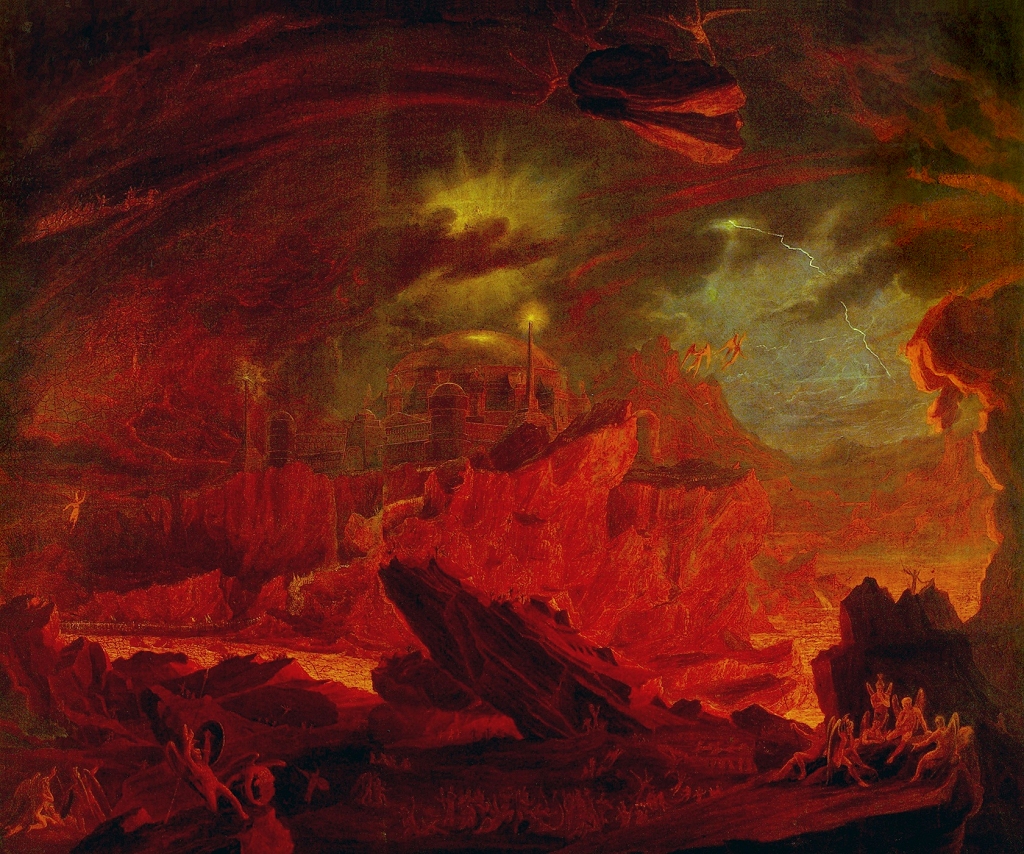
''The Patron Saint of the Romantic School''


Click to enlarge


Suppressed scene from Schiller's Die Räuber (1781):
FRANZ: I do not know, Maurice, if you have read Milton. He who could not endure that another should be above him, and who dared to challenge the Almighty to a duel, was he not an extraordinary genius? He had encountered the Invincible One, and although in defeat he exhausted all his forces, he was not humiliated; eternally, even to the present day, he makes new efforts.

From James Beattie, Dissertations Moral and Critical (1783):
Satan, as Milton has represented him in Paradise Lost, though there are no qualities that can be called good in a moral view…yet there is a grandeur of a ruined archangel; there is force able to contend with the most boisterous elements; and there is boldness which no power but what is Almighty can intimidate. These qualities are astonishing; and…we are often compelled to admire that very greatness by which we are confounded and terrified.

From William Blake, The Marriage of Heaven and Hell (1790):
The reason Milton wrote in fetters when he wrote of Angels and God, and at liberty when of Devils and Hell, is because he was a true Poet and of the Devil's party without knowing it.

From Maximilian Rudwin, The Devil in Legend and Literature (1931):
Satanism is not a part of Romanticism. It is Romanticism. It may well be said without any levity that Satan was the patron saint of the Romantic School.


(Illustration is John Martin, The Fallen Angels Entering Pandemonium, 1841.)

Friday, September 17, 2010

The Destruction


Click to enlarge

From Friedrich von Schiller's Die Räuber (1781):
FRANZ: Suddenly a fearful thunderclap struck my slumbering ear, shuddering I leapt up, and behold, I thought I saw the whole horizon stand ablaze with fiery flames, and mountains and cities and forests melted like wax in a furnace, and a howling whirlwind swept away the sea and the earth and the sky — and a voice rang out as of a brazen trumpet: Earth, give up thy dead, give up thy dead, O sea! and the bare ground was in labour, and began to cast up skulls and ribs and jaws and all manner of bones that joined together and made bodies of men, and they gathered in a great stream, more than the eye could see, a living torrent!

Illustration is John Martin (1789-1854), The Destruction of Herculaneum and Pompeii.

Friday, August 27, 2010

The Robbers (Die Räuber)


Excerpts from Friedrich von Schiller's Die Räuber (1781):
FRANZ: Might is right, and the limits of our strength our only law.

FRANZ: I will crush everything that stands in the way of my becoming master.

MOOR: The bright spark of Promethean fire is burnt out.

MOOR: The law has cramped the flight of eagles to a snail's pace. The law never yet made a great man, but freedom will breed a giant, a colossus.

MOOR: Oh, if only Arminius's spirit still glowed in the ashes! — Give me an army of fellows like me to command, and I'll turn Germany into a republic that will make Rome and Sparta look like nunneries.

SPIEBELBERG: Necessity brings out the best in us! That's why I shan't be afraid of it comes to the worst. Danger fortifies our courage; our strength grows in adversity.

SPIEGELBERG: Your name shall be written in the stars! What does it matter where your soul goes?

ROLLER: Without Moor we're a body without a soul.

MOOR: See, the scales have fallen from my eyes! What a fool I was, to seek to return to the cage! My spirit thirsts for deeds, my lungs for freedom — murderers, robbers! at that word I trampled the law beneath my feet — men showed me no humanity when to humanity I appealed; so let me forget sympathy and human feeling! I have no father now, I have no love now, and blood and death shall teach me to forget that ever I held anything dear! Oh, my amusement shall be the terror of the dearth — it is agreed, I shall be your captain! and good fortune to the champion among you who lights the fiercest fires, who does the foulest murders, for I say to you he shall have a kingly reward! Gather round me every one, and swear loyalty and obedience till death! Swear by this man's right hand of mine!
ALL: We swear loyalty and obedience to you till death!

AMALIA: Now I am with Karl again — a beggar, did he say? Why then, the world is turned upside-down, beggars are kings and kings are beggars!

FRANZ: But must my plans submit to the iron yoke of mechanical laws? Is my high-flying spirit to be bound to the snail's pace of material necessity?

FRANZ: What can you do to him? How can a rat hurt a lion?

HERRMANN: Sooner may the bullet turn in its flight and tear the marksman's own bowels.

AMALIA: In Heaven's name, that is not Karl. Here, here — The whole, so different. These dull colours cannot reflect the divine spirit that shone in his fiery eye. Away with it! this is a mere man.

FRANZ: I am not one for stroking and fondling. I will set my pointed spurs into your flesh, and see what a keen whip will do.

SPIEGELBERG: Climate makes very little difference, genius will thrive in any soil.

RATZMANN: If he had given the devil his word that he would go to hell, he would never say a prayer, even though he could save himself with half an Our Father.

SCHWEITZER: We'll save him, or if we can't save him, then at least we'll light him a funeral pyre such as no king ever had, one that will burn them black and blue.

SCHWEITZER: By God, before a quarter of an hour was up, the north-east wind came and served us a treat — he must have had his grudge against the town too! — and helped the fire on its way to the topmost gables. And us meanwhile up and down the streets like furies — fire, fire! All through the town — shrieks and howls and rampage — the firebells start to ring, then up goes the powder-magazine in the air, as if the earth was split in two, and heaven burst, and hell sunk ten thousand fathoms deeper.

ROLLER: The hungry ravens croaking, thirty of them perched there on my half-rotten predecessor.

SCHUFTERLE: A baby, lying there as right as rain under the table, and the table just about to catch fire. — Poor little brute! I said, you're freeing! And threw it into the flames.

MOOR: I shall come amongst you, and terrible shall be my judgment upon you.

SCHWEITZER: We shall be upon them like the Flood and rain down on their heads like thunder-bolts.

MOOR: Now, lads! Now is the time! We are lost, or we must fight like wild boars at bay.
SCHWEITZER: Ha! I'll rip their bellies with my tusks till their tripes come bursting out by the yard! Lead on, captain! We will follow you into the jaws of death!
MOOR: Load all weapons. There is no shortage of powder?
SCHWEITZER: No, powder enough to blow the earth sky-high!

PRIEST: Image of that first loathsome rabble-rouser, who stirred up a thousand legions of innocent angels to fiery rebellion, and dragged them down with him to the pit of damnation.

MOOR: Thus says Moor, captain of murderers and incendiaries. It is true. I killed the Count, I plundered the Dominican church and set it alight, I cast firebrands into your city of bigots, I blew up the powder-magazine over the heads of pious Christians — but that is not all.

MOOR: Tell them my trade is retribution — vengeance is my calling.

MOOR: Who will be the first to abandon his captain in his hour of need?'
ROLLER: Not if nine circles of hell surrounded us! Every man who is not a dog, save your captain!
SCHWEITZER: Pardon in our bullets! Away, vermin! tell the magistrates who sent you that in Moor's band you could not find a single traitor. — Save, save the captain!
ALL: Save, save, save the captain!
MOOR: Now we are free — Comrades! I feel an army in my fist — death or liberty! — at least they shall take none of us alive!

AMALIA: Look, villain, what I can do to you now! I am a woman, but a woman in desperation — once dare to lay your lustful hands on my body — this steel shall pierce your loathsome breast, and my uncle's spirit will guide my hand!

AMALIA: I felt I was as strong as a fiery steed, fierce as the tigress pursuing the triumphant robber of her cubs.

MOOR: Why should man succeed where he imitates the ant, when he is thwarted where he is like the gods?

MOOR: And I so hideous in this fair world — and I, a monster on the glorious earth. . . . I alone cast out, I alone set apart from the ranks fo the blessed — not for me the sweet name of child — not for me the lover's melting glance — never, never more the bosom friend's embrace. Set about with murderers, in the midst of hissing vipers — fettered to vice with bands of iron — rocked giddily over the abyss of destruction on the frail reed of vice — I, I alone cast out, a howling Abaddon amidst the fair world's happy blossoms!

KOSINSKY: Men I am seeking, who can look death in the face and let danger play about them like a charmed snake, who value freedom more than life and honour, whose very name, sweet sound to the poor and the oppressed, strokes terror in the valiant and turns the tyrant pale.

KOSINSKY: I have always wished that I could see the man with destruction in his eye, there as he sat upon the ruins of Carthage — now I need wish it no longer.

KOSINSKY: What should I fear, if I do not fear death?

MOOR: Here you step beyond the bounds of humanity — you must either be more than a man, or you are a devil.

SCHWEITZER: Lead us to hell and I will follow you!

MOOR: Soil of my fatherland, I salute you! Sky of my fatherland! Sun of my fatherland! meadows and hills and forests! I salute you, from my heart I salute you all! — how sweet the breezes blow from the mountains of my home! with what joyous balm you greet the poor outcast!

AMALIA: This is the first Count, the founder of the line, who was ennobled by Barbarossa when he served under him against the corsairs.

AMALIA: Flee from my soul, treacherous, godless desires! in the heart where Karl reigns there is no place for mortal man.

MOOR: She knows that I roam an outcast, a wanderer in the desert, and her love flies through exile and desert to be with me.

MOOR: Unhappy because she loves me! Why, what if I were a murderer? What, my lady? What if you lover could count a man killed for each one of your kisses? Alas for my Amalia! she is an unhappy lady.
AMALIA: Ah! and I, I am happy! My only one is like the light of heaven itself, and heaven is grace and mercy! He could not bear to hurt the merest insect — his soul is as far from thoughts of blood as the pole fo day from midnight.

MOOR: Externals are but the varnish upon a man — I am my heaven and my hell.

MOOR: Did you ever dream that you were the arm of a greater majesty? the tangled knot of our destinies is unravelled! Today, today and invisible power has conferred nobility upon our handiwork! Bow down in adoration before him who decreed you this sublime fate, who led you to this place, who deemed you worthy to be the terrible angels of his dark judgment! Uncover your heads! Kneels in the dust, that you may stand up sanctified!

FRANZ: If I smash this Venus to pieces, then symmetry and beauty have ceased to exist.

MOSER: If you still stand firm in death, if your principles do not desert you even then, then the victory is yours.

MOSER: It will be an awakening as of one buried alive in the bowels of the churchyard.

FRANZ: Lord God, I have been no common murderer — Lord God, I have never stooped to trifles —
DANIEL: God have mercy on us, his prayer itself's a sin.

SCHWEITZER: Dead,? What? dead? Without me, dead? It's a lie, I tell you — see how quickly he will jump up! — Hey, you there! There's a father to be murdered.

MOOR: Swoon then, Amalia! — Die, father! Die through me a third time! — These your rescuers are robbers and murderers! Your Karl is their captain!

MOOR: Have I not heard death whistling towards me from more than a thousand musket-barrels, and without yielding a foot, and am I now to learn to quake like a woman? to quake before a woman? — No, no woman shall shake my manhood — Blood! blood! It is only something caught from a woman — give me blood to swill, and it will pass.

AMALIA: Murderer! Devil! Angel — I cannot leave you.

MOOR: Ah, what is this? She does not spit as me, she does not thrust me from her — Amalia! Have you forgotten? do you know who it is you are embracing, Amalia?
AMALIA: My only one, I shall never leave you!
MOOR: She forgives me, she loves me! I am pure as the heavenly aether, she loves me! Tears of gratitude to you, merciful God in Heaven! Peace has returned to my soul, the raging torment is past, hell is no more — See, O see, the children of light weep upon the neck fo the weeping devil.

ROBBER: Shame on your perjury! the spirit of Roller that died for you, Roller whom you summoned from the dead to be your witness, will blush for your cowardice, and rise armoured from his grave to punish you.

(Photograph shows a scene from a performance of Die Räuber at the open-air theatre in Hohenstein in 1931.)

Friday, August 6, 2010

''A stranger to his own century''


From Schiller, On the Aesthetic Education of Man, Letter IX (1794):
The artist is indeed the child of his age; but woe to him if he is at the same time its ward or, worse still, its minion! Let some beneficent deity snatch the suckling betimes from his mother’s breast, nourish him with the milk of a better age, and suffer him to come to maturity under a distant Grecian sky. Then, when he has become a man, let him return, a stranger, to his own century; not, however, to gladden it by his appearance, but rather, terrible like Agamemnon’s son, to cleanse and to purify it. His theme he will, indeed, take from the present; but his form he will borrow from a nobler time, nay, from beyond time altogether, from the absolute, unchanging unity of his being. Here, from the pure ether of his genius, the living source of beauty flows down, untainted by the corruption of the generations and ages wallowing in the dark eddies below.

The theme of his work may be degraded by vagaries of the public mood, even as this has been known to ennoble it; but its form, inviolate, will remain immune from such vicissitudes. The Roman of the first century had long been bowing the knee before his emperors when statues still portrayed him erect; temples continued to be sacred to the eye long after the gods had become objects of derision; and the infamous crimes of a Nero or a Commodus were put to shame by the noble style of the building whose frame lent them cover.

Humanity has lost its dignity; but art has rescued it and preserved it in significant stone. Truth lives on in the illusion of art, and it is from this copy, or afterimage, that the original image will once again be restored. Just as the nobility of art survived the nobility of nature, so now art goes before her, a voice rousing from slumber and preparing the shape of things to come. Even before truth’s triumphant light can penetrate the recesses of the human heart, the poet’s imagination will intercept its rays, and the peaks of humanity will be radiant while the dews of night still linger in the valley.

But how is the artist to protect himself against the corruption of the age that besets him on all sides? By disdaining its opinion. Let him direct his gaze upwards, to the dignity of his calling and the universal law, not downwards toward fortune and the needs of daily life.

Work for your contemporaries; but create what they need, not what they praise. . . . Banish from their pleasures caprice, frivolity, and coarseness, and imperceptibly you will banish these from their actions and, eventually, from their inclinations too. Surround them, wherever you meet them, with the great and noble forms of genius, and encompass them about with the symbols of perfection, until semblance conquer reality, and art triumph over nature.

(Illustration is Caspar David Friedrich, Wanderer Above the Sea of Fog, 1818.)

Wednesday, August 4, 2010

''Columbus''


Click to enlarge

COLUMBUS

Friedrich von Schiller

Sail on, oh captain! Though the mockers grin
And though the helm slip from a heedless hand,
Forever westward! There is a land
Which shall receive you. You have seen
Its shore before your eyes. Trust your skills.
Though oceans may be empty on their verge--
You willed a land. It shall rise from the surge.
For nature always yields what human spirit wills.

1796


(Image is Dioscoro Teofila de la Puebla Tolin, The First Landing of Christopher Columbus in America, 1862.)

Monday, July 26, 2010

Great Castles of Europe: Neuschwanstein


This episode from the 1990s TLC series Great Castles of Europe spotlights the fairy-tale Bavarian castle Neuschwanstein, one of the most beautiful castles in the world, and tells the story of its visionary builder, the tragic King Ludwig II, including commentary about his admiration for the great German Romantic composer Richard Wagner. The video also features views of the nearby castles Hohenschwangau and Linderhof.

The video is split into three parts. Part one:


Part two:


Part three:


Schloß Neuschwanstein: Official Site