Showing posts with label cursed wanderer. Show all posts

Saturday, September 11, 2010

''The Rime of the Ancient Mariner''


Click to enlarge

THE RIME OF THE ANCIENT MARINER

Samuel Taylor Coleridge

NOTE: This poem exists in two forms. The first, published in 1798, contains a number of horrific elements that the second version, published in 1817 and now considered definitive, omits. This text restores the omitted stanzas from the 1798 version, which are italicized for the purpose of identification.


PART THE FIRST.

It is an ancient Mariner,
And he stoppeth one of three.
"By thy long grey beard and glittering eye,
Now wherefore stopp'st thou me?

"The Bridegroom's doors are opened wide,
And I am next of kin;
The guests are met, the feast is set:
May'st hear the merry din."

He holds him with his skinny hand,
"There was a ship," quoth he.
"Hold off! unhand me, grey-beard loon!"
Eftsoons his hand dropt he.

He holds him with his glittering eye--
The Wedding-Guest stood still,
And listens like a three years child:
The Mariner hath his will.

The Wedding-Guest sat on a stone:
He cannot chuse but hear;
And thus spake on that ancient man,
The bright-eyed Mariner.

The ship was cheered, the harbour cleared,
Merrily did we drop
Below the kirk, below the hill,
Below the light-house top.

The Sun came up upon the left,
Out of the sea came he!
And he shone bright, and on the right
Went down into the sea.

Higher and higher every day,
Till over the mast at noon--
The Wedding-Guest here beat his breast,
For he heard the loud bassoon.

The bride hath paced into the hall,
Red as a rose is she;
Nodding their heads before her goes
The merry minstrelsy.

The Wedding-Guest he beat his breast,
Yet he cannot chuse but hear;
And thus spake on that ancient man,
The bright-eyed Mariner.

And now the STORM-BLAST came, and he
Was tyrannous and strong:
He struck with his o'ertaking wings,
And chased south along.
Click to enlarge

With sloping masts and dipping prow,
As who pursued with yell and blow
Still treads the shadow of his foe
And forward bends his head,
The ship drove fast, loud roared the blast,
And southward aye we fled.

And now there came both mist and snow,
And it grew wondrous cold:
And ice, mast-high, came floating by,
As green as emerald.

And through the drifts the snowy clifts
Did send a dismal sheen:
Nor shapes of men nor beasts we ken--
The ice was all between.

The ice was here, the ice was there,
The ice was all around:
It cracked and growled, and roared and howled,
Like noises in a swound!

At length did cross an Albatross:
Thorough the fog it came;
As if it had been a Christian soul,
We hailed it in God's name.

It ate the food it ne'er had eat,
And round and round it flew.
The ice did split with a thunder-fit;
The helmsman steered us through!

And a good south wind sprung up behind;
The Albatross did follow,
And every day, for food or play,
Came to the mariners' hollo!

In mist or cloud, on mast or shroud,
It perched for vespers nine;
Whiles all the night, through fog-smoke white,
Glimmered the white Moon-shine.

"God save thee, ancient Mariner!
From the fiends, that plague thee thus!--
Why look'st thou so?"--With my cross-bow
I shot the ALBATROSS.


PART THE SECOND.

The Sun now rose upon the right:
Out of the sea came he,
Still hid in mist, and on the left
Went down into the sea.

And the good south wind still blew behind
But no sweet bird did follow,
Nor any day for food or play
Came to the mariners' hollo!

And I had done an hellish thing,
And it would work 'em woe:
For all averred, I had killed the bird
That made the breeze to blow.
Ah wretch! said they, the bird to slay
That made the breeze to blow!

Nor dim nor red, like God's own head,
The glorious Sun uprist:
Then all averred, I had killed the bird
That brought the fog and mist.
'Twas right, said they, such birds to slay,
That bring the fog and mist.

The fair breeze blew, the white foam flew,
The furrow followed free:
We were the first that ever burst
Into that silent sea.

Down dropt the breeze, the sails dropt down,
'Twas sad as sad could be;
And we did speak only to break
The silence of the sea!

All in a hot and copper sky,
The bloody Sun, at noon,
Right up above the mast did stand,
No bigger than the Moon.

Day after day, day after day,
We stuck, nor breath nor motion;
As idle as a painted ship
Upon a painted ocean.

Water, water, every where,
And all the boards did shrink;
Water, water, every where,
Nor any drop to drink.

The very deep did rot: O Christ!
That ever this should be!
Yea, slimy things did crawl with legs
Upon the slimy sea.

About, about, in reel and rout
The death-fires danced at night;
The water, like a witch's oils,
Burnt green, and blue and white.

And some in dreams assured were
Of the spirit that plagued us so:
Nine fathom deep he had followed us
From the land of mist and snow.

And every tongue, through utter drought,
Was withered at the root;
We could not speak, no more than if
We had been choked with soot.

Ah! well a-day! what evil looks
Had I from old and young!
Instead of the cross, the Albatross
About my neck was hung.


PART THE THIRD.

There passed a weary time. Each throat
Was parched, and glazed each eye.
A weary time! a weary time!
How glazed each weary eye,
When looking westward, I beheld
A something in the sky.

At first it seemed a little speck,
And then it seemed a mist:
It moved and moved, and took at last
A certain shape, I wist.

A speck, a mist, a shape, I wist!
And still it neared and neared:
As if it dodged a water-sprite,
It plunged and tacked and veered.

With throats unslaked, with black lips baked,
We could not laugh nor wail;
Through utter drought all dumb we stood!
I bit my arm, I sucked the blood,
And cried, A sail! a sail!

With throats unslaked, with black lips baked,
Agape they heard me call:
Gramercy! they for joy did grin,
And all at once their breath drew in,
As they were drinking all.

See! see! (I cried) she tacks no more!
Hither to work us weal;
Without a breeze, without a tide,
She steadies with upright keel!

The western wave was all a-flame
The day was well nigh done!
Almost upon the western wave
Rested the broad bright Sun;
When that strange shape drove suddenly
Betwixt us and the Sun.

And straight the Sun was flecked with bars,
(Heaven's Mother send us grace!)
As if through a dungeon-grate he peered,
With broad and burning face.

Alas! (thought I, and my heart beat loud)
How fast she nears and nears!
Are those her sails that glance in the Sun,
Like restless gossameres!

Are those her ribs through which the Sun
Did peer, as through a grate?
And is that Woman all her crew?
Is that a DEATH? and are there two?
Is DEATH that woman's mate?

His bones were black with many a crack,
All black and bare, I ween;
Jet-black and bare, save where with rust
Of mouldy damps and charnel crust
They're patch'd with purple and green.


Her lips were red, her looks were free,
Her locks were yellow as gold:
Her skin was as white as leprosy,
The Night-Mare LIFE-IN-DEATH was she,
Who thicks man's blood with cold.

The naked hulk alongside came,
And the twain were casting dice;
"The game is done! I've won! I've won!"
Quoth she, and whistles thrice.

A gust of wind sterte up behind
And whistled thro' his bones;
Thro' the holes of his eyes and the hole of his mouth
Half-whistles and half-groans.


The Sun's rim dips; the stars rush out:
At one stride comes the dark;
With far-heard whisper, o'er the sea.
Off shot the spectre-bark.

We listened and looked sideways up!
Fear at my heart, as at a cup,
My life-blood seemed to sip!

The stars were dim, and thick the night,
The steersman's face by his lamp gleamed white;
From the sails the dew did drip--
Till clombe above the eastern bar
The horned Moon, with one bright star
Within the nether tip.

One after one, by the star-dogged Moon
Too quick for groan or sigh,
Each turned his face with a ghastly pang,
And cursed me with his eye.

Four times fifty living men,
(And I heard nor sigh nor groan)
With heavy thump, a lifeless lump,
They dropped down one by one.

The souls did from their bodies fly,--
They fled to bliss or woe!
And every soul, it passed me by,
Like the whizz of my cross-bow!


PART THE FOURTH.

"I fear thee, ancient Mariner!
I fear thy skinny hand!
And thou art long, and lank, and brown,
As is the ribbed sea-sand.

"I fear thee and thy glittering eye,
And thy skinny hand, so brown."--
Fear not, fear not, thou Wedding-Guest!
This body dropt not down.

Alone, alone, all, all alone,
Alone on a wide wide sea!
And never a saint took pity on
My soul in agony.

The many men, so beautiful!
And they all dead did lie:
And a thousand thousand slimy things
Lived on; and so did I.

I looked upon the rotting sea,
And drew my eyes away;
I looked upon the rotting deck,
And there the dead men lay.

I looked to Heaven, and tried to pray:
But or ever a prayer had gusht,
A wicked whisper came, and made
My heart as dry as dust.

I closed my lids, and kept them close,
And the balls like pulses beat;
For the sky and the sea, and the sea and the sky
Lay like a load on my weary eye,
And the dead were at my feet.

The cold sweat melted from their limbs,
Nor rot nor reek did they:
The look with which they looked on me
Had never passed away.

An orphan's curse would drag to Hell
A spirit from on high;
But oh! more horrible than that
Is a curse in a dead man's eye!
Seven days, seven nights, I saw that curse,
And yet I could not die.

The moving Moon went up the sky,
And no where did abide:
Softly she was going up,
And a star or two beside.

Her beams bemocked the sultry main,
Like April hoar-frost spread;
But where the ship's huge shadow lay,
The charmed water burnt alway
A still and awful red.

Beyond the shadow of the ship,
I watched the water-snakes:
They moved in tracks of shining white,
And when they reared, the elfish light
Fell off in hoary flakes.

Within the shadow of the ship
I watched their rich attire:
Blue, glossy green, and velvet black,
They coiled and swam; and every track
Was a flash of golden fire.

O happy living things! no tongue
Their beauty might declare:
A spring of love gushed from my heart,
And I blessed them unaware:
Sure my kind saint took pity on me,
And I blessed them unaware.

The self same moment I could pray;
And from my neck so free
The Albatross fell off, and sank
Like lead into the sea.


PART THE FIFTH.

Oh sleep! it is a gentle thing,
Beloved from pole to pole!
To Mary Queen the praise be given!
She sent the gentle sleep from Heaven,
That slid into my soul.

The silly buckets on the deck,
That had so long remained,
I dreamt that they were filled with dew;
And when I awoke, it rained.

My lips were wet, my throat was cold,
My garments all were dank;
Sure I had drunken in my dreams,
And still my body drank.

I moved, and could not feel my limbs:
I was so light--almost
I thought that I had died in sleep,
And was a blessed ghost.

And soon I heard a roaring wind:
It did not come anear;
But with its sound it shook the sails,
That were so thin and sere.

The upper air burst into life!
And a hundred fire-flags sheen,
To and fro they were hurried about!
And to and fro, and in and out,
The wan stars danced between.

And the coming wind did roar more loud,
And the sails did sigh like sedge;
And the rain poured down from one black cloud;
The Moon was at its edge.

The thick black cloud was cleft, and still
The Moon was at its side:
Like waters shot from some high crag,
The lightning fell with never a jag,
A river steep and wide.

The strong wind reach'd the ship: it roar'd
And dropp'd down, like a stone!

Beneath the lightning and the Moon
The dead men gave a groan.

They groaned, they stirred, they all uprose,
Nor spake, nor moved their eyes;
It had been strange, even in a dream,
To have seen those dead men rise.


The helmsman steered, the ship moved on;
Yet never a breeze up blew;
The mariners all 'gan work the ropes,
Where they were wont to do:
They raised their limbs like lifeless tools--
We were a ghastly crew.

The body of my brother's son,
Stood by me, knee to knee:
The body and I pulled at one rope,
But he said nought to me.
And I quak'd to think of my own voice
How frightful it would be!


The day-light dawn'd--they dropp'd their arms,
And clustered round the mast;
Sweet sounds rose slowly through their mouths,
And from their bodies passed.

Around, around, flew each sweet sound,
Then darted to the Sun;
Slowly the sounds came back again,
Now mixed, now one by one.

Sometimes a-dropping from the sky
I heard the sky-lark sing;
Sometimes all little birds that are,
How they seemed to fill the sea and air
With their sweet jargoning!

And now 'twas like all instruments,
Now like a lonely flute;
And now it is an angel's song,
That makes the Heavens be mute.

It ceased; yet still the sails made on
A pleasant noise till noon,
A noise like of a hidden brook
In the leafy month of June,
That to the sleeping woods all night
Singeth a quiet tune.

The Marineres all 'gan pull the ropes,
But look at me they n'old:
Thought I, I am as thin as air--
They cannot me behold.


Till noon we quietly sailed on,
Yet never a breeze did breathe:
Slowly and smoothly went the ship,
Moved onward from beneath.

Under the keel nine fathom deep,
From the land of mist and snow,
The spirit slid: and it was he
That made the ship to go.
The sails at noon left off their tune,
And the ship stood still also.

The Sun, right up above the mast,
Had fixed her to the ocean:
But in a minute she 'gan stir,
With a short uneasy motion--
Backwards and forwards half her length
With a short uneasy motion.

Then like a pawing horse let go,
She made a sudden bound:
It flung the blood into my head,
And I fell down in a swound.

How long in that same fit I lay,
I have not to declare;
But ere my living life returned,
I heard and in my soul discerned
Two VOICES in the air.

"Is it he?" quoth one, "Is this the man?
By him who died on cross,
With his cruel bow he laid full low,
The harmless Albatross.

"The spirit who bideth by himself
In the land of mist and snow,
He loved the bird that loved the man
Who shot him with his bow."

The other was a softer voice,
As soft as honey-dew:
Quoth he, "The man hath penance done,
And penance more will do."


PART THE SIXTH.

FIRST VOICE.

But tell me, tell me! speak again,
Thy soft response renewing--
What makes that ship drive on so fast?
What is the OCEAN doing?


SECOND VOICE.

Still as a slave before his lord,
The OCEAN hath no blast;
His great bright eye most silently
Up to the Moon is cast--

If he may know which way to go;
For she guides him smooth or grim
See, brother, see! how graciously
She looketh down on him.


FIRST VOICE.

But why drives on that ship so fast,
Without or wave or wind?


SECOND VOICE.

The air is cut away before,
And closes from behind.

Fly, brother, fly! more high, more high
Or we shall be belated:
For slow and slow that ship will go,
When the Mariner's trance is abated.


I woke, and we were sailing on
As in a gentle weather:
'Twas night, calm night, the Moon was high;
The dead men stood together.

All stood together on the deck,
For a charnel-dungeon fitter:
All fixed on me their stony eyes,
That in the Moon did glitter.

The pang, the curse, with which they died,
Had never passed away:
I could not draw my eyes from theirs,
Nor turn them up to pray.

And now this spell was snapt: once more
I viewed the ocean green.
And looked far forth, yet little saw
Of what had else been seen--

Like one that on a lonesome road
Doth walk in fear and dread,
And having once turned round walks on,
And turns no more his head;
Because he knows, a frightful fiend
Doth close behind him tread.

But soon there breathed a wind on me,
Nor sound nor motion made:
Its path was not upon the sea,
In ripple or in shade.

It raised my hair, it fanned my cheek
Like a meadow-gale of spring--
It mingled strangely with my fears,
Yet it felt like a welcoming.

Swiftly, swiftly flew the ship,
Yet she sailed softly too:
Sweetly, sweetly blew the breeze--
On me alone it blew.

Oh! dream of joy! is this indeed
The light-house top I see?
Is this the hill? is this the kirk?
Is this mine own countree!

We drifted o'er the harbour-bar,
And I with sobs did pray--
O let me be awake, my God!
Or let me sleep alway.

The harbour-bay was clear as glass,
So smoothly it was strewn!
And on the bay the moonlight lay,
And the shadow of the moon.

The moonlight bay was white all o'er,
Till rising from the same,
Full many shapes, that shadows were,
Like as of torches came.

I turn'd my head in fear and dread,
And by the holy rood,
The bodies had advanc'd, and now
Before the mast they stood.

They lifted up their stiff right arms,
They held them strait and tight;
And each right-arm burnt like a torch,
A torch that's borne upright.
Their stony eye-balls glitter'd on
In the red and smoky light.

I pray'd and turn'd my head away
Forth looking as before.
There was no breeze upon the bay,
No wave against the shore.


The rock shone bright, the kirk no less,
That stands above the rock:
The moonlight steeped in silentness
The steady weathercock.

And the bay was white with silent light,
Till rising from the same,
Full many shapes, that shadows were,
In crimson colours came.

A little distance from the prow
Those crimson shadows were:
I turned my eyes upon the deck--
Oh, Christ! what saw I there!

Each corse lay flat, lifeless and flat,
And, by the holy rood!
A man all light, a seraph-man,
On every corse there stood.

This seraph band, each waved his hand:
It was a heavenly sight!
They stood as signals to the land,
Each one a lovely light:

This seraph-band, each waved his hand,
No voice did they impart--
No voice; but oh! the silence sank
Like music on my heart.

But soon I heard the dash of oars;
I heard the Pilot's cheer;
My head was turned perforce away,
And I saw a boat appear.

Then vanish'd all the lovely lights;
The bodies rose anew:
With silent pace, each to his place,
Came back the ghastly crew.
The wind, that shade nor motion made,
On me alone it blew.


The Pilot, and the Pilot's boy,
I heard them coming fast:
Dear Lord in Heaven! it was a joy
The dead men could not blast.

I saw a third--I heard his voice:
It is the Hermit good!
He singeth loud his godly hymns
That he makes in the wood.
He'll shrieve my soul, he'll wash away
The Albatross's blood.


PART THE SEVENTH.

This Hermit good lives in that wood
Which slopes down to the sea.
How loudly his sweet voice he rears!
He loves to talk with marineres
That come from a far countree.

He kneels at morn and noon and eve--
He hath a cushion plump:
It is the moss that wholly hides
The rotted old oak-stump.

The skiff-boat neared: I heard them talk,
"Why this is strange, I trow!
Where are those lights so many and fair,
That signal made but now?"
Click to enlarge

"Strange, by my faith!" the Hermit said--
"And they answered not our cheer!
The planks looked warped! and see those sails,
How thin they are and sere!
I never saw aught like to them,
Unless perchance it were

"Brown skeletons of leaves that lag
My forest-brook along;
When the ivy-tod is heavy with snow,
And the owlet whoops to the wolf below,
That eats the she-wolf's young."

"Dear Lord! it hath a fiendish look--
(The Pilot made reply)
I am a-feared"--"Push on, push on!"
Said the Hermit cheerily.

The boat came closer to the ship,
But I nor spake nor stirred;
The boat came close beneath the ship,
And straight a sound was heard.

Under the water it rumbled on,
Still louder and more dread:
It reached the ship, it split the bay;
The ship went down like lead.

Stunned by that loud and dreadful sound,
Which sky and ocean smote,
Like one that hath been seven days drowned
My body lay afloat;
But swift as dreams, myself I found
Within the Pilot's boat.

Upon the whirl, where sank the ship,
The boat spun round and round;
And all was still, save that the hill
Was telling of the sound.

I moved my lips--the Pilot shrieked
And fell down in a fit;
The holy Hermit raised his eyes,
And prayed where he did sit.

I took the oars: the Pilot's boy,
Who now doth crazy go,
Laughed loud and long, and all the while
His eyes went to and fro.
"Ha! ha!" quoth he, "full plain I see,
The Devil knows how to row."

And now, all in my own countree,
I stood on the firm land!
The Hermit stepped forth from the boat,
And scarcely he could stand.

"O shrieve me, shrieve me, holy man!"
The Hermit crossed his brow.
"Say quick," quoth he, "I bid thee say--
What manner of man art thou?"

Forthwith this frame of mine was wrenched
With a woeful agony,
Which forced me to begin my tale;
And then it left me free.

Since then, at an uncertain hour,
That agony returns;
And till my ghastly tale is told,
This heart within me burns.

I pass, like night, from land to land;
I have strange power of speech;
That moment that his face I see,
I know the man that must hear me:
To him my tale I teach.

What loud uproar bursts from that door!
The wedding-guests are there:
But in the garden-bower the bride
And bride-maids singing are:
And hark the little vesper bell,
Which biddeth me to prayer!

O Wedding-Guest! this soul hath been
Alone on a wide wide sea:
So lonely 'twas, that God himself
Scarce seemed there to be.

O sweeter than the marriage-feast,
'Tis sweeter far to me,
To walk together to the kirk
With a goodly company!--

To walk together to the kirk,
And all together pray,
While each to his great Father bends,
Old men, and babes, and loving friends,
And youths and maidens gay!

Farewell, farewell! but this I tell
To thee, thou Wedding-Guest!
He prayeth well, who loveth well
Both man and bird and beast.

He prayeth best, who loveth best
All things both great and small;
For the dear God who loveth us
He made and loveth all.

The Mariner, whose eye is bright,
Whose beard with age is hoar,
Is gone: and now the Wedding-Guest
Turned from the bridegroom's door.

He went like one that hath been stunned,
And is of sense forlorn:
A sadder and a wiser man,
He rose the morrow morn.

1798/1817


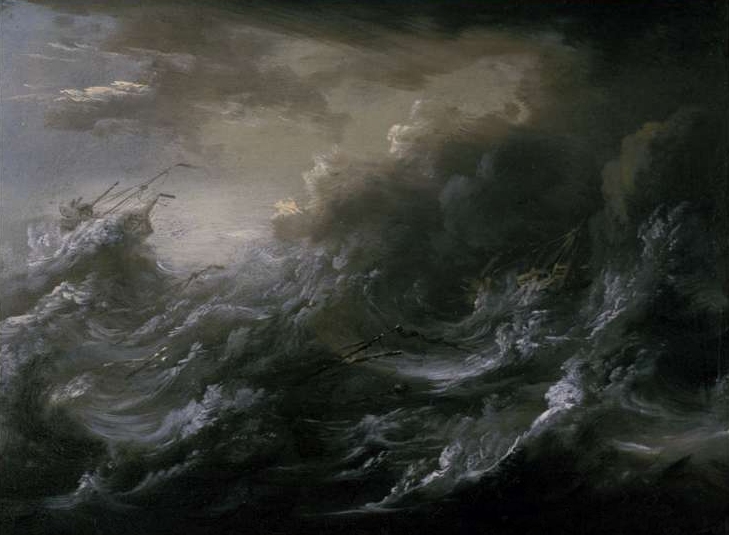
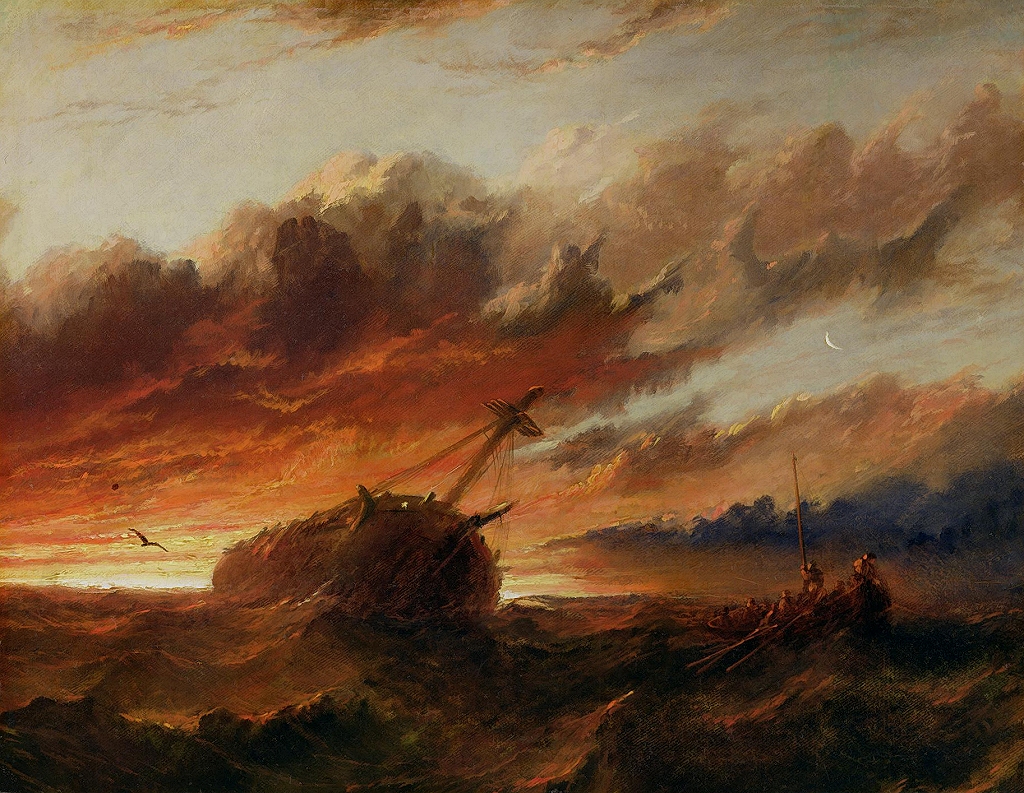
Illustrations are from Gustav Doré, The Rime of the Ancient Mariner, 1870, as well as Christian Wilhelm Ernst Dietrich (1712-74) Sea Storm and Shipwreck, and Francis Danby, Shipwreck, c.1850.

Tuesday, August 24, 2010

The Tomb of Arminius


Click to enlarge

SIR HENGIST

M.G. Lewis

"Herman, or Arminius, is the favourite hero of Germany, whose liberty he defended against the oppression of Rome: Flavus, his brother, sided with the Romans, and in consequence his memory is as much detested by his countrymen, as that of Arminius is beloved. — I forget where I met with the original of this ballad." [Lewis's note]

- - - -

Where rolls the Weser’s golden sand,
Did erst Sir Hengist’s castle stand,
      A warrior brave and good;
His lands extended far and wide,
Where stream’d full many a plenteous tide,
      Where frown’d full many a wood.

It chanced, that homewards from the chace
Sir Hengist urged his courser’s pace,
      The shadowy dales among,
While all was still, and late the hour,
And far off, in the castle tower,
      The bell of midnight rung.

Sudden, a piercing shriek resounds
Throughout the forest’s ample bounds;
      A wildly dreadful yell;
The dogs, by trembling, own their fear,
As if they scent some bad thing near,
      Some soul enlarged from hell!

"See, father!" cried young Egbert; "see
Beneath the shade of yonder tree
      What fearful form is spread!
How fire around his temples glows!
How from his lance and fingers flows
      The stream of bloody red!"

"Stay here!" said Hengist, then with speed
Towards the stranger spurr’d his steed;
      "What brings thee here, Sir Knight,
Who dar’st in my domains to bear
A lance, and by thy haughty air
      Seem’st to demand the fight?"

"Long has my arm forgot to wield
The sword, and raise the massy shield,"
      Replied the stranger drear:
"Peace to this brown oak’s hallow’d shade!
Peace to the bones which here are laid,
      And which we both revere!

"Know’st thou not Siegmar, Herman’s sire,
That arm of steel, that soul of fire?
      Here is his grave. — My name
Is Flavus — at that sound the woods
With curses ring, and Weser’s floods
      My infamy proclaim!

"For such is vengeful Odin’s will
And doom, that traitor-curses still
      Thick on my head shall be,
Till from the blood of brethren slain,
My gory hands and lance again
      I pure and spotless see.

"Still then, when midnight hours permit
Pale spectres Hela’s realm to quit,
      I seek this hallow’d place;
With tears bedew these crimson blots,
And strive to wash away the spots
      No pains can now efface!"

He ceased; when Odin’s eagle came,
By Odin arm’d with blasting flame,
      And seized the phantom knight:
Loud shrieks the spectre’s pangs reveal’d,
And soon a cloud his form conceal’d
      From awe-struck Hengist’s sight.

"Son!" said the chief, with horror chill’d,
While down his brows cold dews distill’d,
      "Now take your sword in hand,
And swear with me, each drop of gore,
That swells your veins, well pleased to pour
      To guard your native land!"

1801


Lewis's "original" for this ballad from his Tales of Wonder has never been discovered, although the enmity between Arminius and Flavus to which the poem refers is noted by Tacitus.

(Illustration is Caspar David Friedrich, Tomb of Arminius, 1813, which Hugh Honour in Romanticism describes as one of Friedrich's "most moving images, that of a lonely sarcophagus set in a cleft of the living rock of ages at the heart of the German fatherland.")

Monday, August 23, 2010

''The Wanderings of Cain''


Click to enlarge

THE WANDERINGS OF CAIN

[An excerpt]

Samuel Taylor Coleridge
Cain stopped, and stifling his groans he sank to the earth, and the child Enos stood in the darkness beside him.

And Cain lifted up his voice and cried bitterly, and said, "The Mighty One that persecuteth me is on this side and on that; he pursueth my soul like the wind, like the sand-blast he passeth through me; he is around me even as the air! O that I might be utterly no more! I desire to die—yea, the things that never had life, neither move they upon the earth—behold! they seem precious to mine eyes. O that a man might live without the breath of his nostrils. So I might abide in darkness, and blackness, and an empty space! Yea, I would lie down, I would not rise, neither would I stir my limbs till I became as the rock in the den of the lion, on which the young lion resteth his head whilst he sleepeth. For the torrent that roareth far off hath a voice: and the clouds in heaven look terribly on me; the Mighty One who is against me speaketh in the wind of the cedar grove; and in silence am I dried up."

The mighty limbs of Cain were wasted as by fire; his hair was as the matted curls on the bison's forehead, and so glared his fierce and sullen eye beneath: and the black abundant locks on either side, a rank and tangled mass, were stained and scorched, as though the grasp of a burning iron hand had striven to rend them; and his countenance told in a strange and terrible language of agonies that had been, and were, and were still to continue to be.

The scene around was desolate; as far as the eye could reach it was desolate: the bare rocks faced each other, and left a long and wide interval of thin white sand. You might wander on and look round and round, and peep into the crevices of the rocks and discover nothing that acknowledged the influence of the seasons. There was no spring, no summer, no autumn: and the winter's snow, that would have been lovely, fell not on these hot rocks and scorching sands. Never morning lark had poised himself over this desert; but the huge serpent often hissed there beneath the talons of the vulture, and the vulture screamed, his wings imprisoned within the coils of the serpent. The pointed and shattered summits of the ridges of the rocks made a rude mimicry of human concerns, and seemed to prophesy mutely of things that then were not; steeples, and battlements, and ships with naked masts. As far from the wood as a boy might sling a pebble of the brook, there was one rock by itself at a small distance from the main ridge. It had been precipitated there perhaps by the groan which the Earth uttered when our first father fell.

Ere they had reached the rock they beheld a human shape: his back was towards them, and they were advancing unperceived, when they heard him smite his breast and cry aloud, "Woe is me! woe is me! I must never die again, and yet I am perishing with thirst and hunger."

Enos glided forward, and creeping softly round the base of the rock, stood before the stranger, and looked up into his face. And the Shape shrieked, and turned round, and Cain beheld him, that his limbs and his face were those of his brother Abel whom he had killed! And Cain stood like one who struggles in his sleep because of the exceeding terribleness of a dream.

Thus as he stood in silence and darkness of soul, the Shape fell at his feet, and embraced his knees, and cried out with a bitter outcry, "Thou eldest born of Adam, whom Eve, my mother, brought forth, cease to torment me! I was feeding my flocks in green pastures by the side of quiet rivers, and thou killedst me; and now I am in misery."

Cain raised up the Shape that was like Abel, and said: — "The Creator of our father, who had respect unto thee, and unto thy offering, wherefore hath he forsaken thee? Didst thou not find favour in the sight of the Lord thy God?"

The Shape answered, "The Lord is God of the living only, the dead have another God."

Then the child Enos lifted up his eyes and prayed; but Cain rejoiced secretly in his heart.

"Wretched shall they be all the days of their mortal life," exclaimed the Shape, "who sacrifice worthy and acceptable sacrifices to the God of the dead; but after death their toil ceaseth. Woe is me, for I was well beloved by the God of the living, and cruel wert thou, O my brother, who didst snatch me away from his power and his dominion."

Having uttered these words, he rose suddenly, and fled over the sands: and Cain said in his heart, "The curse of the Lord is on me; but who is the God of the dead?" and he ran after the Shape, and the Shape fled shrieking over the sands, and the sands rose like white mists behind the steps of Cain, but the feet of him that was like Abel disturbed not the sands. He greatly outrun Cain, and turning short, he wheeled round, and came again to the rock where they had been sitting, and where Enos still stood; and the child caught hold of his garment as he passed by, and he fell upon the ground.

Cain once more sate beside him, and said, "Abel, my brother, I would lament for thee, but that the spirit within me is withered, and burnt up with extreme agony. Now, I pray thee, by thy flocks, and by thy pastures, and by the quiet rivers which thou lovedst, that thou tell me all that thou knowest. Who is the God of the dead? where doth he make his dwelling? what sacrifices are acceptable unto him? for I have offered, but have not been received; I have prayed, and have not been heard; and how can I be afflicted more than I already am?" The Shape arose and answered, "O that thou hadst had pity on me as I will have pity on thee. Follow me, Son of Adam! and bring thy child with thee!"

And they three passed over the white sands between the rocks, silent as the shadows.

1828


This text offers a truncation of Coleridge's haunting prose fragment. The complete, unfinished work can be accessed here.

(Illustration is Thomas Cole, Expulsion, Moon, and Firelight, c.1828, which shows the gateway to the Garden of Eden through which Adam and Eve were cast out of Paradise and the wild wastes into which they were banished — a sublime landscape such as that in which Cain and his heirs were condemned to wander, following his great sin.)

Tuesday, August 10, 2010

''The Last Man''


Click to enlarge

THE LAST MAN (1823)

Thomas Campbell

ALL worldly shapes shall melt in gloom,
      The Sun himself must die,
Before this mortal shall assume
      Its Immortality!
I saw a vision in my sleep
That gave my spirit strength to sweep
      Adown the gulf of Time!
I saw the last of human mould,
That shall Creation's death behold,
      As Adam saw her prime!

The Sun's eye had a sickly glare,
      The Earth with age was wan,
The skeletons of nations were
      Around that lonely man!
Some had expired in fight,--the brands
Still rested in their bony hands;
      In plague and famine some!
Earth's cities had no sound nor tread;
And ships were drifting with the dead
      To shores where all was dumb!

Yet, prophet-like, that lone one stood
      With dauntless words and high,
That shook the sere leaves from the wood
      As if a storm passed by,
Saying, "We are twins in death, proud Sun,
Thy face is cold, thy race is run,
      'Tis Mercy bids thee go.
For thou ten thousand thousand years
Hast seen the tide of human tears,
      That shall no longer flow.

"What though beneath thee man put forth
      His pomp, his pride, his skill;
And arts that made fire, floods, and earth,
      The vassals of his will;--
Yet mourn not I thy parted sway,
Thou dim discrowned king of day:
      For all those trophied arts
And triumphs that beneath thee sprang,
Healed not a passion or a pang
      Entailed on human hearts.

"Go, let oblivion's curtain fall
      Upon the stage of men,
Nor with thy rising beams recall
      Life's tragedy again.
Its piteous pageants bring not back,
Nor waken flesh, upon the rack
      Of pain anew to writhe;
Stretched in disease's shapes abhorred,
Or mown in battle by the sword,
      Like grass beneath the scythe.

"Ee'n I am weary in yon skies
      To watch thy fading fire;
Test of all sumless agonies
      Behold not me expire.
My lips that speak thy dirge of death--
Their rounded gasp and gurgling breath
      To see thou shalt not boast.
The eclipse of Nature spreads my pall,--
The majesty of Darkness shall
      Receive my parting ghost!

"This spirit shall return to Him
      That gave its heavenly spark;
Yet think not, Sun, it shall be dim
      When thou thyself art dark!
No! it shall live again, and shine
In bliss unknown to beams of thine,
      By Him recalled to breath,
Who captive led captivity.
Who robbed the grave of Victory,--
      And took the sting from Death!

"Go, Sun, while Mercy holds me up
      On Nature's awful waste
To drink this last and bitter cup
      Of grief that man shall taste--
Go, tell the night that hides thy face,
Thou saw'st the last of Adam's race,
      On Earth's sepulchral clod,
The darkening universe defy
To quench his Immortality,
      Or shake his trust in God!"


(Illustration is Caspar David Friedrich, Monk by the Sea, 1810.)

Wednesday, July 28, 2010

''The Wandering Jew''


THE WANDERING JEW

Christian Friedrich Daniel Schubart

Ahasuerus the Jew crept forth from the dark cave of Mount Carmel. Near two thousand years have elapsed since he was first goaded by never-ending restlessness to rove the globe from pole to pole. When our Lord was wearied with the burthen of His ponderous cross, and wanted to rest before the door of Ahasuerus, the unfeeling wretch drove Him away with brutality. The Saviour of mankind staggered, sinking under the heavy load, but uttered no complaint. An angel of death appeared before Ahasuerus, and exclaimed indignantly, "Barbarian! thou has denied rest to the Son of man: be it denied thee also, until He comes to judge the world."

A black demon, let loose from hell upon Ahasuerus, goads him now from country to country; he is denied the consolation which death affords, and precluded from the rest of the peaceful grave.

Ahasuerus crept forth from the dark cave of Mount Carmel — he shook the dust from his beard — and taking up one of the skulls heaped there, hurled it down the eminence: it rebounded from the earth in shivered atoms. "This was my father!" roared Ahasuerus. Seven more skulls rolled down from rock to rock; while the infuriate Jew, following them with ghastly looks, exclaimed — "And these were my wives!" He still continued to hurl down skull after skull, roaring in dreadful accents — "And these, and these, and these were my children! They could die; but I! reprobate wretch! alas! I cannot die! Dreadful beyond conception is the judgment that hangs over me. Jerusalem fell — I crushed the sucking babe, and precipitated myself into the destructive flames. I cursed the Romans — but, alas! alas! the restless curse held me by the hair, — and I could not die!

"Rome the giantess fell — I placed myself before the falling statue — she fell and did not crush me. Nations sprang up and disappeared before me; — but I remained and did not die. From cloud-encircled cliffs did I precipitate myself into the ocean; but the foaming billows cast me upon the shore, and the burning arrow of existence pierced my cold heart again. I leaped into Etna's flaming abyss, and roared with the giants for ten long months, polluting with my groans the Mount's sulphureous mouth — ah! ten long months. The volcano fermented, and in a fiery stream of lava cast me up. I lay torn by the torture-snakes of hell amid the glowing cinders, and yet continued to exist. — A forest was on fire: I darted on wings of fury and despair into the crackling wood. Fire dropped upon me from the trees, but the flames only singed my limbs; alas! it could not consume them. — I now mixed with the butchers of mankind, and plunged in the tempest of the raging battle. I roared defiance to the infuriate Gaul, defiance to the victorious German; but arrows and spears rebounded in shivers from my body. The Saracen's flaming sword broke upon my skull: balls in vain hissed upon me: the lightnings of battle glared harmless around my loins: in vain did the elephant trample upon me, in vain the iron hoof of the wrathful steed! The mine, big with destructive power, burst upon me, and hurled me high in the air — I fell on heaps of smoking limbs, but was only singed. The giant's steel club rebounded from my body; the executioner's hand could not strangle me, the tiger's tooth could not pierce me, nor would the hungry lion in the circus devour me. I cohabited with poisonous snakes, and pinched the red crest of the dragon. — The serpent stung, but could not destroy me. The dragon tormented, but dared not devour me. — I now provoked the fury of tyrants: I said to Nero, 'Thou art a bloodhound!' I said to Christiern, 'Thou art a bloodhound!' I said to Muley Ismail, 'Thou art a bloodhound!' — The tyrants invented cruel torments, but did not kill me — Ha! not to be able to die — not to be able to die — not to be permitted to rest after the toils of life — to be doomed to be imprisoned for ever in the clay-formed dungeon — to be for ever clogged with this worthless body, its load of diseases and infirmities — to be condemned to [be]hold for milleniums that yawning monster Sameness, and Time, that hungry hyaena, ever bearing children, and ever devouring again her offspring! — Ha! not to be permitted to die! Awful Avenger in Heaven, hast Thou in Thine armoury of wrath a punishment more dreadful? then let it thunder upon me, command a hurricane to sweep me down to the foot of Carmel, that I there may lie extended; may pant, and writhe, and die!"

1783


-trans. Peter Will
-German title, Der ewige Jude.

(Illustration is Carl Gustav Carus, Pilgrim in a Rocky Valley, 1820.)

Tuesday, July 27, 2010

''The Wild Huntsman''


Click to enlarge

THE WILD HUNTSMAN (1778)

Gottfried August Bürger


Loud, loud the baron winds his horn;
      And, see, a lordly train
On horse, on foot, with defening din,
      Comes scouring o'er the plain.

O'er heath, o'er field, the yelping pack
      Dash swift, from couples freed;
O'er heath, o'er field, close on their track,
      Loud neighs the fiery steed.

And now the Sabbath's holy dawn
      Beam'd high with purple ray,
And bright each hallowed temple's dome
      Reflected back the day.

Now deep and clear the pealing bells
      Struck on the list'ning ear,
And heaven-ward rose from many a voice
      The hymn of praise and prayer.

Swift, swift along the crossway, still
      They speed with eager cry:
See! right and left, two horsemen strange
      Their rapid coursers ply.

Who were the horsemen right and left?
      That may I guess full well:
Who were the horsemen right and left?
      That may I never tell.

The right, of fair and beauteous mien,
      A milk-white steed bestrode;
Mild as the vernal skies, his face
      With heavenly radiance glow'd.

The left spurr'd fast his fiery barb,
      Red as the furnace flame;
Sullen he loured, and from his eyes
      The death-like lightning came.

"Right welcome to our noble sport;"
      The baron greets them fair;
"For well I wot ye hold it good
      To banish moping care.

"No pleasure equal to the chase,
      Or earth, or heaven can yield;"
He spoke,--he waved his cap in air,
      And foremost rushed afield.

"Turn thee!" the milder horseman cries;
      "Turn thee from horns and hounds!
Hear'st not the bells, hear'st not the quire,
      Mingle their sacred sounds?

"They drown the clamor of the chase;
      Oh! hunt not then to-day,
Nor let a fiend's advice destroy
      Thy better angel's sway."

"Hunt on, hunt on," his comrade cries,
      "Nor heed yon dotard's spell;
What is the bawling quire to us?
      Or what the jangling bell?

"Well may the chase delight thee more;
      And well may'st learn from me,
How brave, how princely is our sport,
      From bigot terrors free."

"Well said! well said! in thee I own
      A hero's kindled fire;
These pious foolries move not us,
      We reck nor priest, nor quire.

"And thou, believe me, saintlike dolt,
      Thy bigot rage is vain;
From prayers and beadrolls, what delight
      Can sportsmen hope to gain?"

Still hurry, hurry, on they speed
      O'er valley, hill and plain;
And ever at the baron's side
      Attend the horsemen twain.

See, panting, see, a milk-white hart
      Up-springs from yonder thorn:
"Now swiftly ply both horse and foot;
      Now louder wind the horn!"

See, falls a huntsman! see, his limbs
      The pangs of death distort!
"Lay there and rot: no caitiff's death
      Shall mar our princely sport."

Light bounds with deftest speed the hart,
      Wide o'er the country borne;
Now closer prest a refuge seeks
      Where waves the ripening corn.

See, the poor owner of the field
      Approach with tearful eyes;
"O pity, pity, good my lords!"
      Alas! in vain he cries.

"O spare what little store the poor
      By bitter sweat can earn!"
Now soft the milder horseman warns
      The baron to return.

Not so persuades his stern compeer,
      Best pleas'd with darkest deeds;
Tis his to sway the baron's heart,
      Reckless what mercy pleads.

"Away!" the imperious noble cries;
      "Away, and leave us free!
Off! or by all the powers of hell,
      Thou too shalt hunted be!

"Here, fellows! let this villain prove
      My threats were not in vain:
Loud lash around his piteous face
      The whips of all my train."

Tis said, tis done: swift o'er the fence
      The baron foremost springs;
Swift follow hound, and horse, and man,
      And loud the welkin rings.

Loud rings the welkin with their shouts,
      While man, and horse, and hound,
Ruthless tread down each ripening ear,
      Wide o'er the smoking ground.

O'er heath and field, o'er hill and dale,
      Scared by the approaching cries,
Still close pursued, yet still unreach'd,
      Their destin'd victim flies.

Now mid the lowing herds that graze
      Along yon verdant plain,
He hopes, concealed from every eye,
      A safe retreat to gain.

In vain, for now the savage train
      Press ravening on his heels:
See, prostrate at the baron's feet
      The affrighted herdsman kneels.

Fear for the safety of his charge
      Inspires his faltering tongue;
"O spare," he cries, "these harmless beasts,
      Nor work an orphan's wrong.

"Think, here thy fury would destroy
      A friendless widow's all!"
He spoke:--the gentle stranger strove
      To enforce soft pity's call.

Not so persuades his sullen frere,
      But pleas'd with darkest deeds;
Tis his to sway the baron's heart,
      Reckless what mercy pleads.

"Away, audacious hound!" he cries;
      "Twould do my heart's-blood good,
Might I but see thee transform'd to beasts
      Thee and thy beggar brood.

"Then, to the very gates of heaven,
      Who dare to say me nay!
With joy I'd hunt the losel fry;
      Come fellows, no delay!"

See, far and wide the murderous throng
      Deal many a deadly wound;
Mid slaughter'd numbers, see, the hart
      Sinks bleeding on the ground.

Yet still he summons all his strength
      For one poor effort more,
Staggering he flies; his silver sides
      Drop mingled sweat and gore.

And now he seeks a last retreat
      Deep in the darkling dell,
Where stands, amidst embowering oaks,
      A hermit's holy cell.

E'en here the madly eager train
      Rush swift with impious rage,
When, lo! persuasion on his tongue,
      Steps forth the reverend sage.

"O cease thy chase! nor thus invade
      Religion's free abode;
For know, the tortur'd creature's groans
      E'en now have reach'd his god.

"They cry at heaven's high mercy seat,
      For vengeance on thy head;
O turn, repentant turn, ere yet
      The avenging bolt is sped."

Once more religion's cause in vain
      The gentle stranger pleads;
Once more, alas! his sullen frere
      A willing victim leads.

"Dash on!" the harden'd sinner cries;
      "Shalt thou distrub our sport?
No! boldly would I urge the chase
      In heaven's own inmost court.

"What reck I then thy pious rage?
      No mortal man I fear:
Not god in all his terrors arm'd
      Should stay my fix'd career."

He cracks his whip, he winds his horn,
      He calls his vassal-crew;
Lo! horse and hound, and sage and cell,
      All vanish from his view.

All, all, are gone!--no single rack
      His eager eye can trace;
And silence, still as death, has hush'd
      The clamors of the chase.

In vain he spurs his courser's sides,
      Nor back nor forward borne;
He winds his horn, he calls aloud,
      But hears no sound return.

And now inclos'd in deepest night,
      Dark as the silent grave,
He hears the sullen tempest roar,
      As roars the distant wave.

Loud and louder still the storm
      Howls through the troubled air;
Ten thousand thunders from on high
      The voice of judgment bear.

"Accursed before god and man,
      Unmoved by threat or prayer;
Creator, nor created, aught
      Thy frantic rage would spare.

"Think not in vain creation's lord
      Has heard his creature's groan;
E'en now the torch of vengeance flames
      High by his awful throne.

"Now, hear thy doom! to aftertimes
      A dread example given,
For ever urge thy wild career,
      By fiendish hell-hounds driven."

The voice had ceased; the sulphurous flash
      Shot swift from either pole;
Sore shook the grove; cold horror seized
      The trembling miscreant's soul.

Again the rising tempest roars,
      Again the lightnings play;
And every limb, and every nerve
      Is frozen with dismay.

He sees a giant's swarthy arm
      Start from the yawning ground;
He feels a demon grasp his head,
      And rudely wrench it round.

In torrents now from every side,
      Pours fast a fiery flood;
On each o'erwhelming wave upborne,
      Loud howls the hellish brood.

Sullen and grisly gleams the light,
      Now red, now green, now blue;
Whilst o'er the gulf the fiendish train
      Their destined prey pursue.

In vain he shrieks with wild despair,
      In vain he strives to fly;
Still at this back the hell-born crew
      Their cursed business ply.

By day, full many a fathom deep
      Below earth's smiling face;
By night, high through the troubled air,
      They speed their endless chase.

In vain to turn his eyes aside
      He strives with wild affright;
So never may those maddening scenes
      Escape his tortured sight.

Still must he see those dogs of hell
      Close hovering on his track;
Still must he see the avenging scourge
      Uplighted at his back.

Now this is the wild baron's hunt;
      And many a village youth,
And many a sportsman (dare they speak)
      Could vouch the awful truth.

For oft benighted midst the wilds
      The fiendish troop they hear,
Now shrieking shrill, now cursing loud,
      Come thundering through the air.

No hand shall stay those dogs of hell
      Or quench that sea of fire,
Till god's own dreadful day of doom
      Shall bid the world expire!


-trans. as "The Wild Hunter" by Rambler's Magazine (1809).
-German title: Der wilde Jäger.

(Illustration is Arbo, The Wild Hunt, 1872.)