Showing posts with label Sturm und Drang. Show all posts

Friday, August 27, 2010

The Robbers (Die Räuber)


Excerpts from Friedrich von Schiller's Die Räuber (1781):
FRANZ: Might is right, and the limits of our strength our only law.

FRANZ: I will crush everything that stands in the way of my becoming master.

MOOR: The bright spark of Promethean fire is burnt out.

MOOR: The law has cramped the flight of eagles to a snail's pace. The law never yet made a great man, but freedom will breed a giant, a colossus.

MOOR: Oh, if only Arminius's spirit still glowed in the ashes! — Give me an army of fellows like me to command, and I'll turn Germany into a republic that will make Rome and Sparta look like nunneries.

SPIEBELBERG: Necessity brings out the best in us! That's why I shan't be afraid of it comes to the worst. Danger fortifies our courage; our strength grows in adversity.

SPIEGELBERG: Your name shall be written in the stars! What does it matter where your soul goes?

ROLLER: Without Moor we're a body without a soul.

MOOR: See, the scales have fallen from my eyes! What a fool I was, to seek to return to the cage! My spirit thirsts for deeds, my lungs for freedom — murderers, robbers! at that word I trampled the law beneath my feet — men showed me no humanity when to humanity I appealed; so let me forget sympathy and human feeling! I have no father now, I have no love now, and blood and death shall teach me to forget that ever I held anything dear! Oh, my amusement shall be the terror of the dearth — it is agreed, I shall be your captain! and good fortune to the champion among you who lights the fiercest fires, who does the foulest murders, for I say to you he shall have a kingly reward! Gather round me every one, and swear loyalty and obedience till death! Swear by this man's right hand of mine!
ALL: We swear loyalty and obedience to you till death!

AMALIA: Now I am with Karl again — a beggar, did he say? Why then, the world is turned upside-down, beggars are kings and kings are beggars!

FRANZ: But must my plans submit to the iron yoke of mechanical laws? Is my high-flying spirit to be bound to the snail's pace of material necessity?

FRANZ: What can you do to him? How can a rat hurt a lion?

HERRMANN: Sooner may the bullet turn in its flight and tear the marksman's own bowels.

AMALIA: In Heaven's name, that is not Karl. Here, here — The whole, so different. These dull colours cannot reflect the divine spirit that shone in his fiery eye. Away with it! this is a mere man.

FRANZ: I am not one for stroking and fondling. I will set my pointed spurs into your flesh, and see what a keen whip will do.

SPIEGELBERG: Climate makes very little difference, genius will thrive in any soil.

RATZMANN: If he had given the devil his word that he would go to hell, he would never say a prayer, even though he could save himself with half an Our Father.

SCHWEITZER: We'll save him, or if we can't save him, then at least we'll light him a funeral pyre such as no king ever had, one that will burn them black and blue.

SCHWEITZER: By God, before a quarter of an hour was up, the north-east wind came and served us a treat — he must have had his grudge against the town too! — and helped the fire on its way to the topmost gables. And us meanwhile up and down the streets like furies — fire, fire! All through the town — shrieks and howls and rampage — the firebells start to ring, then up goes the powder-magazine in the air, as if the earth was split in two, and heaven burst, and hell sunk ten thousand fathoms deeper.

ROLLER: The hungry ravens croaking, thirty of them perched there on my half-rotten predecessor.

SCHUFTERLE: A baby, lying there as right as rain under the table, and the table just about to catch fire. — Poor little brute! I said, you're freeing! And threw it into the flames.

MOOR: I shall come amongst you, and terrible shall be my judgment upon you.

SCHWEITZER: We shall be upon them like the Flood and rain down on their heads like thunder-bolts.

MOOR: Now, lads! Now is the time! We are lost, or we must fight like wild boars at bay.
SCHWEITZER: Ha! I'll rip their bellies with my tusks till their tripes come bursting out by the yard! Lead on, captain! We will follow you into the jaws of death!
MOOR: Load all weapons. There is no shortage of powder?
SCHWEITZER: No, powder enough to blow the earth sky-high!

PRIEST: Image of that first loathsome rabble-rouser, who stirred up a thousand legions of innocent angels to fiery rebellion, and dragged them down with him to the pit of damnation.

MOOR: Thus says Moor, captain of murderers and incendiaries. It is true. I killed the Count, I plundered the Dominican church and set it alight, I cast firebrands into your city of bigots, I blew up the powder-magazine over the heads of pious Christians — but that is not all.

MOOR: Tell them my trade is retribution — vengeance is my calling.

MOOR: Who will be the first to abandon his captain in his hour of need?'
ROLLER: Not if nine circles of hell surrounded us! Every man who is not a dog, save your captain!
SCHWEITZER: Pardon in our bullets! Away, vermin! tell the magistrates who sent you that in Moor's band you could not find a single traitor. — Save, save the captain!
ALL: Save, save, save the captain!
MOOR: Now we are free — Comrades! I feel an army in my fist — death or liberty! — at least they shall take none of us alive!

AMALIA: Look, villain, what I can do to you now! I am a woman, but a woman in desperation — once dare to lay your lustful hands on my body — this steel shall pierce your loathsome breast, and my uncle's spirit will guide my hand!

AMALIA: I felt I was as strong as a fiery steed, fierce as the tigress pursuing the triumphant robber of her cubs.

MOOR: Why should man succeed where he imitates the ant, when he is thwarted where he is like the gods?

MOOR: And I so hideous in this fair world — and I, a monster on the glorious earth. . . . I alone cast out, I alone set apart from the ranks fo the blessed — not for me the sweet name of child — not for me the lover's melting glance — never, never more the bosom friend's embrace. Set about with murderers, in the midst of hissing vipers — fettered to vice with bands of iron — rocked giddily over the abyss of destruction on the frail reed of vice — I, I alone cast out, a howling Abaddon amidst the fair world's happy blossoms!

KOSINSKY: Men I am seeking, who can look death in the face and let danger play about them like a charmed snake, who value freedom more than life and honour, whose very name, sweet sound to the poor and the oppressed, strokes terror in the valiant and turns the tyrant pale.

KOSINSKY: I have always wished that I could see the man with destruction in his eye, there as he sat upon the ruins of Carthage — now I need wish it no longer.

KOSINSKY: What should I fear, if I do not fear death?

MOOR: Here you step beyond the bounds of humanity — you must either be more than a man, or you are a devil.

SCHWEITZER: Lead us to hell and I will follow you!

MOOR: Soil of my fatherland, I salute you! Sky of my fatherland! Sun of my fatherland! meadows and hills and forests! I salute you, from my heart I salute you all! — how sweet the breezes blow from the mountains of my home! with what joyous balm you greet the poor outcast!

AMALIA: This is the first Count, the founder of the line, who was ennobled by Barbarossa when he served under him against the corsairs.

AMALIA: Flee from my soul, treacherous, godless desires! in the heart where Karl reigns there is no place for mortal man.

MOOR: She knows that I roam an outcast, a wanderer in the desert, and her love flies through exile and desert to be with me.

MOOR: Unhappy because she loves me! Why, what if I were a murderer? What, my lady? What if you lover could count a man killed for each one of your kisses? Alas for my Amalia! she is an unhappy lady.
AMALIA: Ah! and I, I am happy! My only one is like the light of heaven itself, and heaven is grace and mercy! He could not bear to hurt the merest insect — his soul is as far from thoughts of blood as the pole fo day from midnight.

MOOR: Externals are but the varnish upon a man — I am my heaven and my hell.

MOOR: Did you ever dream that you were the arm of a greater majesty? the tangled knot of our destinies is unravelled! Today, today and invisible power has conferred nobility upon our handiwork! Bow down in adoration before him who decreed you this sublime fate, who led you to this place, who deemed you worthy to be the terrible angels of his dark judgment! Uncover your heads! Kneels in the dust, that you may stand up sanctified!

FRANZ: If I smash this Venus to pieces, then symmetry and beauty have ceased to exist.

MOSER: If you still stand firm in death, if your principles do not desert you even then, then the victory is yours.

MOSER: It will be an awakening as of one buried alive in the bowels of the churchyard.

FRANZ: Lord God, I have been no common murderer — Lord God, I have never stooped to trifles —
DANIEL: God have mercy on us, his prayer itself's a sin.

SCHWEITZER: Dead,? What? dead? Without me, dead? It's a lie, I tell you — see how quickly he will jump up! — Hey, you there! There's a father to be murdered.

MOOR: Swoon then, Amalia! — Die, father! Die through me a third time! — These your rescuers are robbers and murderers! Your Karl is their captain!

MOOR: Have I not heard death whistling towards me from more than a thousand musket-barrels, and without yielding a foot, and am I now to learn to quake like a woman? to quake before a woman? — No, no woman shall shake my manhood — Blood! blood! It is only something caught from a woman — give me blood to swill, and it will pass.

AMALIA: Murderer! Devil! Angel — I cannot leave you.

MOOR: Ah, what is this? She does not spit as me, she does not thrust me from her — Amalia! Have you forgotten? do you know who it is you are embracing, Amalia?
AMALIA: My only one, I shall never leave you!
MOOR: She forgives me, she loves me! I am pure as the heavenly aether, she loves me! Tears of gratitude to you, merciful God in Heaven! Peace has returned to my soul, the raging torment is past, hell is no more — See, O see, the children of light weep upon the neck fo the weeping devil.

ROBBER: Shame on your perjury! the spirit of Roller that died for you, Roller whom you summoned from the dead to be your witness, will blush for your cowardice, and rise armoured from his grave to punish you.

(Photograph shows a scene from a performance of Die Räuber at the open-air theatre in Hohenstein in 1931.)

Saturday, July 31, 2010

Götz von Berlichingen


Click to enlarge

Excerpts from Goethe's Götz von Berlichingen (1773):
KARL: Jaxthausen is a village and castle on the Jaxt. It has belonged for two hundred years to the lords of Berlichingen by hereditary right and by the right of possession.

GÖTZ: Are you not as free, as nobly born as any man in Germany, independent, subject only to the Emperor, and you cringe before vassals?...Do you underestimate the value of being a free knight who is subject only to God, his Emperor, and himself!

GÖTZ: Order and peace! I believe it! That's what every bird of prey wants: to devour its quarry in comfort.

GÖTZ: If your conscience is clear, you are free.

GÖTZ: I am a thorn in your flesh, small as I am, and Sickingen and Selbitz no less so, because we are determined to die before we owe anyone but God for the air we breathe and before we pay loyalty and service to anyone but the Emperor.

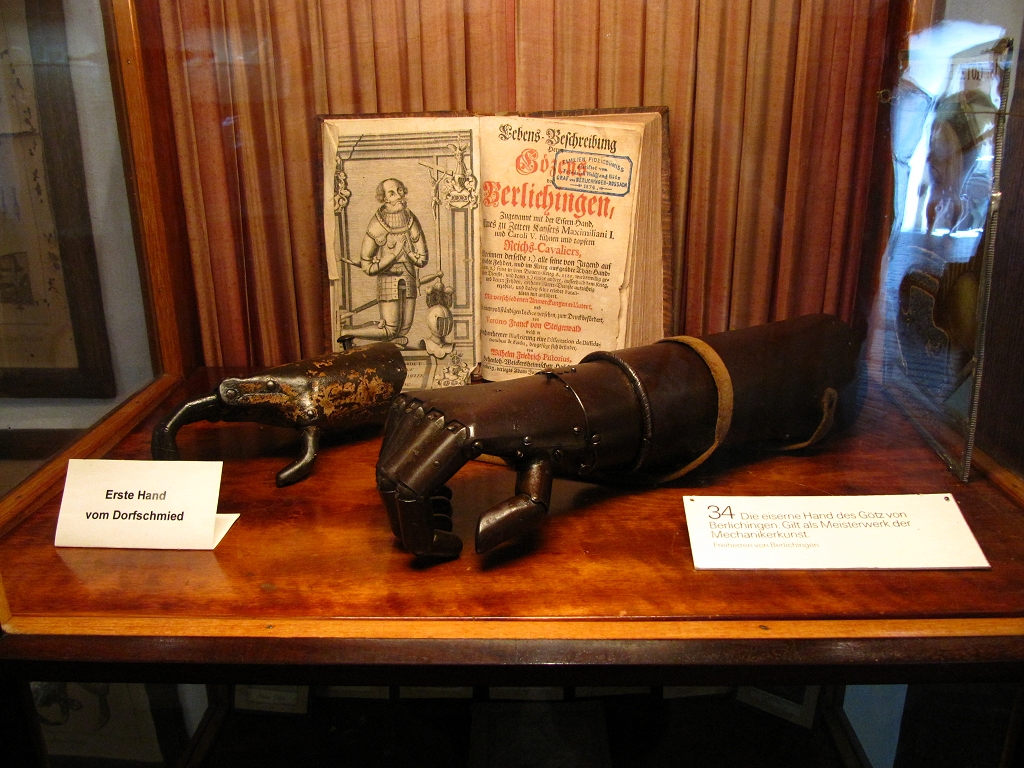
GÖTZ: Last night I thought I gave you my right iron hand, and you held me so tight that it came out of the brassarts as if it had been broken off.

FRANZ: When she looks at anyone it's as though one were standing in spring sunlight.

GEORG: Don't worry! It won't put me off if ever so many are crawling around me: to me they're like rats and mice.

GEORG: A horseman that thinks ahead of time won't take any very broad jumps.

GEORG: He was startled; I saw the confession of his crime on his face. He scarcely had the heart to look at me -- me, a mere squire.
SELBITZ: That was because his conscience was lower than your rank.

THE EMPEROR: God in Heaven! God in Heaven! What is this? One of them has only one hand, the other only one leg. If they ever had two hands and two legs what would you do then?

SICKINGEN: It is an honor for both of you to be betrayed by him.

GÖTZ: Sickingen, you will fall into the pit with me. I was hoping you would get me out of it.

GÖTZ: One wolf is too many for a whole flock of sheep.

GÖTZ: Elizabeth, you will stay with me!
ELIZABETH: Till death!
(exit)
GÖTZ: Whom God loves, to him may He give a wife like that!

THE COUNCILOR: We are under no obligation of good faith with a brigand.
GÖTZ: If you were not wearing the Emperor's likeness, which I venerate in its meanest counterfeit, you would eat that word "brigand" and choke on it! I am engaged in an honorable feud. You could thank God and parade yourself large before the world if you had ever in your life done a deed as noble as that for which I now sit here captive.

GÖTZ: I still have, thank God, one hand left and I did well to use it.

THE COUNCILOR: Seize him!
GÖTZ: Is that your intention? Whoever isn't a Hungarian ox better not come too close to me! He'll get such a box on the ears from this right iron hand of mine as will cure him once and for all of headache, toothache, and all the other aches of this world.

WEISLINGEN: Last night I met Götz in the forest. He drew his sword and challenged me. I reached for mine and my hand failed me. Then he thrust it into his sheath, looked and me contemptuously, and followed me. He is a prisoner, and I tremble before him

GÖTZ: Heavenly air...Freedom! Freedom!

MARIA: Noble man! Noble man! Woe to the age that rejected you!
LERSE: Woe to the posterity that fails to appreciate you!

Click to enlarge

(Images are of Götz von Berlichingen's actual iron hand, along with a prototype to the left, which are housed in the castle museum of the Götzenburg in Jagsthausen; photographed by the author during his latest pilgrimage to Germany, in August, 2009.)

Wednesday, July 28, 2010

''The Wandering Jew''


THE WANDERING JEW

Christian Friedrich Daniel Schubart

Ahasuerus the Jew crept forth from the dark cave of Mount Carmel. Near two thousand years have elapsed since he was first goaded by never-ending restlessness to rove the globe from pole to pole. When our Lord was wearied with the burthen of His ponderous cross, and wanted to rest before the door of Ahasuerus, the unfeeling wretch drove Him away with brutality. The Saviour of mankind staggered, sinking under the heavy load, but uttered no complaint. An angel of death appeared before Ahasuerus, and exclaimed indignantly, "Barbarian! thou has denied rest to the Son of man: be it denied thee also, until He comes to judge the world."

A black demon, let loose from hell upon Ahasuerus, goads him now from country to country; he is denied the consolation which death affords, and precluded from the rest of the peaceful grave.

Ahasuerus crept forth from the dark cave of Mount Carmel — he shook the dust from his beard — and taking up one of the skulls heaped there, hurled it down the eminence: it rebounded from the earth in shivered atoms. "This was my father!" roared Ahasuerus. Seven more skulls rolled down from rock to rock; while the infuriate Jew, following them with ghastly looks, exclaimed — "And these were my wives!" He still continued to hurl down skull after skull, roaring in dreadful accents — "And these, and these, and these were my children! They could die; but I! reprobate wretch! alas! I cannot die! Dreadful beyond conception is the judgment that hangs over me. Jerusalem fell — I crushed the sucking babe, and precipitated myself into the destructive flames. I cursed the Romans — but, alas! alas! the restless curse held me by the hair, — and I could not die!

"Rome the giantess fell — I placed myself before the falling statue — she fell and did not crush me. Nations sprang up and disappeared before me; — but I remained and did not die. From cloud-encircled cliffs did I precipitate myself into the ocean; but the foaming billows cast me upon the shore, and the burning arrow of existence pierced my cold heart again. I leaped into Etna's flaming abyss, and roared with the giants for ten long months, polluting with my groans the Mount's sulphureous mouth — ah! ten long months. The volcano fermented, and in a fiery stream of lava cast me up. I lay torn by the torture-snakes of hell amid the glowing cinders, and yet continued to exist. — A forest was on fire: I darted on wings of fury and despair into the crackling wood. Fire dropped upon me from the trees, but the flames only singed my limbs; alas! it could not consume them. — I now mixed with the butchers of mankind, and plunged in the tempest of the raging battle. I roared defiance to the infuriate Gaul, defiance to the victorious German; but arrows and spears rebounded in shivers from my body. The Saracen's flaming sword broke upon my skull: balls in vain hissed upon me: the lightnings of battle glared harmless around my loins: in vain did the elephant trample upon me, in vain the iron hoof of the wrathful steed! The mine, big with destructive power, burst upon me, and hurled me high in the air — I fell on heaps of smoking limbs, but was only singed. The giant's steel club rebounded from my body; the executioner's hand could not strangle me, the tiger's tooth could not pierce me, nor would the hungry lion in the circus devour me. I cohabited with poisonous snakes, and pinched the red crest of the dragon. — The serpent stung, but could not destroy me. The dragon tormented, but dared not devour me. — I now provoked the fury of tyrants: I said to Nero, 'Thou art a bloodhound!' I said to Christiern, 'Thou art a bloodhound!' I said to Muley Ismail, 'Thou art a bloodhound!' — The tyrants invented cruel torments, but did not kill me — Ha! not to be able to die — not to be able to die — not to be permitted to rest after the toils of life — to be doomed to be imprisoned for ever in the clay-formed dungeon — to be for ever clogged with this worthless body, its load of diseases and infirmities — to be condemned to [be]hold for milleniums that yawning monster Sameness, and Time, that hungry hyaena, ever bearing children, and ever devouring again her offspring! — Ha! not to be permitted to die! Awful Avenger in Heaven, hast Thou in Thine armoury of wrath a punishment more dreadful? then let it thunder upon me, command a hurricane to sweep me down to the foot of Carmel, that I there may lie extended; may pant, and writhe, and die!"

1783


-trans. Peter Will
-German title, Der ewige Jude.

(Illustration is Carl Gustav Carus, Pilgrim in a Rocky Valley, 1820.)

Tuesday, July 27, 2010

''The Wild Huntsman''


Click to enlarge

THE WILD HUNTSMAN (1778)

Gottfried August Bürger


Loud, loud the baron winds his horn;
      And, see, a lordly train
On horse, on foot, with defening din,
      Comes scouring o'er the plain.

O'er heath, o'er field, the yelping pack
      Dash swift, from couples freed;
O'er heath, o'er field, close on their track,
      Loud neighs the fiery steed.

And now the Sabbath's holy dawn
      Beam'd high with purple ray,
And bright each hallowed temple's dome
      Reflected back the day.

Now deep and clear the pealing bells
      Struck on the list'ning ear,
And heaven-ward rose from many a voice
      The hymn of praise and prayer.

Swift, swift along the crossway, still
      They speed with eager cry:
See! right and left, two horsemen strange
      Their rapid coursers ply.

Who were the horsemen right and left?
      That may I guess full well:
Who were the horsemen right and left?
      That may I never tell.

The right, of fair and beauteous mien,
      A milk-white steed bestrode;
Mild as the vernal skies, his face
      With heavenly radiance glow'd.

The left spurr'd fast his fiery barb,
      Red as the furnace flame;
Sullen he loured, and from his eyes
      The death-like lightning came.

"Right welcome to our noble sport;"
      The baron greets them fair;
"For well I wot ye hold it good
      To banish moping care.

"No pleasure equal to the chase,
      Or earth, or heaven can yield;"
He spoke,--he waved his cap in air,
      And foremost rushed afield.

"Turn thee!" the milder horseman cries;
      "Turn thee from horns and hounds!
Hear'st not the bells, hear'st not the quire,
      Mingle their sacred sounds?

"They drown the clamor of the chase;
      Oh! hunt not then to-day,
Nor let a fiend's advice destroy
      Thy better angel's sway."

"Hunt on, hunt on," his comrade cries,
      "Nor heed yon dotard's spell;
What is the bawling quire to us?
      Or what the jangling bell?

"Well may the chase delight thee more;
      And well may'st learn from me,
How brave, how princely is our sport,
      From bigot terrors free."

"Well said! well said! in thee I own
      A hero's kindled fire;
These pious foolries move not us,
      We reck nor priest, nor quire.

"And thou, believe me, saintlike dolt,
      Thy bigot rage is vain;
From prayers and beadrolls, what delight
      Can sportsmen hope to gain?"

Still hurry, hurry, on they speed
      O'er valley, hill and plain;
And ever at the baron's side
      Attend the horsemen twain.

See, panting, see, a milk-white hart
      Up-springs from yonder thorn:
"Now swiftly ply both horse and foot;
      Now louder wind the horn!"

See, falls a huntsman! see, his limbs
      The pangs of death distort!
"Lay there and rot: no caitiff's death
      Shall mar our princely sport."

Light bounds with deftest speed the hart,
      Wide o'er the country borne;
Now closer prest a refuge seeks
      Where waves the ripening corn.

See, the poor owner of the field
      Approach with tearful eyes;
"O pity, pity, good my lords!"
      Alas! in vain he cries.

"O spare what little store the poor
      By bitter sweat can earn!"
Now soft the milder horseman warns
      The baron to return.

Not so persuades his stern compeer,
      Best pleas'd with darkest deeds;
Tis his to sway the baron's heart,
      Reckless what mercy pleads.

"Away!" the imperious noble cries;
      "Away, and leave us free!
Off! or by all the powers of hell,
      Thou too shalt hunted be!

"Here, fellows! let this villain prove
      My threats were not in vain:
Loud lash around his piteous face
      The whips of all my train."

Tis said, tis done: swift o'er the fence
      The baron foremost springs;
Swift follow hound, and horse, and man,
      And loud the welkin rings.

Loud rings the welkin with their shouts,
      While man, and horse, and hound,
Ruthless tread down each ripening ear,
      Wide o'er the smoking ground.

O'er heath and field, o'er hill and dale,
      Scared by the approaching cries,
Still close pursued, yet still unreach'd,
      Their destin'd victim flies.

Now mid the lowing herds that graze
      Along yon verdant plain,
He hopes, concealed from every eye,
      A safe retreat to gain.

In vain, for now the savage train
      Press ravening on his heels:
See, prostrate at the baron's feet
      The affrighted herdsman kneels.

Fear for the safety of his charge
      Inspires his faltering tongue;
"O spare," he cries, "these harmless beasts,
      Nor work an orphan's wrong.

"Think, here thy fury would destroy
      A friendless widow's all!"
He spoke:--the gentle stranger strove
      To enforce soft pity's call.

Not so persuades his sullen frere,
      But pleas'd with darkest deeds;
Tis his to sway the baron's heart,
      Reckless what mercy pleads.

"Away, audacious hound!" he cries;
      "Twould do my heart's-blood good,
Might I but see thee transform'd to beasts
      Thee and thy beggar brood.

"Then, to the very gates of heaven,
      Who dare to say me nay!
With joy I'd hunt the losel fry;
      Come fellows, no delay!"

See, far and wide the murderous throng
      Deal many a deadly wound;
Mid slaughter'd numbers, see, the hart
      Sinks bleeding on the ground.

Yet still he summons all his strength
      For one poor effort more,
Staggering he flies; his silver sides
      Drop mingled sweat and gore.

And now he seeks a last retreat
      Deep in the darkling dell,
Where stands, amidst embowering oaks,
      A hermit's holy cell.

E'en here the madly eager train
      Rush swift with impious rage,
When, lo! persuasion on his tongue,
      Steps forth the reverend sage.

"O cease thy chase! nor thus invade
      Religion's free abode;
For know, the tortur'd creature's groans
      E'en now have reach'd his god.

"They cry at heaven's high mercy seat,
      For vengeance on thy head;
O turn, repentant turn, ere yet
      The avenging bolt is sped."

Once more religion's cause in vain
      The gentle stranger pleads;
Once more, alas! his sullen frere
      A willing victim leads.

"Dash on!" the harden'd sinner cries;
      "Shalt thou distrub our sport?
No! boldly would I urge the chase
      In heaven's own inmost court.

"What reck I then thy pious rage?
      No mortal man I fear:
Not god in all his terrors arm'd
      Should stay my fix'd career."

He cracks his whip, he winds his horn,
      He calls his vassal-crew;
Lo! horse and hound, and sage and cell,
      All vanish from his view.

All, all, are gone!--no single rack
      His eager eye can trace;
And silence, still as death, has hush'd
      The clamors of the chase.

In vain he spurs his courser's sides,
      Nor back nor forward borne;
He winds his horn, he calls aloud,
      But hears no sound return.

And now inclos'd in deepest night,
      Dark as the silent grave,
He hears the sullen tempest roar,
      As roars the distant wave.

Loud and louder still the storm
      Howls through the troubled air;
Ten thousand thunders from on high
      The voice of judgment bear.

"Accursed before god and man,
      Unmoved by threat or prayer;
Creator, nor created, aught
      Thy frantic rage would spare.

"Think not in vain creation's lord
      Has heard his creature's groan;
E'en now the torch of vengeance flames
      High by his awful throne.

"Now, hear thy doom! to aftertimes
      A dread example given,
For ever urge thy wild career,
      By fiendish hell-hounds driven."

The voice had ceased; the sulphurous flash
      Shot swift from either pole;
Sore shook the grove; cold horror seized
      The trembling miscreant's soul.

Again the rising tempest roars,
      Again the lightnings play;
And every limb, and every nerve
      Is frozen with dismay.

He sees a giant's swarthy arm
      Start from the yawning ground;
He feels a demon grasp his head,
      And rudely wrench it round.

In torrents now from every side,
      Pours fast a fiery flood;
On each o'erwhelming wave upborne,
      Loud howls the hellish brood.

Sullen and grisly gleams the light,
      Now red, now green, now blue;
Whilst o'er the gulf the fiendish train
      Their destined prey pursue.

In vain he shrieks with wild despair,
      In vain he strives to fly;
Still at this back the hell-born crew
      Their cursed business ply.

By day, full many a fathom deep
      Below earth's smiling face;
By night, high through the troubled air,
      They speed their endless chase.

In vain to turn his eyes aside
      He strives with wild affright;
So never may those maddening scenes
      Escape his tortured sight.

Still must he see those dogs of hell
      Close hovering on his track;
Still must he see the avenging scourge
      Uplighted at his back.

Now this is the wild baron's hunt;
      And many a village youth,
And many a sportsman (dare they speak)
      Could vouch the awful truth.

For oft benighted midst the wilds
      The fiendish troop they hear,
Now shrieking shrill, now cursing loud,
      Come thundering through the air.

No hand shall stay those dogs of hell
      Or quench that sea of fire,
Till god's own dreadful day of doom
      Shall bid the world expire!


-trans. as "The Wild Hunter" by Rambler's Magazine (1809).
-German title: Der wilde Jäger.

(Illustration is Arbo, The Wild Hunt, 1872.)

Monday, July 26, 2010

''Leonore''


LEONORE (1773)

Gottfried August Bürger

Upstarting with the dawning red,
      Rose Leonore from dreams of ill.
"Oh, Wilhelm! art thou false, or dead?
      How long, how long, wilt loiter still?"--
The youth had gone to Prague to yield
King Frederick aid in battle-field,
Nor word nor friend had come to tell
If he were still alive and well.

War's trumpet blew its dying blast,
      And o'er the empress and the king
Long-wished, long looked-for Peace at last
      Came hovering upon angel-wing.
And all the hosts, with glittering sheen,
And kettledrum and tambourine,
And decked with garlands green and gay,
Marched, merrily, for home away.

And on the highways, paths, and byways,
      Came clustering, mustering, crowds and groups
Of old and young, from far and nigh-ways,
      And met with smiles the noble troops.
"Thank God!" the son and mother cried--
And "Welcome!" many a joyous bride:
But none throughout that happy meeting
Hailed Leonore with kiss or greeting.

She wandered hither, hurried thither;
      She called aloud upon her Lost,
But none knew aught of him she sought,
      Of all that far-extending host.
When all was vain, for sheer despair
She madly tore her night-black hair,
And dashed herself against the stones,
And raved and wept with bitter groans.

Then came her mother hurriedly--
      "Oh, God of Mercy!--what alarms
My darling child? What troubles thee?"--
      And locked her fondly in her arms.
"Oh, mother, mother! dead is dead!
My days are sped, my hopes are fled:
Heaven has no pity on me--none--
Oh, woe is me! oh, wretched one!"

"Alas! alas! Child, place thy trust
      In God, and raise thy heart above:
What God ordains is right and just,
      He is a God of tender love."--
"Oh! mother, mother! false and vain,
For God has wrought me only pain!
I will not pray--my plaint and prayer
Are wasted on the idle air!"

"No, no, my child!--not so--the Lord
      Is good--He heals His children's grief;
The Holy Eucharist will afford
      The anguish of thy soul relief."--
"Hush, mother, mother! What I feel
No Eucharist can ever heal--
No Eucharist can ever give
The shrouded Dead again to live."

"Ah, child, perchance thy lover now--
      A traitor to his love and thee--
Before the altar plights his vow
      To some fair girl of Hungary:
Yet weep not this perfidious wrong,
For he will rue it late and long,
And when he soul and body part
His faithlessness will burn his heart."

"Oh, mother, mother! gone is gone,
      And lorn for once is ever lorn!
The grave is now my hope alone:
      Would God that I had ne'er been born!
Out, out, sick light! Out, flickering taper!
Down, down in night and charnel vapour!
In Heaven there is no pity--none--
Oh, woe is me! oh, wretched one!"

"Oh, God of mercy, enter not
      In judgment with thy suffering child!
Condemn her not--she knows not what
      She raves in this delirium wild.
My child, forget thy tears and sighs,
And look to God and Paradise:
A holier bridegroom shalt thou see,
And He will sweetly comfort thee."

"Oh, mother, what is Paradise?
      Oh, mother, what and where is Hell?
In Wilhelm lies my Paradise--
      Where he is not my life is Hell!
Then out, sick light! Out, flickering taper
Down, down in blackest night and vapour!
In heaven, on earth I will not share
Delight if Wilhelm be not there!"

And thus, as reigned and raged despair
      Throughout her brain, through every vein,
Did this presumptuous maiden dare
      To tax with ill God's righteous will,
And wrang her hands and beat her breast
Till sank the sunlight in the west,
And under heaven's ethereal arch
The silver stars began their march.

When, list! a sound!--hark! hoff, hoff, hoff!
      It nears, she hears a courser's tramp--
And swiftly bounds a rider off
      Before the gate with clattering stamp;
And hark, the bell goes ring, ding, ding!
And hark again! cling, ling, ling, ling!
And through the portal and the hall
There peals a voice with hollow call:

"What, ho! Up, up, sweet love inside!
      Dost watch for me, or art thou sleeping?
Art false, or still my faithful bride?
      And smilest thou, or art thou weeping?"--
"What! Wilhelm! thou? and come thus late!
Oh! Night has seen me weep and wait
And suffer so! But oh! I fear--
Why this wild haste in riding here?"

"I left Bohemia late at night:
      We journey but at midnight, we!
My time was brief, and fleet my flight.
      Up, up! thou must away with me!"--
"Ah, Wilhelm! come inside the house;
The wind moans through the firtree boughs;
Come in, my heart's beloved! and rest
And warm thee in this faithful breast."

"The boughs may wave, the wind may rave;
      Let rave the blast and wave the fir!
Though winds may rave and boughs may wave
      My sable steed expects the spur.
Up! gird thyself, and spring with speed
Behind me on my sable steed!
A hundred leagues must yet be sped
Before we reach the bridal bed."

"Oh, Wilhelm! at so drear an hour,
      A hundred leagues away from bed!
Hark! hark! 'Eleven' from the tower
      Is tolling far with tone of dread!"
"Look round! look up! The moon is bright.
The Dead and We are fleet of flight:
Doubt not I'll bear thee hence away
To home before the break of day."

"And where is then the nuptial hall?
      And where the chamber of the bride?"
"Far, far from hence! Chill, still, and small,
      But six feet long by two feet wide!"
"Hast room for me?" "For me and thee!
Quick! robe thyself and come with me.
The wedding guests await the bride;
The chamber-door stands open wide."

Soon up, soon clad, with lightest bound
      On that black steed the maiden sprung,
And round her love, and warmly round,
      Her snow-white arms she swung and flung;
And deftly, swiftly, hoff, hoff, hoff!
Away went horse and riders off;
Till panted horse and riders too,
And sparks and pebbles flashed and flew!

On left and right, with whirling flight,
      How rock and forest reeled and wheeled!
How danced each height before their sight!
      What thunder-tones the bridges pealed!
"Dost fear! The moon is fair to see;
Hurrah! the Dead ride rapidly!
Beloved! dost dread the shrouded Dead?"
"Ah, no! but let them rest," she said.

But see! what throng, with song and gong
      Moves by, as croaks the raven hoarse!
Hark! funeral song! Hark! knelling dong!
      They sing, "Let's here inter the corpse!"
And nearer draws that mourning throng,
And bearing hearse and bier along.
With hollow hymn outgurgled like
Low reptile groanings from a dyke.

"Entomb your dead when midnight wanes,
      With knell, and bell, and funeral wail!
Now homewards to her dim domains
      I bear my bride--so, comrades, hail!
Come, Sexton, with the choral throng,
And jabber me the bridal song.
Come, Priest, the marriage must be blessed
Before the wedded pair can rest!"

Some spell is in the horseman's call,
      The hymn is hushed, the hearse is gone,
And in his wake the buriers all,
      Tramp, tramp, come clattering, pattering on;
And onward, forward, hoff, hoff, hoff!
Away swept all in gallop off,
Till panted steeds and riders too,
And sparks and pebbles flashed and flew.

On left and right, with flight of light,
      How whirled the hills, the trees, the bowers!
With lightlike flight, on left and right,
      How spun the hamlets, towns, and towers!
"Dost quail! The moon is fair to see;
Hurrah! the Dead ride recklessly!
Beloved! dost dread the shrouded Dead?"
"Ah! let the Dead repose!" she said.

But look! On yonder gibbet's height,
      How round his wheel, as wanly glances
The yellow moon's unclouded light,
      A malefactor's carcase dances!
"So ho! poor Carcase! down with thee!
Down, Thing of Bones, and follow me!
And thou shalt briskly dance, ho, ho!
Before us when to bed we go!"

Whereon the Carcase, brush, ush, ush!
      Came rustling, bustling, close behind,
With whirr as when through hazel-bush,
      Steals cracklingly the winter wind.
And forward, onward, hoff, hoff, hoff!
Away dashed all in gallop off,
Till panted steeds and riders too,
And fire and pebbles flashed and flew.

How swift the eye saw sweep and fly
      Earth's bounding car afar, afar!
How flew on high the circling sky,
      The heavens and every winking star.
"Dost quake? The moon is fair to see.
Hurrah! the Dead ride gloriously!
Beloved! dost dread the shrouded Dead?"
"Oh woe! let rest the Dead!" she said.

" 'Tis well! Ha! ha! the cock is crowing;
      Thy sand, Beloved, is nearly run!
I smell the breeze of Morning blowing.
      My good black steed, thy race is done!
The race is done, the goal is won--
The wedding bed we shall not shun!
The Dead can chase and race apace!
Behold! we face the fated place!"

Before a grated portal stand
      That midnight troop and coalblack horse,
Which, touched as by a viewless wand,
      Bursts open with gigantic force!
With trailing reins and lagging speed
Wends onward now the gasping steed,
Where gastily the moon illumes
A wilderness of graves and tombs!

He halts. O horrible! Behold--
      Hoo! hoo! behold a hideous wonder!
The rider's garments drop like mould
      Of crumbling plasterwork asunder!
His skull, in bony nakedness,
Glares hairless, fleshless, featureless!
And now a skeleton he stands,
With flashing Scythe and Glass of Sands!

High roars the barb--he snorts--he winks--
      His nostrils flame--his eyeballs glow--
And, whirl! the maiden sinks and sinks
      Down in the smothering clay below!
Then howls and shrieks in air were blended;
And wailings from the graves ascended,
Until her heart, in mortal strife,
Wrestled with very Death for Life!

And now, as dimmer moonlight wanes,
      Round Leonore in shadowy ring
The spectres dance their dance of chains,
      And howlingly she hears them sing--
"Bear, bear, although thy heart be riven!
And tamper not with God in heaven.
Thy body's knell they soon shall toll--
May God have mercy on thy soul!"

-trans. James Calrence Mangan
-German title: Lenore.

(Illustration is Horace Vernet, The Ballad of Leonore, 1839.)

''King Hacho's Death-Song''


Click to enlarge

KING HACHO'S DEATH-SONG

RUNIC.--M.G. Lewis

"The original, but in a mutilated state, is inserted in Bartholin. Caus. Contemt. Mort. Here again, as also for the translations of 'The Water-King,' and of the 'Erl-King's Daughter,' I must express my obligations to Mr. Herder's Collection." [Lewis's note]

- - - -

GAUNDUL and Skogul came from Thor,
To choose a king from out the war,
Who to Valhalla's joys should speed,
And drink with Odin beer and mead.

Of Ingwa's race the king renown'd,
Biarner's brother, soon they found,
As arm'd with helmet, sword, and shield,
With eager step he sought the field,
Where clashing glaives and dying cries
Already told the combat's size.

With mighty voice he bids appear
Haleyger brave, and Halmygeer;
Then forth to urge the fight he goes,
The hope of friends, the fear of foes.
The Norman host soon round him swarms,
And Jutland's monarch stands in arms.

Firmly is grasp'd by Hacho bold,
The millstone-splitter's hilt of gold,
Whose blows give death on every side,
And, as 'twere water, brass divide;
A cloud of javelins veils the sky;
The crashing shields in splinters fly;
And on the casques of warriors brave
Resounds the stroke of many a glaive.

Now Tyr's and Bauga's weapons brown
Break on the Norman monarch's crown;
Now hotter, fiercer grows the fight,
Low sinks the pride of many a knight;
And, dyed in slaughter's crimson hue,
Torrents of gore their shields bedew;
From meeting weapons lightning gleams;
From gaping wounds the life-blood streams:
With falling corses groans the land,
And purple waves lash Storda's sand.

The warring heroes now confound
Buckler with buckler, wound with wound:
As eager as were battle sport,
Renown they seek, and death they court;
Till, never more to rise, they fall
In myriads; while, to Odin's hall,
The dæmon of the tempest brings
A blood-stream on his sable wings.

Apart the hostile chiefs were placed;
Broken their swords, their helms unlaced;
Yet neither thought his fate would be,
The hall of Odin soon to see.

--"Great is the feast of gods to-day,"
Propp'd on her sword, did Gaundul say,
"Since to their table they invite
"Hacho, and all his chiefs from flight!"--

The fated monarch hears too plain,
How speaks the chooser of the slain;
Too plain beholds his startled eye,
On their black coursers mounted high
The immortal maids, who near him stand,
Each propp'd on her resistless brand.

"Goddess of Combat!" Hacho cries,
"Thus dost thou give the battle's prize?
"And do then victory's gods deny
"To view my arms with friendly eye?"--
"Chide not!" fierce Skogul thus replied,
"For conquest still shall grace thy side;
"Thou shalt prevail, the foe shall yield,
"And thine remain the bloody field."--

She said, and urged her coal-black steed
Swift to the hall of gods to speed;
And there to Odin's heroes tell
A king drew near with them to dwell.

--"Hither," thus Odin spoke, "the king
"Let Hermoder and Braga bring;
"A monarch comes, a hero guest,
"Who well deserves with me to rest."--

Said Hacho, while his streaming blood
Pour'd down his limbs its crimson flood,
--"God Odin's eyes, my brethren bold,
"Our arms with hostile glance behold!"--

Then Braga spoke.--"Brave monarch, know,
"Thou to Valhalla's joys shalt go,
"There to drink mead in skulls of foes,
"And at the feast of gods repose:
"To greet thee at the magic gate,
"E'en now eight hero-brothers wait,
"With joyful eyes thy corning see,
"And wish, thou foe of kings, for thee."--

--"Yet be my sword," the King replied,
"Once more in Norman slaughter dyed;
"Let me, as heroes should, expire,
"And fall in fight, as fell my sire:
"So shall my glory live, and fame
"Shall long remember Hacho's name."--

He ceases, and to combat flies
He fights, he conquers, and he dies;
But soon he finds what joys attend,
Who dare in fight their days to end:
Soon as he gains Valhalla's gate,
Eight heroes there to greet him wait;
The gods a friend the monarch call,
And welcome him to Odin's hall.

Who in Valhalla thus shall be
Loved and revered, oh! bless'd is he;
His conquest and his fame shall long
Remember'd be, and live in song.
Wolf Fenris first his chain shall break,
And on mankind his fury wreak,
Ere walks a king in Hacho's trace,
Or fills so well his vacant place.

Since to the gods the king hath fled,
Heroes and valiant hosts have bled:
The bones of friends have strewed the sand;
Usurping tyrants sway the land:
And many a tear for Hacho brave
Still falls upon his honour'd grave.


-from M.G. Lewis, Tales of Wonder (1801).
-originally published as König Hakos Todesgesang in J.G. Herder, Volkslieder (1778).

(Illustration is William T. Maud (1865-1903), The Ride of the Valkyries.)