Showing posts with label English Romanticism. Show all posts

Thursday, October 21, 2010

''Lachin y Gair''


Click to enlarge

LACHIN Y GAIR

Lord Byron

"Lachin y Gair, or, as it is pronounced in the Erse, Loch na Garr, towers proudly pre-eminent in the northern highlands, near Invercauld. One of our modern tourists mentions it as the highest mountain, perhaps, in Great Britain. Be this as it may, it is certainly one of the most sublime and picturesque amongst our ‘Caledonian Alps.’ Its appearance is of a dusky hue, but the summit is the seat of eternal snows. Near Lachin y Gair I spent some of the early part of my life, the recollection of which has given birth to these stanzas." [Byron's note]

- - - -

Away, ye gay landscapes, ye garden of roses!
In you let the minions of luxury rove;
Restore me the rocks, where the snow-flake reposes,
Though still they are sacred to freedom and love:
Yet, Caledonia, beloved are thy mountains,
Round their white summits though elements war;
Though cataracts foam ’stead of smooth-flowing fountains,
I sigh for the valley of dark Loch na Garr.

Ah! there my young footsteps in infancy wander’d;
My cap was the bonnet, my cloak was the plaid;
On chieftains long perish’d my memory pondered,
As daily I strode through the pine-cover’d glade;
I sought not my home till the day’s dying glory
Gave place to the rays of the bright polar star;
For fancy was cheered by traditional story,
Disclosed by the natives of dark Loch na Garr.

“Shades of the dead! have I not heard your voices
Rise on the night-rolling breath of the gale?”
Surely the soul of the hero rejoices,
And rides on the wind, o’er his own Highland vale.
Round Loch na Garr while the stormy mist gathers,
Winter presides in his cold icy car:
Clouds there encircle the forms of my fathers;
They dwell in the tempests of dark Loch na Garr.

“Ill-starred, though brave, did no visions foreboding
Tell you that fate had forsaken your cause?”
Ah! were you destined to die at Culloden,
Victory crown’d not your fall with applause:
Still were you happy in death’s earthy slumber,
You rest with your clan in the caves of Braemar;
The pibroch resounds, to the piper’s loud number,
Your deeds on the echoes of dark Loch na Garr.

Years have roll’d on, Loch na Garr, since I left you,
Years must elapse ere I tread you again:
Nature of verdure and flow’rs has bereft you,
Yet still are you dearer than Albion’s plain.
England! thy beauties are tame and domestic
To one who has roved o’er the mountains afar:
Oh for the crags that are wild and majestic!
The steep frowning glories of dark Loch na Garr!

1807


(Illustration is Albert Bierstadt, Among the Sierra Nevada Mountains, 1868.)

Sunday, October 17, 2010

''Elver's Hoh''


Click to enlarge

ELVER'S HOH

DANISH—M.G. Lewis

"The original is to be found in the Kiampe-Viiser, Copenhagen, 1739. My version of this ballad (as also of most of the Danish ballads in this collection) was made from a German translation to be found in Herder’s Volkslieder." [Lewis's note]

- - - -

The knight laid his head upon Elver’s Hoh,
    Soft slumbers his senses beguiling;
Fatigue press’d its seal on his eyelids, when lo!
    Two maidens drew near to him, smiling;
The one she kiss’d softly Sir Algamore’s eyes;
    The other she whisper’d him sweetly,
“Arise! thou gallant young warrior, arise,
    For the dance it goes gaily and featly!

“Arise, thou gallant young warrior, arise,
    And dance with us now and for ever!
My damsels with music thine ear shall surprise,
    And sweeter a mortal heard never—”
Then straight of young maidens appear’d a fair throng,
    Who their voices in harmony raising,
The winds they were still as the sounds flew along,
    By silence their melody praising.

The winds they were still as the sounds flew along,
    The wolf howl’d no more from the mountains;
The rivers were mute upon hearing the song,
    And calm’d the loud rush of their fountains:
The fish, as they swam in the waters so clear,
    To the soft sounds delighted attended,
And nightingales, charm’d the sweet accents to hear,
    Their notes with the melody blended.

“Now hear me, thou gallant young warrior, now hear!
    If thou wilt partake of our pleasure,
We’ll teach thee to draw the pale moon from her sphere,
    We’ll show thee the sorcerer’s treasure!
We’ll teach thee the Runic rhyme, teach thee to hold
    The wild bear in magical fetters,
To charm the red dragon, who broods over gold,
    And tame him by mystical letters.”

Now hither, now thither, then danced the gay band,
    By witchcraft the hero surprising,
Who ever sat silent, his sword in his hand,
    Their sports and their pleasures despising.
“Now hear me, thou gallant young warrior, now hear!
    If still thou disdain’st what we proffer,
With dagger and knife from thy breast will we tear
    Thine heart, which refuses our offer!”

Oh! glad was the knight when he heard the cock crow!
    His enemies trembled, and left him:
Else must he have stayed upon Elver’s Hoh,
    And the witches of life had bereft him.
Beware then, ye warriors, returning by night
    From court, dress’d in gold and in silver;
Beware how you slumber on Elver’s rough height,
    Beware of the witches of Elver!

1801


-from M.G. Lewis, Tales of Wonder (1801).
-originally published as Elvers Hoh in J.G. Herder, Volkslieder (1778).

(Illustration is Lawrence Koe, Venus and Tannhäuser, 1896)

Saturday, October 16, 2010

''Childe Roland to the Dark Tower Came''


Click to enlarge

CHILDE ROLAND TO THE DARK TOWER CAME

Robert Browning


I.

My first thought was, he lied in every word,
    That hoary cripple, with malicious eye
    Askance to watch the working of his lie
On mine, and mouth scarce able to afford
Suppression of the glee, that pursed and scored
    Its edge, at one more victim gained thereby.

II.

What else should he be set for, with his staff?
    What, save to waylay with his lies, ensnare
    All travellers who might find him posted there,
And ask the road? I guessed what skull-like laugh
Would break, what crutch 'gin write my epitaph
    For pastime in the dusty thoroughfare,

III.

If at his counsel I should turn aside
    Into that ominous tract which, all agree,
    Hides the Dark Tower. Yet acquiescingly
I did turn as he pointed: neither pride
Nor hope rekindling at the end descried,
    So much as gladness that some end might be.

IV.

For, what with my whole world-wide wandering,
    What with my search drawn out thro' years, my hope
    Dwindled into a ghost not fit to cope
With that obstreperous joy success would bring,
I hardly tried now to rebuke the spring
    My heart made, finding failure in its scope.

V.

As when a sick man very near to death
    Seems dead indeed, and feels begin and end
    The tears and takes the farewell of each friend,
And hears one bid the other go, draw breath
Freelier outside, ("since all is o'er," he saith,
    "And the blow falIen no grieving can amend;")

VI.

While some discuss if near the other graves
    Be room enough for this, and when a day
    Suits best for carrying the corpse away,
With care about the banners, scarves and staves:
And still the man hears all, and only craves
    He may not shame such tender love and stay.

VII.

Thus, I had so long suffered in this quest,
    Heard failure prophesied so oft, been writ
    So many times among "The Band"—to wit,
The knights who to the Dark Tower's search addressed
Their steps—that just to fail as they, seemed best,
    And all the doubt was now—should I be fit?

VIII.

So, quiet as despair, I turned from him,
    That hateful cripple, out of his highway
    Into the path he pointed. All the day
Had been a dreary one at best, and dim
Was settling to its close, yet shot one grim
    Red leer to see the plain catch its estray.

IX.

For mark! no sooner was I fairly found
    Pledged to the plain, after a pace or two,
    Than, pausing to throw backward a last view
O'er the safe road, 'twas gone; grey plain all round:
Nothing but plain to the horizon's bound.
    I might go on; nought else remained to do.

X.

So, on I went. I think I never saw
    Such starved ignoble nature; nothing throve:
    For flowers—as well expect a cedar grove!
But cockle, spurge, according to their law
Might propagate their kind, with none to awe,
    You'd think; a burr had been a treasure-trove.

XI.

No! penury, inertness and grimace,
    In some strange sort, were the land's portion. "See
    "Or shut your eyes," said nature peevishly,
"It nothing skills: I cannot help my case:
"'Tis the Last judgment's fire must cure this place,
    "Calcine its clods and set my prisoners free."

XII.

If there pushed any ragged thistle-stalk
    Above its mates, the head was chopped; the bents
    Were jealous else. What made those holes and rents
In the dock's harsh swarth leaves, bruised as to baulk
All hope of greenness?'tis a brute must walk
    Pashing their life out, with a brute's intents.

XIII.

As for the grass, it grew as scant as hair
    In leprosy; thin dry blades pricked the mud
    Which underneath looked kneaded up with blood.
One stiff blind horse, his every bone a-stare,
Stood stupefied, however he came there:
    Thrust out past service from the devil's stud!

XIV.

Alive? he might be dead for aught I know,
    With that red gaunt and colloped neck a-strain,
    And shut eyes underneath the rusty mane;
Seldom went such grotesqueness with such woe;
I never saw a brute I hated so;
    He must be wicked to deserve such pain.

XV.

I shut my eyes and turned them on my heart.
    As a man calls for wine before he fights,
    I asked one draught of earlier, happier sights,
Ere fitly I could hope to play my part.
Think first, fight afterwards—the soldier's art:
    One taste of the old time sets all to rights.

XVI.

Not it! I fancied Cuthbert's reddening face
    Beneath its garniture of curly gold,
    Dear fellow, till I almost felt him fold
An arm in mine to fix me to the place,
That way he used. Alas, one night's disgrace!
    Out went my heart's new fire and left it cold.

XVII.

Giles then, the soul of honour—there he stands
    Frank as ten years ago when knighted first.
    What honest man should dare (he said) he durst.
Good—but the scene shifts—faugh! what hangman hands
Pin to his breast a parchment? His own bands
    Read it. Poor traitor, spit upon and curst!

XVIII.

Better this present than a past like that;
    Back therefore to my darkening path again!
    No sound, no sight as far as eye could strain.
Will the night send a howlet or a bat?
I asked: when something on the dismal flat
    Came to arrest my thoughts and change their train.

XIX.

A sudden little river crossed my path
    As unexpected as a serpent comes.
    No sluggish tide congenial to the glooms;
This, as it frothed by, might have been a bath
For the fiend's glowing hoof—to see the wrath
    Of its black eddy bespate with flakes and spumes.

XX.

So petty yet so spiteful! All along,
    Low scrubby alders kneeled down over it;
    Drenched willows flung them headlong in a fit
Of route despair, a suicidal throng:
The river which had done them all the wrong,
    Whate'er that was, rolled by, deterred no whit.

XXI.

Which, while I forded,—good saints, how I feared
    To set my foot upon a dead man's cheek,
    Each step, or feel the spear I thrust to seek
For hollows, tangled in his hair or beard!
—It may have been a water-rat I speared,
    But, ugh! it sounded like a baby's shriek.

XXII.

Glad was I when I reached the other bank.
    Now for a better country. Vain presage!
    Who were the strugglers, what war did they wage,
Whose savage trample thus could pad the dank
Soil to a plash? Toads in a poisoned tank,
    Or wild cats in a red-hot iron cage—

XXIII.

The fight must so have seemed in that fell cirque.
    What penned them there, with all the plain to choose?
    No foot-print leading to that horrid mews,
None out of it. Mad brewage set to work
Their brains, no doubt, like galley-slaves the Turk
    Pits for his pastime, Christians against Jews.

XXIV.

And more than that—a furlong on—why, there!
    What bad use was that engine for, that wheel,
    Or brake, not wheel—that harrow fit to reel
Men's bodies out like silk? with all the air
Of Tophet's tool, on earth left unaware,
    Or brought to sharpen its rusty teeth of steel.

XXV.

Then came a bit of stubbed ground, once a wood,
    Next a marsh, it would seem, and now mere earth
    Desperate and done with; (so a fool finds mirth,
Makes a thing and then mars it, till his mood
Changes and off he goes!) within a rood—
    Bog, clay and rubble, sand and stark black dearth.

XXVI.

Now blotches rankling, coloured gay and grim,
    Now patches where some leanness of the soil's
    Broke into moss or substances like boils;
Then came some palsied oak, a cleft in him
Like a distorted mouth that splits its rim
    Gaping at death, and dies while it recoils.

XXVII.

And just as far as ever from the end!
    Nought in the distance but the evening, nought
    To point my footstep further! At the thought,
great black bird, Apollyon's bosom-friend,
Sailed past, nor beat his wide wing dragon-penned
    That brushed my cap—perchance the guide I sought.

XXVIII.

For, looking up, aware I somehow grew,
    'Spite of the dusk, the plain had given place
    All round to mountains—with such name to grace
Mere ugly heights and heaps now stolen in view.
How thus they had surprised me,—solve it, you!
    How to get from them was no clearer case.

XXIX.

Yet half I seemed to recognize some trick
    Of mischief happened to me, God knows when—
    In a bad dream perhaps. Here ended, then,
Progress this way. When, in the very nick
Of giving up, one time more, came a click
    As when a trap shuts—you're inside the den!

XXX.

Burningly it came on me all at once,
    This was the place! those two hills on the right,
    Crouched like two bulls locked horn in horn in fight;
While to the left, a tall scalped mountain... Dunce,
Dotard, a-dozing at the very nonce,
    After a life spent training for the sight!

XXXI.

What in the midst lay but the Tower itself?
    The round squat turret, blind as the fool's heart,
    Built of brown stone, without a counter-part
In the whole world. The tempest's mocking elf
Points to the shipman thus the unseen shelf
    He strikes on, only when the timbers start.

XXXII.

Not see? because of night perhaps?—why, day
    Came back again for that! before it left,
    The dying sunset kindled through a cleft:
The hills, like giants at a hunting, lay,
Chin upon hand, to see the game at bay,—
    "Now stab and end the creature—to the heft!"

XXXIII.

Not hear? when noise was everywhere! it tolled
    Increasing like a bell. Names in my ears
    Of all the lost adventurers my peers,—
How such a one was strong, and such was bold,
And such was fortunate, yet, each of old
    Lost, lost! one moment knelled the woe of years.

XXXIV.

There they stood, ranged along the hill-sides, met
    To view the last of me, a living frame
    For one more picture! in a sheet of flame
I saw them and I knew them all. And yet
Dauntless the slug-horn to my lips I set,
    And blew. "Childe Roland to the Dark Tower came."

1855


(Illustration is Viktor Mikhailovich Vasnetsov, The Knight at the Crossroads, 1882.)

Saturday, October 9, 2010

Manfred and the Witch of the Alps


Click to enlarge

MANFRED

Lord Byron

Act II Scene II

A lower Valley in the Alps.— A Cataract.

MANFRED takes some of the water into the palm of his hand, and flings it in the air, muttering the adjuration. After a pause, the WITCH OF THE ALPS rises beneath the arch of the sunbow of the torrent.

MANFRED: From my youth upwards
My spirit walk'd not with the souls of men,
Nor look'd upon the earth with human eyes;
The thirst of their ambition was not mine;
The aim of their existence was not mine;
My joys, my griefs, my passions, and my powers,
Made me a stranger; though I wore the form,
I had no sympathy with breathing flesh,
Nor midst the creatures of clay that girded me
Was there but one who— but of her anon.
I said with men, and with the thoughts of men,
I held but slight communion; but instead,
My joy was in the Wilderness, to breathe
The difficult air of the iced mountain's top,
Where the birds dare not build, nor insect's wing
Flit o'er the herbless granite; or to plunge
Into the torrent, and to roll along
On the swift whirl of the new breaking wave
Of river-stream, or ocean, in their flow.
In these my early strength exulted; or
To follow through the night the moving moon,
The stars and their development, or catch
The dazzling lightnings till my eyes grew dim;
Or to look, list'ning, on the scatter'd leaves,
While Autumn winds were at their evening song.
These were my pastimes, and to be alone;
For if the beings, of whom I was one,—
Hating to be so,— cross'd me in my path,
I felt myself degraded back to them,
And was all clay again. And then I dived,
In my lone wanderings, to the caves of death,
Searching its cause in its effect, and drew
From wither'd bones, and skulls, and heap'd up dust,
Conclusions most forbidden. Then I pass'd
The nights of years in sciences, untaught
Save in the old-time; and with time and toil,
And terrible ordeal, and such penance
As in itself hath power upon the air
And spirits that do compass air and earth,
Space, and the peopled infinite, I made
Mine eyes familiar with Eternity,

1816


(Illustration is John Martin, Manfred and the Witch of the Alps, 1837.)

Thursday, October 7, 2010

''The age of chivalry is gone''


Click to enlarge

From Edmund Burke, Reflections on the Revolution in France:
It is now sixteen or seventeen years since I saw the queen of France, then the Dauphiness, at Versailles; and surely never lighted on this orb, which she hardly seemed to touch, a more delightful vision. I saw her just above the horizon, decorating and cheering the elevated sphere she just began to move in,—glittering like the morning-star, full of life and splendor and joy.

Oh! what a revolution! and what an heart must I have, to contemplate without emotion that elevation and that fall! Little did I dream, when she added titles of veneration to those of enthusiastic, distant, respectful love, that she should ever be obliged to carry the sharp antidote against disgrace concealed in that bosom! little did I dream that I should have lived to see such disasters fallen upon her in a nation of gallant men, in a nation of men of honour, and of cavaliers! I thought ten thousand swords must have leaped from their scabbards to avenge even a look that threatened her with insult. But the age of chivalry is gone. That of sophisters, economists, and calculators has succeeded; and the glory of Europe is extinguished forever.

Never, never more, shall we behold that generous loyalty to rank and sex, that proud submission, that dignified obedience, that subordination of the heart, which kept alive, even in servitude itself, the spirit of an exalted freedom! The unbought grace of life, the cheap defence of nations, the nurse of manly sentiment and heroic enterprise, is gone! It is gone, that sensibility of principle, that chastity of honor, which felt a stain like a wound, which inspired courage whilst it mitigated ferocity, which ennobled whatever it touched, and under which vice itself lost half its evil by losing all its grossness!

1790

In this passage, Burke recalls his meeting with the beautiful Marie Antoinette, who was so tragically murdered by the criminal rabble who incited the French Revolution.


(Illustration is Edmund Blair Leighton, The Accolade, 1901. Please see the learned comment below for a possible identification of the knight's coat of arms, originally thought to be the insignia of Silesia.)

Tuesday, October 5, 2010

''The Minstrel''


Click to enlarge

THE MINSTREL

[Two excerpts]

James Beattie

XI.
    There lived, in Gothic days, as legends tell,
    A shepherd-swain, a man of low degree;
    Whose sires, perchance, in Fairyland might dwell,
    Sicilian groves, or vales of Arcady;
    But he, I ween, was of the North Countrie:
    A nation famed for song, and beauty’s charms;
    Zealous, yet modest; innocent, though free;
    Patient of toil; serene amidst alarms;
Inflexible in faith; invincible in arms.

XXI.
    And oft the craggy cliff he loved to climb,
    When all in mist the world below was lost.
    What dreadful pleasure! there to stand sublime,
    Like shipwrecked mariner on desert coast,
    And view the enormous waste of vapour, tost
    In billows, lengthening to the horizon round,
    Now scooped in gulfs, with mountains now embossed!
    And hear the voice of mirth and song rebound,
Flocks, herds, and waterfalls, along the hoar profound!

1771-74


Complete text of The Minstrel.

(Illustration is Caspar David Friedrich, Morning in the Riesengebirge, 1810-11.)

Monday, September 27, 2010

Manfred on the Jungfrau


Click to enlarge

MANFRED

Lord Byron

Act I Scene II

The Mountain of the Jungfrau. — Time, Morning.—
MANFRED alone upon the Cliffs.

MANFRED: The spirits I have raised abandon me,
The spells which I have studied baffled me,
The remedy I reck'd of tortured me;
I lean no more on super-human aid,
It hath no power upon the past, and for
The future, till the past be gulf'd in darkness,
It is not of my search. — My mother Earth!
And thou fresh breaking Day, and you, ye Mountains,
Why are ye beautiful? I cannot love ye.
And thou, the bright eye of the universe
That openest over all, and unto all
Art a delight — thou shin'st not on my heart.
And you, ye crags, upon whose extreme edge
I stand, and on the torrent's brink beneath
Behold the tall pines dwindled as to shrubs
In dizziness of distance; when a leap,
A stir, a motion, even a breath, would bring
My breast upon its rocky bosom's bed
To rest forever — wherefore do I pause?
I feel the impulse—yet I do not plunge;
I see the peril — yet do not recede;
And my brain reels — and yet my foot is firm.
There is a power upon me which withholds,
And makes it my fatality to live;
If it be life to wear within myself
This barrenness of spirit, and to be
My own soul's sepulchre, for I have ceased
To justify my deeds unto myself—
The last infirmity of evil.

[An eagle passes.]
                                          Ay,
Thou winged and cloud-cleaving minister,
Whose happy flight is highest into heaven,
Well may'st thou swoop so near me — I should be
Thy prey, and gorge thine eaglets; thou art gone
Where the eye cannot follow thee; but thine
Yet pierces downward, onward, or above,
With a pervading vision. — Beautiful!
How beautiful is all this visible world!
How glorious in its action and itself!
But we, who name ourselves its sovereigns, we,
Half dust, half deity, alike unfit
To sink or soar, with our mix'd essence make
A conflict of its elements, and breathe
The breath of degradation and of pride,
Contending with low wants and lofty will,
Till our mortality predominates,
And men are what they name not to themselves,
And trust not to each other.

1816


(Illustration is John Martin, Manfred on the Jungfrau, 1837.)

Saturday, September 25, 2010

The Isle of the Dead


Click to enlarge

DONICA

Robert Southey

In Finland there is a castle which is called the New Rock, moated about with a river of unfounded depth, the water black, and the fish therein very distasteful to the palate. In this are spectres often seen, which foreshew either the death of the Governor, or some prime officer belonging to the place; and most commonly it appeareth in the shape of an harper, sweetly singing and dallying and playing under the water.

It is reported of one Donica, that after she was dead, the Devil walked in her body for the space of two years, so that none suspected but that she was still alive; for she did both speak and eat, though very sparingly; only she had a deep paleness on her countenance, which was the only sign of death. At length a Magician coming by where she was then in the company of many other virgins, as soon as he beheld her he said, "fair Maids, why keep you company with the dead Virgin whom you suppose to be alive?" when taking away the magic charm which was tied under her arm, the body fell down lifeless and without motion.

The following Ballad is founded on these stories. They are to be found in the notes to "The Hierarchies of the blessed Angels," a poem by Thomas Heywood, printed in folio by Adam Islip, 1635.
[Southey's note]

- - - -

High on a rock, whose castled shade
    Darken'd the lake below,
In ancient strength majestic stood
    The towers of Arlinkow.

The fisher in the lake below
    Durst never cast his net,
Nor ever swallow in its waves
    Her passing wings would wet.

The cattle from its ominous banks
    In wild alarm would run,
Tho' parched with thirst and faint beneath
    The summer's scorching sun.

For sometimes when no passing breeze
    The long lank sedges waved,
All white with foam and heaving high
    Its deafening billows raved;

And when the tempest from its base
    The rooted pine would shake,
The powerless storm unruffling swept
    Across the calm dead lake.

And ever then when death drew near
    The house of Arlinkow,
Its dark unfathom'd depths did send
    Strange music from below.

The Lord of Arlinkow was old,
    One only child had he,
Donica was the Maiden's name
    As fair as fair might be.

A bloom as bright as opening morn
    Flush'd o'er her clear white cheek,
The music of her voice was mild,
    Her full dark eyes were meek.

Far was her beauty known, for none
    So fair could Finland boast,
Her parents loved the Maiden much,
    Young EBERHARD loved her most.

Together did they hope to tread
    The pleasant path of life,
For now the day drew near to make
    Donica Eberhard's wife.

The eve was fair, and mild the air,
    Along the lake they stray;
The eastern hill reflected bright
    The fading tints of day.

And brightly o'er the water stream'd
    The liquid radiance wide;
Donica's little dog ran on
    And gambol'd at her side.

Youth, health, and love bloom'd on her cheek,
    Her full dark eyes express
In many a glance to Eberhard
    Her soul's meek tenderness.

Nor sound was heard, nor passing gale
    Sigh'd thro' the long lank sedge,
The air was hushed; no little wave
    Dimpled the water's edge.

Sudden the unfathom'd lake sent forth
    Strange music from beneath,
And slowly o'er the waters sail'd
    The solemn sounds of death.

As the deep sounds of death arose,
    Donica's cheek grew pale,
And in the arms of Eberhard
    The senseless maiden fell.

Loudly the youth in terror shriek'd,
    And loud he call'd for aid,
And with a wild and eager look
    Gazed on the death-pale maid.

But soon again did better thoughts
    In Eberhard arise,
And he with trembling hope beheld
    The maiden raise her eyes.

And on his arm reclin'd she moved
    With feeble pace and slow,
And soon with strength recover'd, reach'd
    The towers of Arlinkow.

Yet never to Donica's cheek
    Return'd the lively hue,
Her cheeks were deathy white, and wan,
    Her lips a livid blue.

Her eyes so bright and black of yore
    Were now more black and bright,
And beam'd strange lustre in her face
    So deadly wan and white.

The dog that gambol'd by her side,
    And lov'd with her to stray,
Now at his alter'd mistress howl'd
    And fled in fear away.

Yet did the faithful Eberhard
    Not love the maid the less;
He gazed with sorrow, but he gazed
    With deeper tenderness.

And when he found her health unharm'd
    He would not brook delay,
But press'd the not unwilling maid
    To fix the bridal day.

And when at length it came, with joy
    They hail'd the bridal day,
And onward to the house of God
    They went their willing way.

And as they at the altar stood
    And heard the sacred rite,
The hallowed tapers dimly stream'd
    A pale sulphureous light.

And as the youth with holy warmth
    Her hand in his did hold,
Sudden he felt Donica's hand
    Grow deadly damp and cold.

And loudly did he shriek, for lo!
    A Spirit met his view,
And Eberhard in the angel form
    His own Donica knew.

That instant from her earthly frame
    Howling the dæmon fled,
And at the side of Eberhard
    The livid form fell dead.

1797


(Illustration is Arnold Böcklin, The Isle of the Dead, 1883.)

Thursday, September 23, 2010

''The Patron Saint of the Romantic School''


Click to enlarge


Suppressed scene from Schiller's Die Räuber (1781):
FRANZ: I do not know, Maurice, if you have read Milton. He who could not endure that another should be above him, and who dared to challenge the Almighty to a duel, was he not an extraordinary genius? He had encountered the Invincible One, and although in defeat he exhausted all his forces, he was not humiliated; eternally, even to the present day, he makes new efforts.

From James Beattie, Dissertations Moral and Critical (1783):
Satan, as Milton has represented him in Paradise Lost, though there are no qualities that can be called good in a moral view…yet there is a grandeur of a ruined archangel; there is force able to contend with the most boisterous elements; and there is boldness which no power but what is Almighty can intimidate. These qualities are astonishing; and…we are often compelled to admire that very greatness by which we are confounded and terrified.

From William Blake, The Marriage of Heaven and Hell (1790):
The reason Milton wrote in fetters when he wrote of Angels and God, and at liberty when of Devils and Hell, is because he was a true Poet and of the Devil's party without knowing it.

From Maximilian Rudwin, The Devil in Legend and Literature (1931):
Satanism is not a part of Romanticism. It is Romanticism. It may well be said without any levity that Satan was the patron saint of the Romantic School.


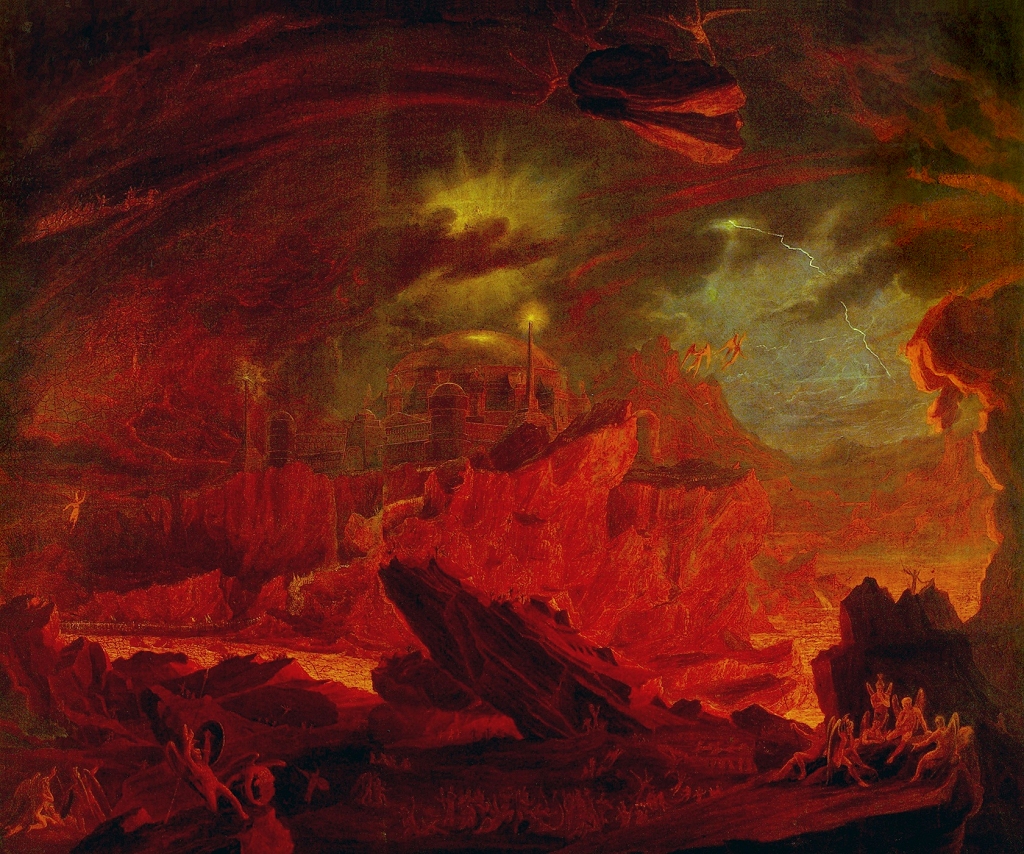
(Illustration is John Martin, The Fallen Angels Entering Pandemonium, 1841.)

Monday, September 20, 2010

Manfred


Click to enlarge

MANFRED

Lord Byron

The scene of the Drama is amongst the Higher Alps — partly in the Castle of Manfred, and partly in the Mountains.

Act I Scene I

Manfred alone. — Scene, a Gothic Gallery. — Time, Midnight.

MANFRED: The lamp must be replenish'd, but even then
It will not burn so long as I must watch.
My slumbers — if I slumber — are not sleep,
But a continuance of enduring thought,
Which then I can resist not: in my heart
There is a vigil, and these eyes but close
To look within; and yet I live, and bear
The aspect and the form of breathing men.
But grief should be the instructor of the wise;
Sorrow is knowledge: they who know the most
Must mourn the deepest o'er the fatal truth,
The Tree of Knowledge is not that of Life.
Philosophy and science, and the springs
Of wonder, and the wisdom of the world,
I have essay'd, and in my mind there is
A power to make these subject to itself—
But they avail not: I have done men good,
And I have met with good even among men—
But this avail'd not: I have had my foes,
And none have baffled, many fallen before me—
But this avail'd not: Good, or evil, life,
Powers, passions, all I see in other beings,
Have been to me as rain unto the sands,
Since that all-nameless hour. I have no dread,
And feel the curse to have no natural fear
Nor fluttering throb, that beats with hopes or wishes
Or lurking love of something on the earth.

1816


Illustration is Carl Gustav Carus, Faust im Studierzimmer (Faust in His Study), c.1851.

Sunday, September 19, 2010

''The Old Woman of Berkeley''


Click to enlarge

THE OLD WOMAN OF BERKELEY

Robert Southey

"This story is also related by Olaus Magnus; and in the Nuremberg Chronicle." [Southey's note]

- - - -

The Raven croak'd as she sate at her meal,
      And the Old Woman knew what he said,
And she grew pale at the Raven's tale,
      And sicken'd and went to her bed.

"Now fetch me my children, and fetch them with speed,"
      The Old Woman of Berkeley said,
"The Monk my son, and my daughter the Nun,
      Bid them hasten or I shall be dead."

The Monk her son, and her daughter the Nun,
      Their way to Berkeley went,
And they have brought with pious thought
      The holy sacrament.

The Old Woman shriek'd as they enter'd her door,
      And she cried with a voice of despair,
"Now take away the sacrament,
      For its presence I cannot bear!"

Her lip it trembled with agony,
      The sweat ran down her brow,
"I have tortures in store for evermore,
      But spare me, my children, now!"

Away they sent the sacrament,
      The fit it left her weak,
She look's at her children with ghastly eyes,
      And faintly struggled to speak.

"All kind of sin have I rioted in,
      And the judgment now must be,
But I secured my children's souls,
      Oh! pray, my children, for me!

"I have 'nointed myself with infant's fat,
      The fiends have been my slaves,
From sleeping babes I have suck'd the breath,
And breaking by charms the sleep of death,
      I have call'd the dead from their graves.

"And the Devil will fetch me now in fire,
      My witchcrafts to atone;
And I who have troubled the dead man's grave
      Shall never have rest in my own.

"Bless, I entreat, my winding sheet,
      My children, I beg of you;
And with holy water sprinkle my shroud,
      And sprinkle my coffin, too.

"And let me be chain'd in my coffin of stone,
      And fasten it strong, I implore,
With iron bars, and with three chains,
      Chain it to the church floor.

"And bless the chains and sprinkle them,
      And let fifty Priests stand round,
Who night and day the mass may say
      Where I lie on the ground.

"And see that fifty Choristers
      Beside the bier attend me,
And day and night by the tapers' light,
      With holy hymns defend me.

"Let the church bells all, both great and small,
      Be toll'd by night and day,
To drive from thence the fiends who come
      To bear my body away.

"And ever have the church door barr'd
      After the even-song;
And I beseech you, children dear,
      Let the bars and bolts be strong.

"And let this be three days and nights
      My wretched corpse to save;
Till the fourth morning keep me safe,
      And then I may rest in my grave."

The Old Woman of Berkeley laid her down,
      And her eyes grew deadly dim,
Short came her breath, and the struggle of death
      Did loosen every limb.

They blest the old woman's winding sheet
      With rites and prayers due,
With holy water they sprinkled her shroud,
      And they sprinkled her coffin too.

And they chain'd her in her coffin of stone,
      And with iron barr'd it down,
And in the church with three strong chains
      The chain'd it to the ground.

And they blest the chains and sprinkled them,
      And fifty Priests stood round,
By night and day the mass to say
      Where she lay on the ground.

And fifty sacred Choristers
      Beside the bier attend her,
Who day and night by the taper's light
      Should with holy hymns defend her.

To see the Priests and Choristers
      It was a goodly sight,
Each holding, as it were a staff,
      A taper burning bright.

And the church bells all, both great and small,
      Did toll so loud and long;
And they have barr'd the church door hard,
      After the even-song.

And the first night the tapers' light
      Burnt steadily and clear,
But they without a hideous rout
      Of angry fiends could hear;

A hideous roar at the church door
      Like a long thunder peal;
And the Priests they pray'd, and the Choristers sung
      Louder in fearful zeal.

Loud toll'd the bell, the Priests pray'd well,
      The tapers they burnt bright,
The Monk her son, and her daughter the Nun,
      They told their beads all night.

The cock he crew, the Fiends they flew
      From the voice of the morning away;
Then undisturb'd the Choristers sing,
      And the fifty Priests they pray;
As they had sung and pray'd all night,
      They pray'd and sung all day.

The second night the tapers' light
      Burnt dismally and blue,
And every one saw his neighbour's face
      Like a dead man's face to view.

And yells and cries without arise
      That the stoutest heart might shock,
And a deafening roar like a cataract pouring
      Over a mountain rock.

The Monk and Nun they told their beads
      As fast as they could tell,
And aye as louder grew the noise
      The faster went the bell.

Louder and louder the Choristers sung
      As they trembled more and more,
And the Priests as they pray'd to heaven for aid,
      They smote their breasts full sore.

The cock he crew, the Fiends they flew
      From the voice of the morning away;
Then undisturb'd the Choristers sing,
      And the fifty Priests they pray;
As they had sung and pray'd all night,
      The pray'd and sung all day.

The third night came, and the tapers' flame
      A frightful stench did make;
And they burnt as though they had been dipt
      In the burning brimstone lake.

And the loud commotion, like the rushing of ocean,
      Grew momently more and more;
And strokes as of a battering ram
      Did shake the strong church door.

The bellmen, they for very fear
      Could toll the bell no longer;
And still as louder grew the strokes
      Their fear it grew the stronger.

The Monk and Nun forgot their beads,
      They fell on the ground in dismay;
There was not a single Saint in heaven
      To whom they did not pray.

And the Choristers' song, which late was so strong,
      Falter'd with consternation,
For the church did rock as an earthquake shock
      Uplifed its foundation.

And a sound was heard like the trumpet's blast,
      That shall one day wake the dead;
The strong church door could bear no more,
      And the bolts and the bars they fled;

And the tapers' light was extinguish'd quite,
      And the Choristers faintly sung,
And the Priests dismay'd, panted and pray'd,
And on all the Saints in heaven for aid
      They call'd with trembling tongue.

And in He came with eyes of flame,
      The Devil to fetch the dead,
And all the church with his presence glow'd
      Like a fiery furnace red.

He laid his hand on the iron chains,
      And like flax they moulder'd asunder,
And the coffin lid, which was barr'd so firm,
      He burst with his voice of thunder.

And he bade the Old Woman of Berkeley rise,
      And come with her Master away;
A cold sweat started on that cold corpse,
      At the voice she was forced to obey.

She rose on her feet in her winding sheet,
      Her dead flesh quiver'd with fear,
And a groan like that which the Old Woman gave
      Never did mortal hear.

She follow'd her Master to the church door,
      There stood a black horse there;
His breath was red like furnace smoke,
      His eyes like a meteor's glare.

The Devil he flung her on the horse,
      And he leapt up before,
And away like the lightning's speed they went,
      And she was seen no more.

They saw her no more, but her cries
      For four miles round they could hear,
And children at rest at their mothers' breast
      Started, and scream'd with fear.

1799


(Illustration is John Henry Fuseli, The Nightmare, 1781.)

Tuesday, September 14, 2010

''The Dream''


Click to enlarge

THE DREAM

[An excerpt]

Lord Byron

VIII

A change came o'er the spirit of my dream.
The Wanderer was alone as heretofore,
The beings which surrounded him were gone,
Or were at war with him; he was a mark
For blight and desolation, compassed round
With Hatred and Contention; Pain was mixed
In all which was served up to him, until,
Like to the Pontic monarch of old days,
He fed on poisons, and they had no power,
But were a kind of nutriment; he lived
Through that which had been death to many men,
And made him friends of mountains; with the stars
And the quick Spirit of the Universe
He held his dialogues: and they did teach
To him the magic of their mysteries;
To him the book of Night was opened wide,
And voices from the deep abyss revealed
A marvel and a secret. — Be it so.

1816


(Illustration is Carl Gustav Carus, Faust's Dream, c.1851.)

The Dream (complete text)

Saturday, September 11, 2010

''The Rime of the Ancient Mariner''


Click to enlarge

THE RIME OF THE ANCIENT MARINER

Samuel Taylor Coleridge

NOTE: This poem exists in two forms. The first, published in 1798, contains a number of horrific elements that the second version, published in 1817 and now considered definitive, omits. This text restores the omitted stanzas from the 1798 version, which are italicized for the purpose of identification.


PART THE FIRST.

It is an ancient Mariner,
And he stoppeth one of three.
"By thy long grey beard and glittering eye,
Now wherefore stopp'st thou me?

"The Bridegroom's doors are opened wide,
And I am next of kin;
The guests are met, the feast is set:
May'st hear the merry din."

He holds him with his skinny hand,
"There was a ship," quoth he.
"Hold off! unhand me, grey-beard loon!"
Eftsoons his hand dropt he.

He holds him with his glittering eye--
The Wedding-Guest stood still,
And listens like a three years child:
The Mariner hath his will.

The Wedding-Guest sat on a stone:
He cannot chuse but hear;
And thus spake on that ancient man,
The bright-eyed Mariner.

The ship was cheered, the harbour cleared,
Merrily did we drop
Below the kirk, below the hill,
Below the light-house top.

The Sun came up upon the left,
Out of the sea came he!
And he shone bright, and on the right
Went down into the sea.

Higher and higher every day,
Till over the mast at noon--
The Wedding-Guest here beat his breast,
For he heard the loud bassoon.

The bride hath paced into the hall,
Red as a rose is she;
Nodding their heads before her goes
The merry minstrelsy.

The Wedding-Guest he beat his breast,
Yet he cannot chuse but hear;
And thus spake on that ancient man,
The bright-eyed Mariner.

And now the STORM-BLAST came, and he
Was tyrannous and strong:
He struck with his o'ertaking wings,
And chased south along.

Click to enlarge

With sloping masts and dipping prow,
As who pursued with yell and blow
Still treads the shadow of his foe
And forward bends his head,
The ship drove fast, loud roared the blast,
And southward aye we fled.

And now there came both mist and snow,
And it grew wondrous cold:
And ice, mast-high, came floating by,
As green as emerald.

And through the drifts the snowy clifts
Did send a dismal sheen:
Nor shapes of men nor beasts we ken--
The ice was all between.

The ice was here, the ice was there,
The ice was all around:
It cracked and growled, and roared and howled,
Like noises in a swound!

At length did cross an Albatross:
Thorough the fog it came;
As if it had been a Christian soul,
We hailed it in God's name.

It ate the food it ne'er had eat,
And round and round it flew.
The ice did split with a thunder-fit;
The helmsman steered us through!

And a good south wind sprung up behind;
The Albatross did follow,
And every day, for food or play,
Came to the mariners' hollo!

In mist or cloud, on mast or shroud,
It perched for vespers nine;
Whiles all the night, through fog-smoke white,
Glimmered the white Moon-shine.

"God save thee, ancient Mariner!
From the fiends, that plague thee thus!--
Why look'st thou so?"--With my cross-bow
I shot the ALBATROSS.


PART THE SECOND.

The Sun now rose upon the right:
Out of the sea came he,
Still hid in mist, and on the left
Went down into the sea.

And the good south wind still blew behind
But no sweet bird did follow,
Nor any day for food or play
Came to the mariners' hollo!

And I had done an hellish thing,
And it would work 'em woe:
For all averred, I had killed the bird
That made the breeze to blow.
Ah wretch! said they, the bird to slay
That made the breeze to blow!

Nor dim nor red, like God's own head,
The glorious Sun uprist:
Then all averred, I had killed the bird
That brought the fog and mist.
'Twas right, said they, such birds to slay,
That bring the fog and mist.

The fair breeze blew, the white foam flew,
The furrow followed free:
We were the first that ever burst
Into that silent sea.

Down dropt the breeze, the sails dropt down,
'Twas sad as sad could be;
And we did speak only to break
The silence of the sea!

All in a hot and copper sky,
The bloody Sun, at noon,
Right up above the mast did stand,
No bigger than the Moon.

Day after day, day after day,
We stuck, nor breath nor motion;
As idle as a painted ship
Upon a painted ocean.

Water, water, every where,
And all the boards did shrink;
Water, water, every where,
Nor any drop to drink.

The very deep did rot: O Christ!
That ever this should be!
Yea, slimy things did crawl with legs
Upon the slimy sea.

About, about, in reel and rout
The death-fires danced at night;
The water, like a witch's oils,
Burnt green, and blue and white.

And some in dreams assured were
Of the spirit that plagued us so:
Nine fathom deep he had followed us
From the land of mist and snow.

And every tongue, through utter drought,
Was withered at the root;
We could not speak, no more than if
We had been choked with soot.

Ah! well a-day! what evil looks
Had I from old and young!
Instead of the cross, the Albatross
About my neck was hung.


PART THE THIRD.

There passed a weary time. Each throat
Was parched, and glazed each eye.
A weary time! a weary time!
How glazed each weary eye,
When looking westward, I beheld
A something in the sky.

At first it seemed a little speck,
And then it seemed a mist:
It moved and moved, and took at last
A certain shape, I wist.

A speck, a mist, a shape, I wist!
And still it neared and neared:
As if it dodged a water-sprite,
It plunged and tacked and veered.

With throats unslaked, with black lips baked,
We could not laugh nor wail;
Through utter drought all dumb we stood!
I bit my arm, I sucked the blood,
And cried, A sail! a sail!

With throats unslaked, with black lips baked,
Agape they heard me call:
Gramercy! they for joy did grin,
And all at once their breath drew in,
As they were drinking all.

See! see! (I cried) she tacks no more!
Hither to work us weal;
Without a breeze, without a tide,
She steadies with upright keel!

The western wave was all a-flame
The day was well nigh done!
Almost upon the western wave
Rested the broad bright Sun;
When that strange shape drove suddenly
Betwixt us and the Sun.

And straight the Sun was flecked with bars,
(Heaven's Mother send us grace!)
As if through a dungeon-grate he peered,
With broad and burning face.

Alas! (thought I, and my heart beat loud)
How fast she nears and nears!
Are those her sails that glance in the Sun,
Like restless gossameres!

Are those her ribs through which the Sun
Did peer, as through a grate?
And is that Woman all her crew?
Is that a DEATH? and are there two?
Is DEATH that woman's mate?

His bones were black with many a crack,
All black and bare, I ween;
Jet-black and bare, save where with rust
Of mouldy damps and charnel crust
They're patch'd with purple and green.


Her lips were red, her looks were free,
Her locks were yellow as gold:
Her skin was as white as leprosy,
The Night-Mare LIFE-IN-DEATH was she,
Who thicks man's blood with cold.

The naked hulk alongside came,
And the twain were casting dice;
"The game is done! I've won! I've won!"
Quoth she, and whistles thrice.

A gust of wind sterte up behind
And whistled thro' his bones;
Thro' the holes of his eyes and the hole of his mouth
Half-whistles and half-groans.


The Sun's rim dips; the stars rush out:
At one stride comes the dark;
With far-heard whisper, o'er the sea.
Off shot the spectre-bark.

We listened and looked sideways up!
Fear at my heart, as at a cup,
My life-blood seemed to sip!

The stars were dim, and thick the night,
The steersman's face by his lamp gleamed white;
From the sails the dew did drip--
Till clombe above the eastern bar
The horned Moon, with one bright star
Within the nether tip.

One after one, by the star-dogged Moon
Too quick for groan or sigh,
Each turned his face with a ghastly pang,
And cursed me with his eye.

Four times fifty living men,
(And I heard nor sigh nor groan)
With heavy thump, a lifeless lump,
They dropped down one by one.

The souls did from their bodies fly,--
They fled to bliss or woe!
And every soul, it passed me by,
Like the whizz of my cross-bow!


PART THE FOURTH.

"I fear thee, ancient Mariner!
I fear thy skinny hand!
And thou art long, and lank, and brown,
As is the ribbed sea-sand.

"I fear thee and thy glittering eye,
And thy skinny hand, so brown."--
Fear not, fear not, thou Wedding-Guest!
This body dropt not down.

Alone, alone, all, all alone,
Alone on a wide wide sea!
And never a saint took pity on
My soul in agony.

The many men, so beautiful!
And they all dead did lie:
And a thousand thousand slimy things
Lived on; and so did I.

I looked upon the rotting sea,
And drew my eyes away;
I looked upon the rotting deck,
And there the dead men lay.

I looked to Heaven, and tried to pray:
But or ever a prayer had gusht,
A wicked whisper came, and made
My heart as dry as dust.

I closed my lids, and kept them close,
And the balls like pulses beat;
For the sky and the sea, and the sea and the sky
Lay like a load on my weary eye,
And the dead were at my feet.

The cold sweat melted from their limbs,
Nor rot nor reek did they:
The look with which they looked on me
Had never passed away.

An orphan's curse would drag to Hell
A spirit from on high;
But oh! more horrible than that
Is a curse in a dead man's eye!
Seven days, seven nights, I saw that curse,
And yet I could not die.

The moving Moon went up the sky,
And no where did abide:
Softly she was going up,
And a star or two beside.

Her beams bemocked the sultry main,
Like April hoar-frost spread;
But where the ship's huge shadow lay,
The charmed water burnt alway
A still and awful red.

Beyond the shadow of the ship,
I watched the water-snakes:
They moved in tracks of shining white,
And when they reared, the elfish light
Fell off in hoary flakes.

Within the shadow of the ship
I watched their rich attire:
Blue, glossy green, and velvet black,
They coiled and swam; and every track
Was a flash of golden fire.

O happy living things! no tongue
Their beauty might declare:
A spring of love gushed from my heart,
And I blessed them unaware:
Sure my kind saint took pity on me,
And I blessed them unaware.

The self same moment I could pray;
And from my neck so free
The Albatross fell off, and sank
Like lead into the sea.


PART THE FIFTH.

Oh sleep! it is a gentle thing,
Beloved from pole to pole!
To Mary Queen the praise be given!
She sent the gentle sleep from Heaven,
That slid into my soul.

The silly buckets on the deck,
That had so long remained,
I dreamt that they were filled with dew;
And when I awoke, it rained.

My lips were wet, my throat was cold,
My garments all were dank;
Sure I had drunken in my dreams,
And still my body drank.

I moved, and could not feel my limbs:
I was so light--almost
I thought that I had died in sleep,
And was a blessed ghost.

And soon I heard a roaring wind:
It did not come anear;
But with its sound it shook the sails,
That were so thin and sere.

The upper air burst into life!
And a hundred fire-flags sheen,
To and fro they were hurried about!
And to and fro, and in and out,
The wan stars danced between.

And the coming wind did roar more loud,
And the sails did sigh like sedge;
And the rain poured down from one black cloud;
The Moon was at its edge.

The thick black cloud was cleft, and still
The Moon was at its side:
Like waters shot from some high crag,
The lightning fell with never a jag,
A river steep and wide.

The strong wind reach'd the ship: it roar'd
And dropp'd down, like a stone!

Beneath the lightning and the Moon
The dead men gave a groan.

They groaned, they stirred, they all uprose,
Nor spake, nor moved their eyes;
It had been strange, even in a dream,
To have seen those dead men rise.


The helmsman steered, the ship moved on;
Yet never a breeze up blew;
The mariners all 'gan work the ropes,
Where they were wont to do:
They raised their limbs like lifeless tools--
We were a ghastly crew.

The body of my brother's son,
Stood by me, knee to knee:
The body and I pulled at one rope,
But he said nought to me.
And I quak'd to think of my own voice
How frightful it would be!


The day-light dawn'd--they dropp'd their arms,
And clustered round the mast;
Sweet sounds rose slowly through their mouths,
And from their bodies passed.

Around, around, flew each sweet sound,
Then darted to the Sun;
Slowly the sounds came back again,
Now mixed, now one by one.

Sometimes a-dropping from the sky
I heard the sky-lark sing;
Sometimes all little birds that are,
How they seemed to fill the sea and air
With their sweet jargoning!

And now 'twas like all instruments,
Now like a lonely flute;
And now it is an angel's song,
That makes the Heavens be mute.

It ceased; yet still the sails made on
A pleasant noise till noon,
A noise like of a hidden brook
In the leafy month of June,
That to the sleeping woods all night
Singeth a quiet tune.

The Marineres all 'gan pull the ropes,
But look at me they n'old:
Thought I, I am as thin as air--
They cannot me behold.


Till noon we quietly sailed on,
Yet never a breeze did breathe:
Slowly and smoothly went the ship,
Moved onward from beneath.

Under the keel nine fathom deep,
From the land of mist and snow,
The spirit slid: and it was he
That made the ship to go.
The sails at noon left off their tune,
And the ship stood still also.

The Sun, right up above the mast,
Had fixed her to the ocean:
But in a minute she 'gan stir,
With a short uneasy motion--
Backwards and forwards half her length
With a short uneasy motion.

Then like a pawing horse let go,
She made a sudden bound:
It flung the blood into my head,
And I fell down in a swound.

How long in that same fit I lay,
I have not to declare;
But ere my living life returned,
I heard and in my soul discerned
Two VOICES in the air.

"Is it he?" quoth one, "Is this the man?
By him who died on cross,
With his cruel bow he laid full low,
The harmless Albatross.

"The spirit who bideth by himself
In the land of mist and snow,
He loved the bird that loved the man
Who shot him with his bow."

The other was a softer voice,
As soft as honey-dew:
Quoth he, "The man hath penance done,
And penance more will do."


PART THE SIXTH.

FIRST VOICE.

But tell me, tell me! speak again,
Thy soft response renewing--
What makes that ship drive on so fast?
What is the OCEAN doing?


SECOND VOICE.

Still as a slave before his lord,
The OCEAN hath no blast;
His great bright eye most silently
Up to the Moon is cast--

If he may know which way to go;
For she guides him smooth or grim
See, brother, see! how graciously
She looketh down on him.


FIRST VOICE.

But why drives on that ship so fast,
Without or wave or wind?


SECOND VOICE.

The air is cut away before,
And closes from behind.

Fly, brother, fly! more high, more high
Or we shall be belated:
For slow and slow that ship will go,
When the Mariner's trance is abated.


I woke, and we were sailing on
As in a gentle weather:
'Twas night, calm night, the Moon was high;
The dead men stood together.

All stood together on the deck,
For a charnel-dungeon fitter:
All fixed on me their stony eyes,
That in the Moon did glitter.

The pang, the curse, with which they died,
Had never passed away:
I could not draw my eyes from theirs,
Nor turn them up to pray.

And now this spell was snapt: once more
I viewed the ocean green.
And looked far forth, yet little saw
Of what had else been seen--

Like one that on a lonesome road
Doth walk in fear and dread,
And having once turned round walks on,
And turns no more his head;
Because he knows, a frightful fiend
Doth close behind him tread.

But soon there breathed a wind on me,
Nor sound nor motion made:
Its path was not upon the sea,
In ripple or in shade.

It raised my hair, it fanned my cheek
Like a meadow-gale of spring--
It mingled strangely with my fears,
Yet it felt like a welcoming.

Swiftly, swiftly flew the ship,
Yet she sailed softly too:
Sweetly, sweetly blew the breeze--
On me alone it blew.

Oh! dream of joy! is this indeed
The light-house top I see?
Is this the hill? is this the kirk?
Is this mine own countree!

We drifted o'er the harbour-bar,
And I with sobs did pray--
O let me be awake, my God!
Or let me sleep alway.

The harbour-bay was clear as glass,
So smoothly it was strewn!
And on the bay the moonlight lay,
And the shadow of the moon.

The moonlight bay was white all o'er,
Till rising from the same,
Full many shapes, that shadows were,
Like as of torches came.

I turn'd my head in fear and dread,
And by the holy rood,
The bodies had advanc'd, and now
Before the mast they stood.

They lifted up their stiff right arms,
They held them strait and tight;
And each right-arm burnt like a torch,
A torch that's borne upright.
Their stony eye-balls glitter'd on
In the red and smoky light.

I pray'd and turn'd my head away
Forth looking as before.
There was no breeze upon the bay,
No wave against the shore.


The rock shone bright, the kirk no less,
That stands above the rock:
The moonlight steeped in silentness
The steady weathercock.

And the bay was white with silent light,
Till rising from the same,
Full many shapes, that shadows were,
In crimson colours came.

A little distance from the prow
Those crimson shadows were:
I turned my eyes upon the deck--
Oh, Christ! what saw I there!

Each corse lay flat, lifeless and flat,
And, by the holy rood!
A man all light, a seraph-man,
On every corse there stood.

This seraph band, each waved his hand:
It was a heavenly sight!
They stood as signals to the land,
Each one a lovely light:

This seraph-band, each waved his hand,
No voice did they impart--
No voice; but oh! the silence sank
Like music on my heart.

But soon I heard the dash of oars;
I heard the Pilot's cheer;
My head was turned perforce away,
And I saw a boat appear.

Then vanish'd all the lovely lights;
The bodies rose anew:
With silent pace, each to his place,
Came back the ghastly crew.
The wind, that shade nor motion made,
On me alone it blew.


The Pilot, and the Pilot's boy,
I heard them coming fast:
Dear Lord in Heaven! it was a joy
The dead men could not blast.

I saw a third--I heard his voice:
It is the Hermit good!
He singeth loud his godly hymns
That he makes in the wood.
He'll shrieve my soul, he'll wash away
The Albatross's blood.


PART THE SEVENTH.

This Hermit good lives in that wood
Which slopes down to the sea.
How loudly his sweet voice he rears!
He loves to talk with marineres
That come from a far countree.

He kneels at morn and noon and eve--
He hath a cushion plump:
It is the moss that wholly hides
The rotted old oak-stump.

The skiff-boat neared: I heard them talk,
"Why this is strange, I trow!
Where are those lights so many and fair,
That signal made but now?"

Click to enlarge

"Strange, by my faith!" the Hermit said--
"And they answered not our cheer!
The planks looked warped! and see those sails,
How thin they are and sere!
I never saw aught like to them,
Unless perchance it were

"Brown skeletons of leaves that lag
My forest-brook along;
When the ivy-tod is heavy with snow,
And the owlet whoops to the wolf below,
That eats the she-wolf's young."

"Dear Lord! it hath a fiendish look--
(The Pilot made reply)
I am a-feared"--"Push on, push on!"
Said the Hermit cheerily.

The boat came closer to the ship,
But I nor spake nor stirred;
The boat came close beneath the ship,
And straight a sound was heard.

Under the water it rumbled on,
Still louder and more dread:
It reached the ship, it split the bay;
The ship went down like lead.

Stunned by that loud and dreadful sound,
Which sky and ocean smote,
Like one that hath been seven days drowned
My body lay afloat;
But swift as dreams, myself I found
Within the Pilot's boat.

Upon the whirl, where sank the ship,
The boat spun round and round;
And all was still, save that the hill
Was telling of the sound.

I moved my lips--the Pilot shrieked
And fell down in a fit;
The holy Hermit raised his eyes,
And prayed where he did sit.

I took the oars: the Pilot's boy,
Who now doth crazy go,
Laughed loud and long, and all the while
His eyes went to and fro.
"Ha! ha!" quoth he, "full plain I see,
The Devil knows how to row."

And now, all in my own countree,
I stood on the firm land!
The Hermit stepped forth from the boat,
And scarcely he could stand.

"O shrieve me, shrieve me, holy man!"
The Hermit crossed his brow.
"Say quick," quoth he, "I bid thee say--
What manner of man art thou?"

Forthwith this frame of mine was wrenched
With a woeful agony,
Which forced me to begin my tale;
And then it left me free.

Since then, at an uncertain hour,
That agony returns;
And till my ghastly tale is told,
This heart within me burns.

I pass, like night, from land to land;
I have strange power of speech;
That moment that his face I see,
I know the man that must hear me:
To him my tale I teach.

What loud uproar bursts from that door!
The wedding-guests are there:
But in the garden-bower the bride
And bride-maids singing are:
And hark the little vesper bell,
Which biddeth me to prayer!

O Wedding-Guest! this soul hath been
Alone on a wide wide sea:
So lonely 'twas, that God himself
Scarce seemed there to be.

O sweeter than the marriage-feast,
'Tis sweeter far to me,
To walk together to the kirk
With a goodly company!--

To walk together to the kirk,
And all together pray,
While each to his great Father bends,
Old men, and babes, and loving friends,
And youths and maidens gay!

Farewell, farewell! but this I tell
To thee, thou Wedding-Guest!
He prayeth well, who loveth well
Both man and bird and beast.

He prayeth best, who loveth best
All things both great and small;
For the dear God who loveth us
He made and loveth all.

The Mariner, whose eye is bright,
Whose beard with age is hoar,
Is gone: and now the Wedding-Guest
Turned from the bridegroom's door.

He went like one that hath been stunned,
And is of sense forlorn:
A sadder and a wiser man,
He rose the morrow morn.

1798/1817


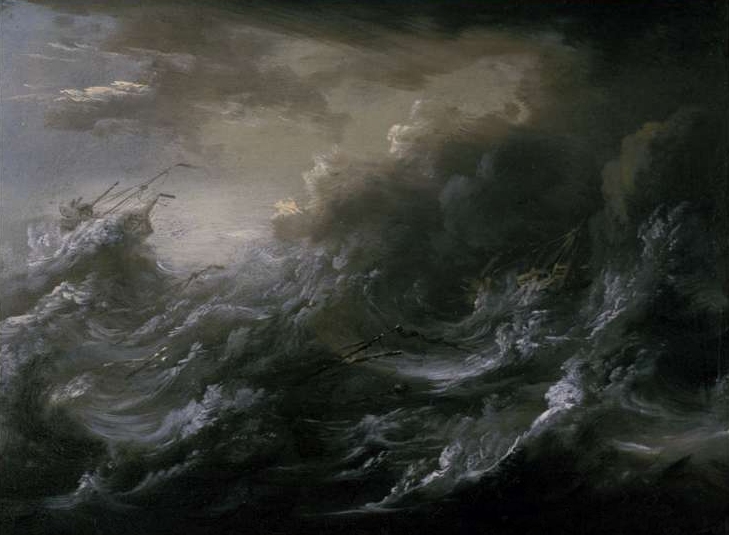
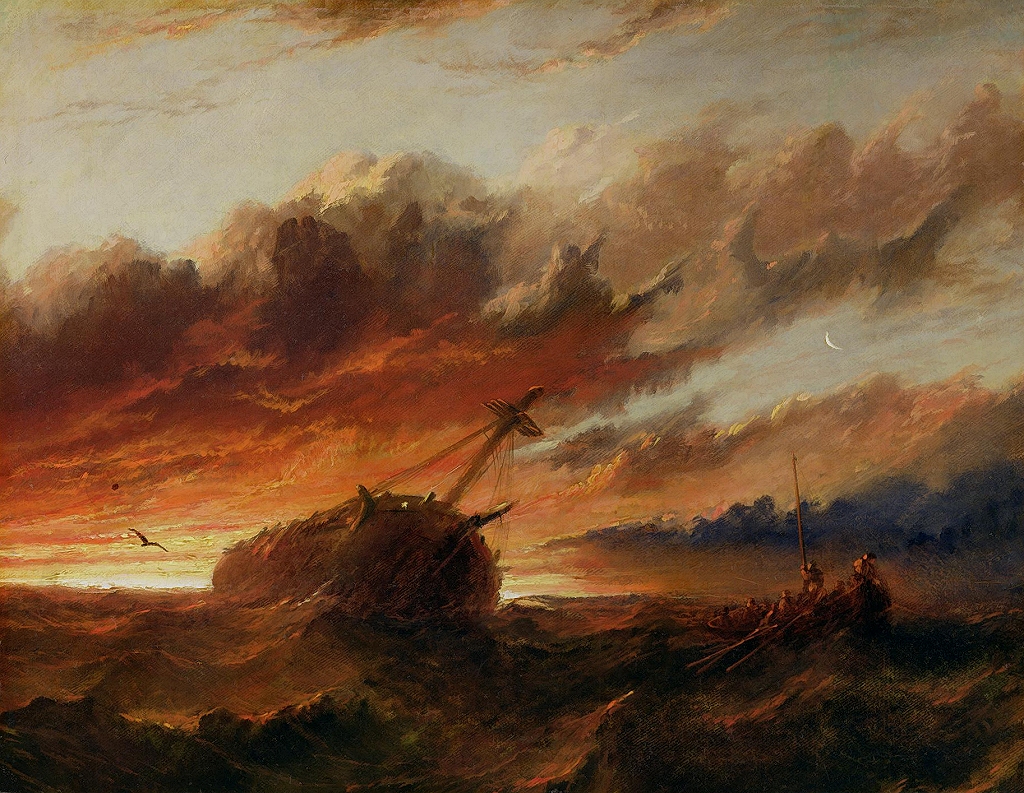
Illustrations are from Gustav Doré, The Rime of the Ancient Mariner, 1870, as well as Christian Wilhelm Ernst Dietrich (1712-74) Sea Storm and Shipwreck, and Francis Danby, Shipwreck, c.1850.

Friday, September 10, 2010

''Proudly eminent''


Click to enlarge

From Milton, Paradise Lost (1674):
                          He, above the rest
In shape and gesture proudly eminent,
Stood like a tower. His form had yet not lost
All her original brightness, nor appeared
Less than Archangel ruined, and th' excess
Of glory obscured: as when the sun new-risen
Looks through the horizontal misty air
Shorn of his beams, or, from behind the moon,
In dim eclipse, disastrous twilight sheds
On half the nations, and with fear of change
Perplexes monarchs. Darkened so, yet shone
Above them all th' Archangel: but his face
Deep scars of thunder had intrenched, and care
Sat on his faded cheek, but under brows
Of dauntless courage, and considerate pride
Waiting revenge. (I.589-604)

(Illustration is John Martin, Satan, Sin, and Death, 1824.)

Thursday, September 9, 2010

Ossian


Click to enlarge

FRAGMENTS OF ANCIENT POETRY

James Macpherson


VIII
By the side of a rock on the hill, beneath the aged trees, old Oscian sat on the moss; the last of the race of Fingal. Sightless are his aged eyes; his beard is waving in the wind. Dull through the leafless trees he heard the voice of the north. Sorrow revived in his soul: he began and lamented the dead.

How hast thou fallen like an oak, with all thy branches round thee! Where is Fingal the King? where is Oscur my son? where are all my race? Alas! in the earth they lie. I feel their tombs with my hands. I hear the river below murmuring hoarsely over the stones. What dost thou, O river, to me? Thou bringest back the memory of the past.

The race of Fingal stood on thy banks, like a wood in a fertile soil. Keen were their spears of steel. Hardy was he who dared to encounter their rage. Fillan the great was there. Thou Oscur wert there, my son! Fingal himself was there, strong in the grey locks of years. Full rose his sinewy limbs; and wide his shoulders spread. The unhappy met with his arm, when the pride of his wrath arose.

The son of Morny came; Gaul, the tallest of men. He stood on the hill like an oak; his voice was like the streams of the hill. Why reigneth alone, he cries, the son of the mighty Corval? Fingal is not strong to save: he is no support for the people. I am strong as a storm in the ocean; as a whirlwind on the hill. Yield, son of Corval; Fingal, yield to me.

Oscur stood forth to meet him; my son would meet the foe. But Fingal came in his strength, and smiled at the vaunter's boast. They threw their arms round each other; they struggled on the plain. The earth is ploughed with their heels. Their bones crack as the boat on the ocean, when it leaps from wave to wave. Long did they toil; with night, they fell on the sounding plain; as two oaks, with their branches mingled, fall crashing from the hill. The tall son of Morny is bound; the aged overcame.

Fair with her locks of gold, her smooth neck, and her breasts of snow; fair, as the spirits of the hill when at silent noon they glide along the heath; fair, as the rainbow of heaven; came Minvane the maid. Fingal! She softly saith, loose me my brother Gaul. Loose me the hope of my race, the terror of all but Fingal. Can I, replies the King, can I deny the lovely daughter of the hill? take thy brother, O Minvane, thou fairer than the snow of the north!

Such, Fingal! were thy words; but thy words I hear no more. Sightless I sit by thy tomb. I hear the wind in the wood; but no more I hear my friends. The cry of the hunter is over. The voice of war is ceased.

1760


"The decay and old age of poetry" is how the Romantic critic William Hazlitt favourably referred to the gloomy yet stirring works that came to be known as the poems of Ossian. As much the creation of their translator, James Macpherson, as of the Welsh bard of the Dark Ages to whom Macpherson attributed authorship, these visionary and atmospheric prose poems exerted a profound influence on the Romantic movement.

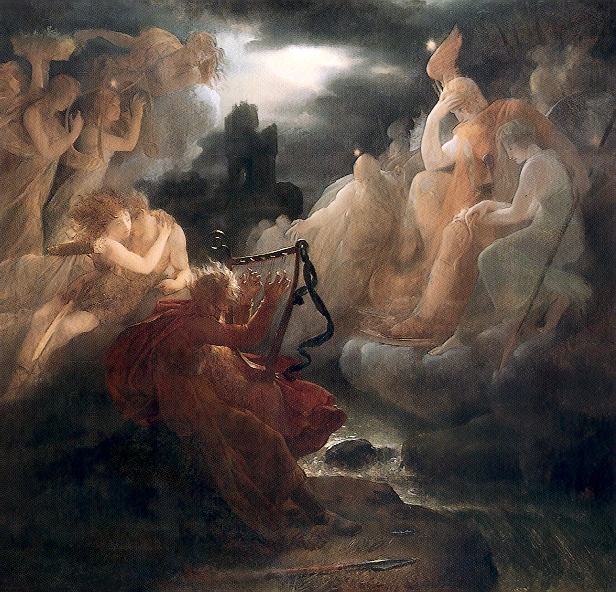
(Illustration is Baron François Gérard, Ossian Awakening the Spirits on the Banks of the Lora with the Sound of his Harp, c.1801.)

The Poems of Ossian

Tuesday, September 7, 2010

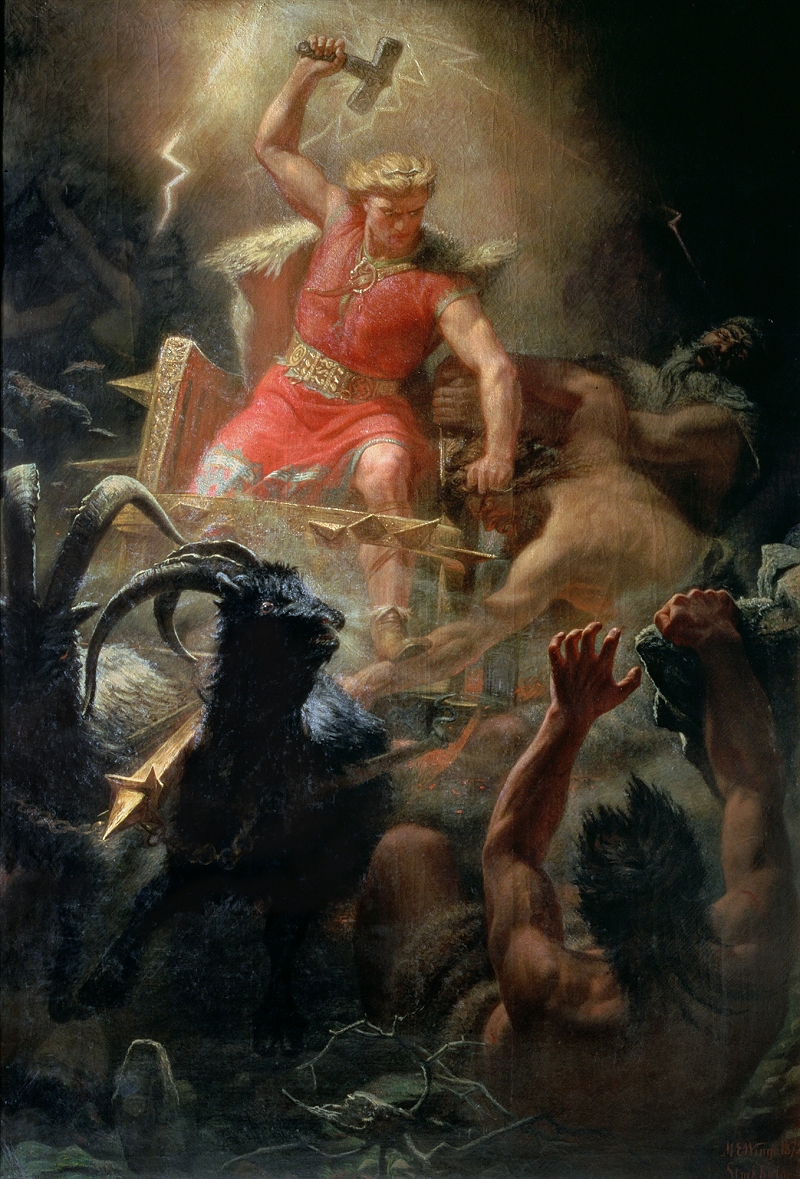
''Dauntless 'midst the wreck of earth''


Click to enlarge

TRANSLATION FROM HORACE

Lord Byron

The man of firm and noble soul
No factious clamours can control;
No threat'ning tyrant's darkling brow
      Can swerve him from his just intent:
Gales the warring waves which plough,
      By Auster on the billows spent,
To curb the Adriatic main,
Would awe his fix'd determined mind in vain.

Aye, and the red right arm of Jove,
Hurtling his lightnings from above,
With all his terrors there unfurl'd,
      He would, unmoved, unawed, behold;
The flames of an expiring world,
      Again in crashing chaos roll'd,
In vast promiscuous ruin hurl'd,
Might light his glorious funeral pile:
Still dauntless 'midst the wreck of earth he'd smile.

1804


(Illustration is Mårten Eskil Winge, Thor's Fight with the Giants, 1872.)

Thursday, September 2, 2010

''The Bard''


Click to enlarge

THE BARD. A PINDARIC ODE

[excerpted]

Thomas Gray

"The following Ode is founded on a Tradition current in Wales, that Edward the First, when he completed the conquest of his country, ordered all the Bards, that fell into his hands, to be put to death." [Gray's note]

- - - -

"Ruin seize thee, ruthless King!
Confusion on thy banners wait,
Tho' fanned by Conquest's crimson wing
They mock the air with idle state.
Helm, nor Hauberk's twisted mail,
Nor even thy virtues, Tyrant, shall avail
To save thy secret soul from nightly fears,
From Cambria's curse, from Cambria's tears!"
Such were the sounds, that o'er the crested pride
Of the first Edward scatter'd wild dismay,
As down the steep of Snowdon's shaggy side
He wound with toilsome march his long array.
Stout Glo'ster stood aghast in speechless trance:
"To arms!" cried Mortimer, and couch'd his quiv'ring lance.

On a rock, whose haughty brow
Frowns o'er old Conway's foaming flood,
Robed in the sable garb of woe,
With haggard eyes the Poet stood;
(Loose his beard, and hoary hair
Stream'd, like a meteor, to the troubled air)
And with a Master's hand, and Prophet's fire,
Struck the deep sorrows of his lyre.
"Hark, how each giant-oak, and desert cave,
Sighs to the torrent's aweful voice beneath!
O'er thee, oh King! their hundred arms they wave,
Revenge on thee in hoarser murmurs breath;
Vocal no more, since Cambria's fatal day,
To high-born Hoel's harp, or soft Llewellyn's lay.

"Cold is Cadwallo's tongue,
That hush'd the stormy main:
Brave Urien sleeps upon his craggy bed:
Mountains, ye mourn in vain
Modred, whose magic song
Made huge Plinlimmon bow his cloud-top'd head.
On dreary Arvon's shore they lie,
Smear'd with gore, and ghastly pale:
Far, far aloof th' affrighted ravens sail;
The famish'd Eagle screams, and passes by.
Dear lost companions of my tuneful art,
Dear, as the light that visits these sad eyes,
Dear, as the ruddy drops that warm my heart,
Ye died amidst your country's cries--
No more I weep. They do not sleep.
On yonder cliffs, a griesly band,
I see them sit, they linger yet,
Avengers of their native land:
With me in dreadful harmony they join,
And weave with bloody hands, the tissue of thy line.

"Fond impious Man, think'st thou, yon sanguine cloud,
Rais'd by thy breath, has quench'd the Orb of day?
To-morrow he repairs the golden flood,
And warms the nations with redoubled ray.
Enough for me: With joy I see
The different doom our Fates assign.
Be thine Despair, and scept'red Care,
To triumph, and to die, are mine."
He spoke, and headlong from the mountain's height
Deep in the roaring tide he plung'd to endless night.

(1755-57)


This text presents the first three stanzas of Thomas Gray's poem "The Bard," as well as the conclusion. In the first two stanzas, the speaker, the last surviving bard of Wales (Cambria), launches his curse against Edward I. In the third stanza, he names the other bards whom the king has killed. The following stanzas (which are omitted here) have the Bard prophesying the misery and ruin that will befall Edward's line. In the final stanza, included in this excerpt, the Bard commits heroic suicide by leaping off of the cliff of Snowdon into the Conway river below.

A complete text of the poem, including Gray's original explanatory notes, appears here.

(Illustration is John Martin, The Bard, c.1817.)

Monday, August 30, 2010

''The Charge of the Light Brigade''


Click to enlarge

THE CHARGE OF THE LIGHT BRIGADE

Alfred, Lord Tennyson

Half a league, half a league,
      Half a league onward,
All in the valley of Death
      Rode the six hundred.
"Forward the Light Brigade!
Charge for the guns!" he said.
Into the valley of Death
      Rode the six hundred.

"Forward, the Light Brigade!"
Was there a man dismay'd?
Not tho' the soldier knew
      Some one had blunder'd.
Theirs not to make reply,
Theirs not to reason why,
Theirs but to do and die.
Into the valley of Death
      Rode the six hundred.

Cannon to right of them,
Cannon to left of them,
Cannon in front of them
      Volley'd and thunder'd;
Storm'd at with shot and shell,
Boldly they rode and well,
Into the jaws of Death,
Into the mouth of hell
      Rode the six hundred.

Flash'd all their sabres bare,
Flash'd as they turn'd in air
Sabring the gunners there,
Charging an army, while
      All the world wonder'd.
Plunged in the battery-smoke
Right thro' the line they broke;
Cossack and Russian
Reel'd from the sabre-stroke
      Shatter'd and sunder'd.
Then they rode back, but not,
      Not the six hundred.

Cannon to right of them,
Cannon to left of them,
Cannon behind them
      Volley'd and thunder'd;
Storm'd at with shot and shell,
While horse and hero fell,
They that had fought so well
Came thro' the jaws of Death,
Back from the mouth of hell,
All that was left of them,
      Left of six hundred.

When can their glory fade?
O the wild charge they made!
      All the world wonder'd.
Honor the charge they made!
Honor the Light Brigade,
      Noble six hundred!

1854


(Illustration is Friedrich Kaiser (1815-90), The Charge of the Light Brigade.)

Thursday, August 26, 2010

''The land of honourable death''


Click to enlarge

ON THIS DAY I COMPLETE MY THIRTY-SIXTH YEAR

Lord Byron

’TIS time this heart should be unmoved,
    Since others it hath ceased to move:
Yet, though I cannot be beloved,
                Still let me love!

My days are in the yellow leaf;
    The flowers and fruits of love are gone;
The worm, the canker, and the grief
                Are mine alone!

The fire that on my bosom preys
    Is lone as some volcanic isle;
No torch is kindled at its blaze—
                A funeral pile.

The hope, the fear, the jealous care,
    The exalted portion of the pain
And power of love, I cannot share,
                But wear the chain.

But ’tis not thus—and ’tis not here—
    Such thoughts should shake my soul, nor now,
Where glory decks the hero’s bier,
                Or binds his brow.

The sword, the banner, and the field,
    Glory and Greece, around me see!
The Spartan, borne upon his shield,
                Was not more free.

Awake! (not Greece—she is awake!)
    Awake, my spirit! Think through whom
Thy life-blood tracks its parent lake,
                And then strike home!

Tread those reviving passions down,
    Unworthy manhood!—unto thee
Indifferent should the smile or frown
                Of beauty be.

If thou regret’st thy youth, why live?
    The land of honourable death
Is here:—up to the field, and give
                Away thy breath!

Seek out—less often sought than found—
    A soldier’s grave, for thee the best;
Then look around, and choose thy ground,
                And take thy rest.

1824


Lord Byron's death was as noble as that of any of his heroes. He fell in the fight for Greek independence, having personally funded the war effort and participated in the actions. Written in the field of combat, this was his last poem.

(Illustration is Caspar David Friedrich, The Temple of Juno in Agrigento, c.1828-30.)

Wednesday, August 25, 2010

''Ode on Melancholy''


Click to enlarge

ODE ON MELANCHOLY

[An excerpt]

John Keats

Though you should build a bark of dead men's bones,
      And rear a phantom gibbet for a mast,
Stitch creeds together for a sail, with groans
      To fill it out, bloodstained and aghast;
Although your rudder be a Dragon's tail,
      Long sever'd, yet still hard with agony,
            Your cordage large uprootings from the skull
Of bald Medusa; certes you would fail
      To find the Melancholy, whether she
            Dreameth in any isle of Lethe dull.

1819


This is the original first stanza, withheld from publication, of Keats's "Ode on Melancholy" — although in fact it is the most interesting section of the poem. The rest of the ode, as published, can be found here. The poet's theme, that the most acute melancholy is experienced not through horror but thwarted happiness, is irrefutable.

(Illustration is John Martin (1789-1854), Cadmus and the Dragon.)