Showing posts with label Martin John. Show all posts

Saturday, October 9, 2010

Manfred and the Witch of the Alps


Click to enlarge

MANFRED

Lord Byron

Act II Scene II

A lower Valley in the Alps.— A Cataract.

MANFRED takes some of the water into the palm of his hand, and flings it in the air, muttering the adjuration. After a pause, the WITCH OF THE ALPS rises beneath the arch of the sunbow of the torrent.

MANFRED: From my youth upwards
My spirit walk'd not with the souls of men,
Nor look'd upon the earth with human eyes;
The thirst of their ambition was not mine;
The aim of their existence was not mine;
My joys, my griefs, my passions, and my powers,
Made me a stranger; though I wore the form,
I had no sympathy with breathing flesh,
Nor midst the creatures of clay that girded me
Was there but one who— but of her anon.
I said with men, and with the thoughts of men,
I held but slight communion; but instead,
My joy was in the Wilderness, to breathe
The difficult air of the iced mountain's top,
Where the birds dare not build, nor insect's wing
Flit o'er the herbless granite; or to plunge
Into the torrent, and to roll along
On the swift whirl of the new breaking wave
Of river-stream, or ocean, in their flow.
In these my early strength exulted; or
To follow through the night the moving moon,
The stars and their development, or catch
The dazzling lightnings till my eyes grew dim;
Or to look, list'ning, on the scatter'd leaves,
While Autumn winds were at their evening song.
These were my pastimes, and to be alone;
For if the beings, of whom I was one,—
Hating to be so,— cross'd me in my path,
I felt myself degraded back to them,
And was all clay again. And then I dived,
In my lone wanderings, to the caves of death,
Searching its cause in its effect, and drew
From wither'd bones, and skulls, and heap'd up dust,
Conclusions most forbidden. Then I pass'd
The nights of years in sciences, untaught
Save in the old-time; and with time and toil,
And terrible ordeal, and such penance
As in itself hath power upon the air
And spirits that do compass air and earth,
Space, and the peopled infinite, I made
Mine eyes familiar with Eternity,

1816


(Illustration is John Martin, Manfred and the Witch of the Alps, 1837.)

Monday, September 27, 2010

Manfred on the Jungfrau


Click to enlarge

MANFRED

Lord Byron

Act I Scene II

The Mountain of the Jungfrau. — Time, Morning.—
MANFRED alone upon the Cliffs.

MANFRED: The spirits I have raised abandon me,
The spells which I have studied baffled me,
The remedy I reck'd of tortured me;
I lean no more on super-human aid,
It hath no power upon the past, and for
The future, till the past be gulf'd in darkness,
It is not of my search. — My mother Earth!
And thou fresh breaking Day, and you, ye Mountains,
Why are ye beautiful? I cannot love ye.
And thou, the bright eye of the universe
That openest over all, and unto all
Art a delight — thou shin'st not on my heart.
And you, ye crags, upon whose extreme edge
I stand, and on the torrent's brink beneath
Behold the tall pines dwindled as to shrubs
In dizziness of distance; when a leap,
A stir, a motion, even a breath, would bring
My breast upon its rocky bosom's bed
To rest forever — wherefore do I pause?
I feel the impulse—yet I do not plunge;
I see the peril — yet do not recede;
And my brain reels — and yet my foot is firm.
There is a power upon me which withholds,
And makes it my fatality to live;
If it be life to wear within myself
This barrenness of spirit, and to be
My own soul's sepulchre, for I have ceased
To justify my deeds unto myself—
The last infirmity of evil.

[An eagle passes.]
                                          Ay,
Thou winged and cloud-cleaving minister,
Whose happy flight is highest into heaven,
Well may'st thou swoop so near me — I should be
Thy prey, and gorge thine eaglets; thou art gone
Where the eye cannot follow thee; but thine
Yet pierces downward, onward, or above,
With a pervading vision. — Beautiful!
How beautiful is all this visible world!
How glorious in its action and itself!
But we, who name ourselves its sovereigns, we,
Half dust, half deity, alike unfit
To sink or soar, with our mix'd essence make
A conflict of its elements, and breathe
The breath of degradation and of pride,
Contending with low wants and lofty will,
Till our mortality predominates,
And men are what they name not to themselves,
And trust not to each other.

1816


(Illustration is John Martin, Manfred on the Jungfrau, 1837.)

Thursday, September 23, 2010

''The Patron Saint of the Romantic School''


Click to enlarge


Suppressed scene from Schiller's Die Räuber (1781):
FRANZ: I do not know, Maurice, if you have read Milton. He who could not endure that another should be above him, and who dared to challenge the Almighty to a duel, was he not an extraordinary genius? He had encountered the Invincible One, and although in defeat he exhausted all his forces, he was not humiliated; eternally, even to the present day, he makes new efforts.

From James Beattie, Dissertations Moral and Critical (1783):
Satan, as Milton has represented him in Paradise Lost, though there are no qualities that can be called good in a moral view…yet there is a grandeur of a ruined archangel; there is force able to contend with the most boisterous elements; and there is boldness which no power but what is Almighty can intimidate. These qualities are astonishing; and…we are often compelled to admire that very greatness by which we are confounded and terrified.

From William Blake, The Marriage of Heaven and Hell (1790):
The reason Milton wrote in fetters when he wrote of Angels and God, and at liberty when of Devils and Hell, is because he was a true Poet and of the Devil's party without knowing it.

From Maximilian Rudwin, The Devil in Legend and Literature (1931):
Satanism is not a part of Romanticism. It is Romanticism. It may well be said without any levity that Satan was the patron saint of the Romantic School.


(Illustration is John Martin, The Fallen Angels Entering Pandemonium, 1841.)

Friday, September 17, 2010

The Destruction


Click to enlarge

From Friedrich von Schiller's Die Räuber (1781):
FRANZ: Suddenly a fearful thunderclap struck my slumbering ear, shuddering I leapt up, and behold, I thought I saw the whole horizon stand ablaze with fiery flames, and mountains and cities and forests melted like wax in a furnace, and a howling whirlwind swept away the sea and the earth and the sky — and a voice rang out as of a brazen trumpet: Earth, give up thy dead, give up thy dead, O sea! and the bare ground was in labour, and began to cast up skulls and ribs and jaws and all manner of bones that joined together and made bodies of men, and they gathered in a great stream, more than the eye could see, a living torrent!

Illustration is John Martin (1789-1854), The Destruction of Herculaneum and Pompeii.

Friday, September 10, 2010

''Proudly eminent''


Click to enlarge

From Milton, Paradise Lost (1674):
                          He, above the rest
In shape and gesture proudly eminent,
Stood like a tower. His form had yet not lost
All her original brightness, nor appeared
Less than Archangel ruined, and th' excess
Of glory obscured: as when the sun new-risen
Looks through the horizontal misty air
Shorn of his beams, or, from behind the moon,
In dim eclipse, disastrous twilight sheds
On half the nations, and with fear of change
Perplexes monarchs. Darkened so, yet shone
Above them all th' Archangel: but his face
Deep scars of thunder had intrenched, and care
Sat on his faded cheek, but under brows
Of dauntless courage, and considerate pride
Waiting revenge. (I.589-604)

(Illustration is John Martin, Satan, Sin, and Death, 1824.)

Thursday, September 2, 2010

''The Bard''


Click to enlarge

THE BARD. A PINDARIC ODE

[excerpted]

Thomas Gray

"The following Ode is founded on a Tradition current in Wales, that Edward the First, when he completed the conquest of his country, ordered all the Bards, that fell into his hands, to be put to death." [Gray's note]

- - - -

"Ruin seize thee, ruthless King!
Confusion on thy banners wait,
Tho' fanned by Conquest's crimson wing
They mock the air with idle state.
Helm, nor Hauberk's twisted mail,
Nor even thy virtues, Tyrant, shall avail
To save thy secret soul from nightly fears,
From Cambria's curse, from Cambria's tears!"
Such were the sounds, that o'er the crested pride
Of the first Edward scatter'd wild dismay,
As down the steep of Snowdon's shaggy side
He wound with toilsome march his long array.
Stout Glo'ster stood aghast in speechless trance:
"To arms!" cried Mortimer, and couch'd his quiv'ring lance.

On a rock, whose haughty brow
Frowns o'er old Conway's foaming flood,
Robed in the sable garb of woe,
With haggard eyes the Poet stood;
(Loose his beard, and hoary hair
Stream'd, like a meteor, to the troubled air)
And with a Master's hand, and Prophet's fire,
Struck the deep sorrows of his lyre.
"Hark, how each giant-oak, and desert cave,
Sighs to the torrent's aweful voice beneath!
O'er thee, oh King! their hundred arms they wave,
Revenge on thee in hoarser murmurs breath;
Vocal no more, since Cambria's fatal day,
To high-born Hoel's harp, or soft Llewellyn's lay.

"Cold is Cadwallo's tongue,
That hush'd the stormy main:
Brave Urien sleeps upon his craggy bed:
Mountains, ye mourn in vain
Modred, whose magic song
Made huge Plinlimmon bow his cloud-top'd head.
On dreary Arvon's shore they lie,
Smear'd with gore, and ghastly pale:
Far, far aloof th' affrighted ravens sail;
The famish'd Eagle screams, and passes by.
Dear lost companions of my tuneful art,
Dear, as the light that visits these sad eyes,
Dear, as the ruddy drops that warm my heart,
Ye died amidst your country's cries--
No more I weep. They do not sleep.
On yonder cliffs, a griesly band,
I see them sit, they linger yet,
Avengers of their native land:
With me in dreadful harmony they join,
And weave with bloody hands, the tissue of thy line.

"Fond impious Man, think'st thou, yon sanguine cloud,
Rais'd by thy breath, has quench'd the Orb of day?
To-morrow he repairs the golden flood,
And warms the nations with redoubled ray.
Enough for me: With joy I see
The different doom our Fates assign.
Be thine Despair, and scept'red Care,
To triumph, and to die, are mine."
He spoke, and headlong from the mountain's height
Deep in the roaring tide he plung'd to endless night.

(1755-57)


This text presents the first three stanzas of Thomas Gray's poem "The Bard," as well as the conclusion. In the first two stanzas, the speaker, the last surviving bard of Wales (Cambria), launches his curse against Edward I. In the third stanza, he names the other bards whom the king has killed. The following stanzas (which are omitted here) have the Bard prophesying the misery and ruin that will befall Edward's line. In the final stanza, included in this excerpt, the Bard commits heroic suicide by leaping off of the cliff of Snowdon into the Conway river below.

A complete text of the poem, including Gray's original explanatory notes, appears here.

(Illustration is John Martin, The Bard, c.1817.)

Wednesday, August 25, 2010

''Ode on Melancholy''


Click to enlarge

ODE ON MELANCHOLY

[An excerpt]

John Keats

Though you should build a bark of dead men's bones,
      And rear a phantom gibbet for a mast,
Stitch creeds together for a sail, with groans
      To fill it out, bloodstained and aghast;
Although your rudder be a Dragon's tail,
      Long sever'd, yet still hard with agony,
            Your cordage large uprootings from the skull
Of bald Medusa; certes you would fail
      To find the Melancholy, whether she
            Dreameth in any isle of Lethe dull.

1819


This is the original first stanza, withheld from publication, of Keats's "Ode on Melancholy" — although in fact it is the most interesting section of the poem. The rest of the ode, as published, can be found here. The poet's theme, that the most acute melancholy is experienced not through horror but thwarted happiness, is irrefutable.

(Illustration is John Martin (1789-1854), Cadmus and the Dragon.)

Monday, August 16, 2010

''The most heroic subject ever chosen''


Click to enlarge

From William Hazlitt, "On Shakespeare and Milton," from Lectures on the English Poets (1818):

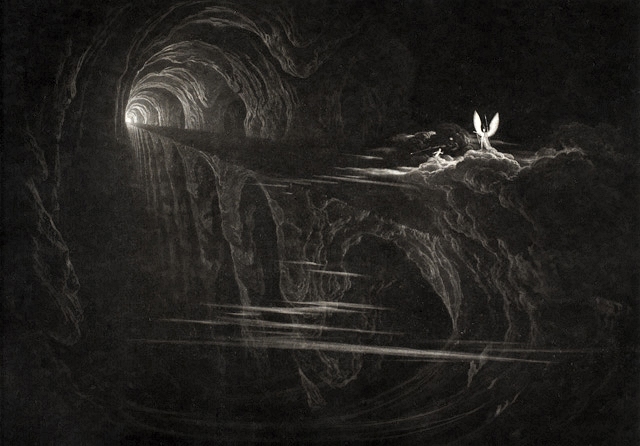
Satan is the most heroic subject that ever was chosen for a poem; and the execution is as perfect as the design is lofty.

He was the first of created beings, who, for endeavouring to be equal with the highest, and to divide the empire of heaven with the Almighty, was hurled down to hell. His aim was no less than the throne of the universe; his means, myriads of angelic armies bright, the third part of the heavens, whom he lured after him with his countenance, and who durst defy the Omnipotent in arms. His ambition was the greatest, and his punishment was the greatest; but not so his despair, for his fortitude was as great as his sufferings. His strength of mind was matchless as his strength of body; the vastness of his designs did not surpass the firm, inflexible determination with which he submitted to his irreversible doom, and final loss of all good. His power of action and of suffering was equal.

He was the greatest power that was ever overthrown, with the strongest will left to resist or to endure. He was baffled, not confounded. He stood like a tower; or
“As when Heaven's fire
Hath scathed the forest oaks or mountain pines!”
He is still surrounded with hosts of rebel angels, armed warriors, who own him as their sovereign leader, and with whose fate he sympathises as he views them round, far as the eye can reach; though he keeps aloof from them in his own mind, and holds supreme counsel only with his own breast.

An outcast from Heaven, Hell trembles beneath his feet, Sin and Death are at his heels, and mankind are his easy prey.
“All is not lost; th' unconquerable will,
And study of revenge, immortal hate,
And courage never to submit or yield,
And what else is not to be overcome,”
are still his. The sense of his punishment seems lost in the magnitude of it; the fierceness of tormenting flames, is qualified and made innoxious by the greater fierceness of his pride; the loss of infinite happiness to himself is compensated in thought, by the power of inflicting infinite misery on others.

Yet Satan is not the principle of malignity, or of the abstract love of evil — but of the abstract love of power, of pride, of self-will personified, to which last principle all other good and evil, and even his own, are subordinate. From this principle he never once flinches. His love of power and contempt for suffering are never once relaxed from the highest pitch of intensity. His thoughts burn like a hell within him; but the power of thought holds dominion in his mind over every other consideration. The consciousness of a determined purpose, of “that intellectual being, those thoughts that wander through eternity,” though accompanied with endless pain, he prefers to nonentity, to “being swallowed up and lost in the wide womb of uncreated night.” He expresses the sum and substance of all ambition in one line: “Fallen cherub, to be weak is miserable, doing or suffering!”

After such a conflict as his, and such a defeat, to retreat in order, to rally, to make terms, to exist at all, is something; but he does more than this — he founds a new empire in hell, and from it conquers this new world, whither he bends his undaunted flight, forcing his way through nether and surrounding fires.

The poet has not in all this given us a mere shadowy outline; the strength is equal to the magnitude of the conception. The Achilles of Homer is not more distinct; the Titans were not more vast; Prometheus chained to his rock was not a more terrific example of suffering and of crime.

Wherever the figure of Satan is introduced, whether he walks or flies, “rising aloft incumbent on the dusky air,” it is illustrated with the most striking and appropriate images: so that we see it always before us, gigantic, irregular, portentous, uneasy, and disturbed — but dazzling in its faded splendour, the clouded ruins of a god. The deformity of Satan is only in the depravity of his will; he has no bodily deformity to excite our loathing or disgust. The horns and tail are not there, poor emblems of the unbending, unconquered spirit, of the writhing agonies within. Milton was too magnanimous and open an antagonist to support his argument by the bye-tricks of a hump and cloven foot; to bring into the fair field of controversy the good old catholic prejudices of which Tasso and Dante have availed themselves, and which the mystic German critics would restore. He relied on the justice of his cause, and did not scruple to give the devil his due.

(Illustration is John Martin, The Bridge over Chaos, 1827.)

Sunday, August 8, 2010

''Successful beyond hope''


Click to enlarge

From Milton, Paradise Lost (1674):
Thrones, Dominations, Princedoms, Virtues, Powers;
For in possession such, not only of right,
I call ye, and declare ye now; return'd
Successful beyond hope, to lead ye forth
Triumphant out of this infernal Pit
Abominable, accurst, the house of woe,
And Dungeon of our Tyrant: Now possess,
As Lords, a spacious World, to our native Heaven
Little inferior, by my adventure hard
With peril great achiev'd. (X.460-69)

(Illustration is John Martin, Satan on His Throne, 1824.)

Saturday, August 7, 2010

''The Destruction of Sennacherib''


Click to enlarge

THE DESTRUCTION OF SENNACHERIB

Lord Byron

The Assyrian came down like the wolf on the fold,
And his cohorts were gleaming in purple and gold;
And the sheen of their spears was like stars on the sea,
When the blue wave rolls nightly on deep Galilee.

Like the leaves of the forest when Summer is green,
That host with their banners at sunset were seen:
Like the leaves of the forest when Autumn hath blown,
That host on the morrow lay withered and strown.

For the Angel of Death spread his wings on the blast,
And breathed in the face of the foe as he passed;
And the eyes of the sleepers waxed deadly and chill,
And their hearts but once heaved, and for ever grew still!

And there lay the steed with his nostril all wide,
But through it there rolled not the breath of his pride;
And the foam of his gasping lay white on the turf,
And cold as the spray of the rock-beating surf.

And there lay the rider distorted and pale,
With the dew on his brow, and the rust on his mail:
And the tents were all silent, the banners alone,
The lances unlifted, the trumpet unblown.

And the widows of Ashur are loud in their wail,
And the idols are broke in the temple of Baal;
And the might of the Gentile, unsmote by the sword,
Hath melted like snow in the glance of the Lord!

1815


(Illustration is John Martin, The Destruction of Sodom and Gomorrah, 1852.)

Tuesday, August 3, 2010

The Sublime and the Beautiful


THE SUBLIME
Click to enlarge

THE BEAUTIFUL
Click to enlarge

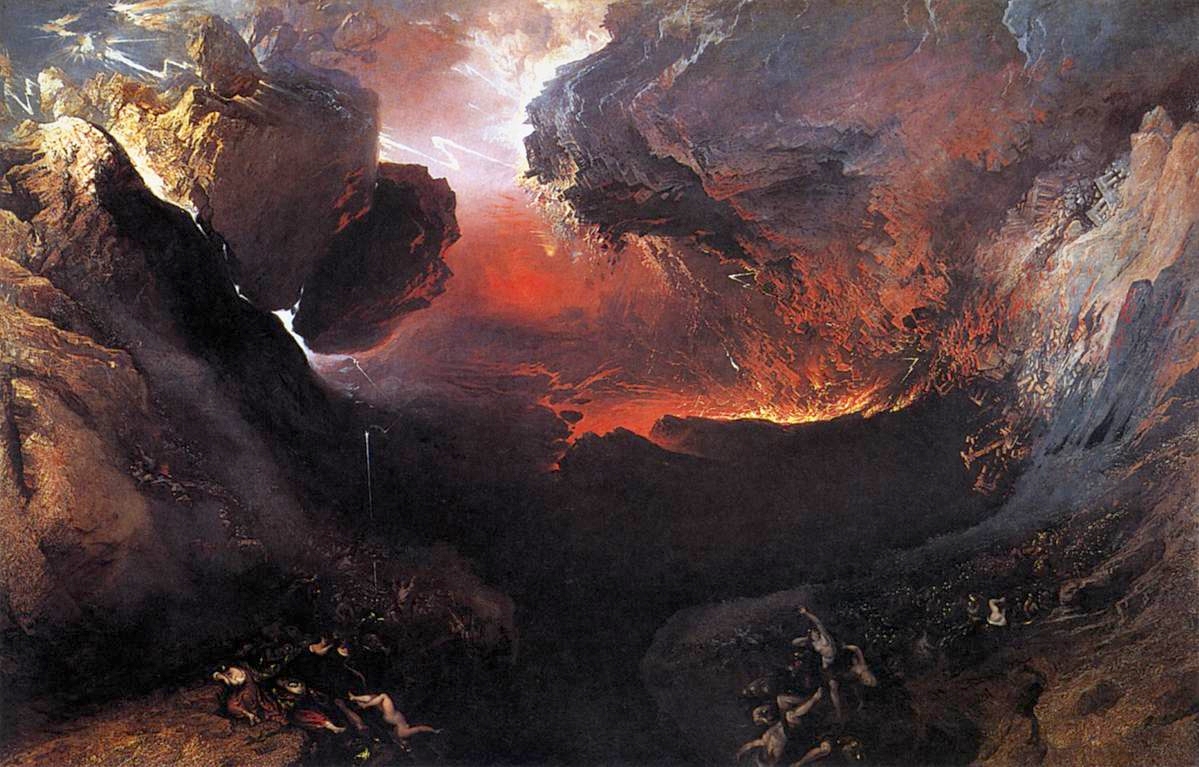
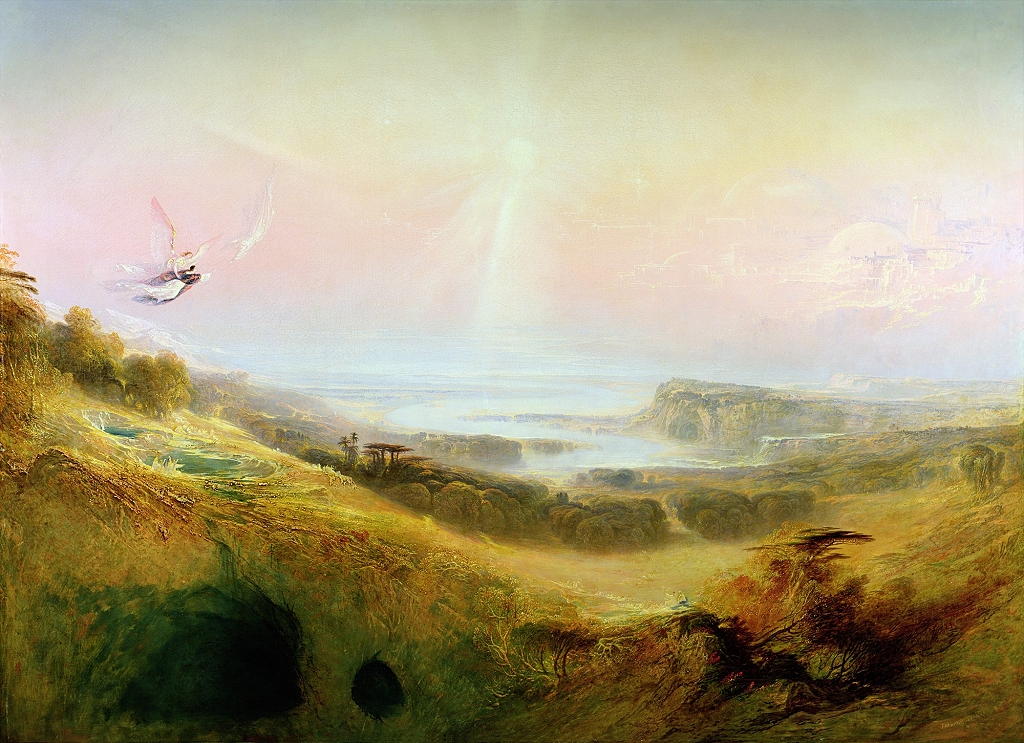
From Kant, Observations on the Feeling of the Beautiful and Sublime (1764):
Finer feeling, which we now wish to consider, is chiefly of two kinds: the feeling of the sublime and that of the beautiful. The stirring of each is pleasant, but in different ways.

The sight of a mountain whose snow-covered peak rises above the clouds, the description of a raging storm, or Milton's portrayal of the infernal kingdom, arouse enjoyment but with horror; on the other hand, the sight of flower-strewn meadows, valleys with winding brooks and covered with grazing flocks, the description of Elysium, or Homer’s portrayal of the girdle of Venus, also occasion a pleasant sensation but one that is joyous and smiling. In order that the former impression could occur to us in due strength, we must have a feeling of the sublime, and, in order to enjoy the latter well, a feeling of the beautiful.

Tall oaks and lonely shadows in a sacred grove are sublime; flower beds, low hedges and trees trimmed in hedges are beautiful. Night is sublime, day is beautiful.

The sublime moves, the beautiful charms.

The mien of a man who is undergoing the full feeling of the sublime is earnest, sometimes rigid and astonished. On the other hand the lively sensation of the beautiful proclaims itself through shining cheerfulness in the eyes, through smiling features, and often through audible mirth.

Deep loneliness is sublime, but in a way that stirs terror. Hence great far-reaching solitudes, like the colossal Komul Desert in Tartary, have always given us occasion for peopling them with fearsome spirits, goblins, and ghouls.

The sublime must always be great; the beautiful can also be small.

Open bold revenge, following a great offense, bears something of the great about it; and as unlawful as it may be, nevertheless its telling moves one with both horror and gratification....

Resolute audacity in a rogue is of the greatest danger, but it moves in the telling, and even if he is dragged to a disgraceful death he nevertheless ennobles it to some extent by going to it defiantly and with disdain.

-German title: Beobachtungen über das Gefühl des Schönen und Erhabenen.

(Illustrations are John Martin, The Great Day of His Wrath, 1851-53; and The Celestial City and the River of Bliss, 1841.)

Saturday, July 31, 2010

''Myself am Hell''


Click to enlarge

From Milton, Paradise Lost (1674):
Me miserable! which way shall I fly
Infinite wrath, and infinite despair?
Which way I fly is Hell; myself am Hell;
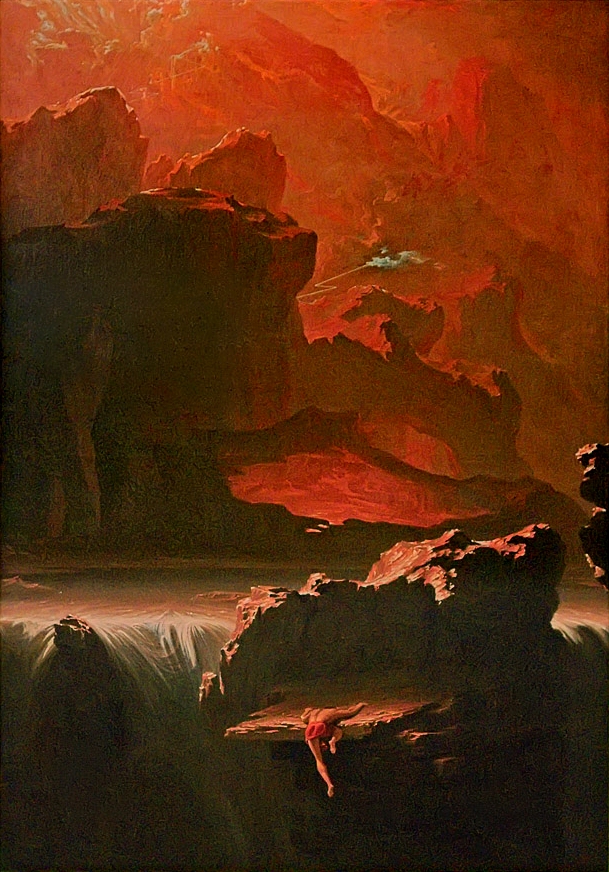
And in the lowest deep a lower deep
Still threatening to devour me opens wide,
To which the Hell I suffer seems a Heav'n. (IV.73-78)

(Illustration is John Martin, Sadak in Search of the Waters of Oblivion, 1812.)

Thursday, July 29, 2010

''Awake, arise, or be forever fall'n"


From Milton, Paradise Lost (1674):
                                  Princes, Potentates,
Warriors, the Flowr of Heav'n, once yours, now lost,
If such astonishment as this can sieze
Eternal spirits; or have ye chos'n this place
After the toil of battle to repose
Your wearied vertue, for the ease you find
To slumber here, as in the Vales of Heav'n?
Or in this abject posture have ye sworn
To adore the Conquerour? who now beholds
Cherub and Seraph rowling in the flood
With scatter'd arms and ensigns, till anon
His swift pursuers from Heav'n Gates discern
Th' advantage, and descending tread us down
Thus drooping, or with linked thunderbolts
Transfix us to the bottom of this gulf.
Awake, arise, or be for ever fall'n. (I.315-330)

(Illustration is John Martin, Satan Arousing the Fallen Angels, 1824.)

Wednesday, July 28, 2010

"Better to reign in Hell, than serve in Heav'n"


Click to enlarge

From Milton, Paradise Lost (1674):
                                          Here at least
We shall be free; th' Almighty hath not built
Here for his envy, will not drive us hence:
Here we may reign secure, and in my choice
To reign is worth ambition though in Hell:
Better to reign in Hell, then serve in Heav'n. (I.258-263)

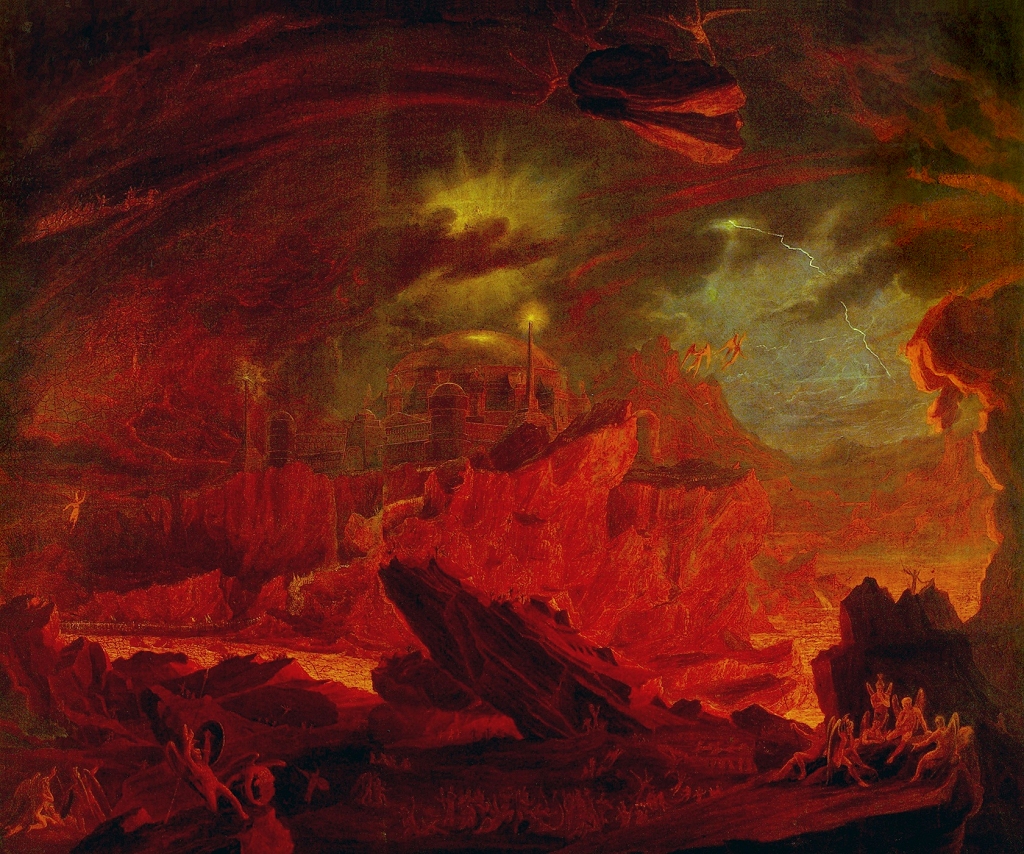
(Illustration is John Martin, Pandemonium, 1824-27.)

''The mind is its own place''


Click to enlarge

From Milton, Paradise Lost (1674):
                                Farewell happy fields
Where joy forever dwells: Hail horrors, hail
Infernal world, and thou profoundest Hell
Receive thy new possessor: one who brings
A mind not to be chang'd by place or time.
The mind is its own place, and in itself
Can make a Heav'n of Hell, a Hell of Heav'n.
What matter where, if I be still the same...? (I.249-256)

(Illustration is John Martin, Pandemonium, 1841.)